



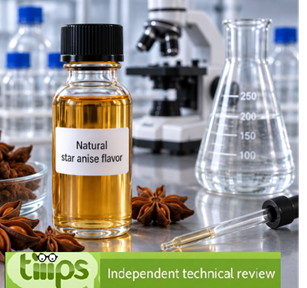
Natural star anise flavor
Natural star anise flavor is a flavoring ingredient obtained from natural components of star anise (Illicium verum, family Schisandraceae), an aromatic plant native to East Asia.
The fruit, with its characteristic star-shaped appearance, has a sweet, warm, spicy and licorice-like aromatic profile.
The main compound responsible for its characteristic aroma is trans-anethole, which is also present in common anise and fennel, together with numerous other volatile substances that contribute to its aromatic complexity.
Depending on the preparation, it may also contain varying amounts of limonene, linalool, estragole and other terpenes and aromatic compounds.
The natural flavor may be obtained through extraction, distillation or other processes applied to the plant material, followed where necessary by concentration and formulation.
It may be supplied in liquid or powdered form, with carriers such as water, alcohol, maltodextrin or other technological ingredients.
It is important that food-grade raw material comes from Illicium verum and is not confused with other Illicium species, particularly Japanese star anise (Illicium anisatum), which contains toxic compounds and is not suitable for food use.
From a nutritional point of view, the flavor is used in very small amounts and serves essentially a flavoring function.
Calories
There is no single standard caloric value for natural star anise flavor because it depends on concentration and any carriers present.
At normal use levels, its caloric contribution to the finished product is generally negligible.
Powdered preparations containing maltodextrin or other carbohydrates may have a significant energy value per 100 g, although they are normally used in very small quantities.
Uses in Food
It is used in biscuits, baked goods, confectionery, candies, chocolate, creams and desserts.
It may also flavor tea, herbal infusions, beverages, syrups and non-alcoholic preparations.
It is used in some sauces, marinades and spiced dishes, particularly in Asian cuisines.
Its aromatic profile combines well with cinnamon, cloves, ginger, citrus fruits, vanilla and cocoa.
Because the flavor is very intense, very small amounts are generally sufficient to characterize the finished product.
Uses in Cosmetics
Star anise extracts and aromatic components may be used in cosmetics mainly for their fragrancing properties.
They may occur in soaps, bath products, creams, balms, shampoos and perfumes.
Star anise essential oil and its aromatic constituents may also be used in fragranced formulations at controlled concentrations.
Concentrated aromatic substances may cause skin irritation or sensitization in susceptible individuals.
Food-grade natural star anise flavor should not automatically be considered equivalent to a standardized cosmetic ingredient.
Allergens
Star anise is not among the major food allergens requiring mandatory declaration in the European Union.
Rare individual reactions may nevertheless occur. Any allergens introduced through carriers or other formulation ingredients should be assessed for the specific product.
Assessment
A highly effective natural flavoring ingredient with a characteristic sweet, spicy and intense aromatic profile, normally used in very small quantities.
Ingredient verdict: a useful natural flavor for providing the distinctive note of star anise, with generally negligible nutritional and caloric impact.
Cons: possible rare sensitivities; composition may vary depending on the formulation

