Concentrated butter
Concentrated butter is a dairy product obtained from butter or other milk products by removing almost all water and non-fat components, producing an ingredient composed predominantly of milk fat.
Depending on the specific commercial type, the fat content may be at least 96% and, in highly concentrated products or anhydrous milk fat, may reach approximately 99.8%.
Compared with conventional butter, which contains a significant proportion of water, concentrated butter therefore has a higher fat and energy concentration.
It consists mainly of milk triglycerides and contains both saturated fatty acids and monounsaturated fatty acids, with smaller amounts of polyunsaturated fats.
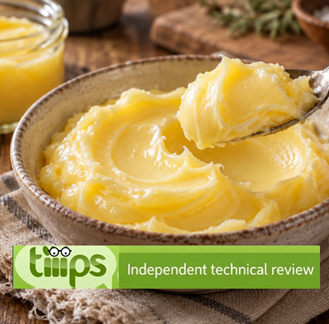
It also naturally contains fat-soluble milk components, including vitamin A and small amounts of other fat-soluble vitamins, depending on the raw material and processing method.
Protein, lactose and minerals are present only in very small amounts in highly concentrated products because most non-fat milk solids are removed during production.
It should not automatically be confused with ghee: both are rich in milk fat, but ghee has specific production and sensory characteristics. Ghee, butter oil and anhydrous milk fat are treated as distinct milk-fat products.
Calories
Concentrated butter provides approximately 865–900 kcal per 100 g, depending on its actual fat percentage.
Products containing close to 99.8% milk fat may provide nearly 900 kcal per 100 g.
It is therefore an ingredient with a very high energy density.
Uses in Food
It is used in baked goods, biscuits, confectionery, chocolate, creams, fillings and dairy preparations.
It can provide buttery flavour, creaminess and structure without introducing the amount of water present in conventional butter.
It is particularly useful in formulations where precise control of moisture content is important, such as anhydrous creams, fat-based fillings and confectionery products.
It may also be used in cooking and other food preparations because of its low water and non-fat solids content.
Because of its high lipid concentration, it should primarily be considered a source of fat and calories.
Uses in Cosmetics
Milk-derived lipids may be used in some cosmetic formulations for their emollient and conditioning properties.
They may contribute softness to creams, balms and skincare products by forming part of the lipid phase and helping reduce water loss from the skin surface.
Food-grade concentrated butter is not, however, a particularly common cosmetic ingredient and should not be considered equivalent to purified and standardized milk lipids intended for cosmetic use.
Allergens
Concentrated butter is derived from milk, which is one of the major food allergens requiring mandatory declaration in the European Union.
In highly concentrated products, milk proteins may be present only in residual amounts, but the dairy origin remains relevant for milk allergen declaration.
Assessment
A highly concentrated ingredient that is technologically useful and provides flavour, structure and milk fat, but is also extremely high in fat and calories.
Ingredient verdict: a concentrated source of milk fat, particularly useful when buttery characteristics are required with very little water; best consumed in moderation because of its high energy density and saturated fat content.
Cons: Allergen; high saturated fat and calorie content
Studies
In the scientific field it is now established that the consumption of butter can bring serious risks in the cardiovascular system. This study summarizing the general lines was carried out on 23,000 subjects for 8 years (1) and another in-depth study of 33,000 subjects found a positive association between butter and the risk of myocardial infarction (2) and obesity.
Butter is also a potential factor of arterial stiffness that preludes to cardiovascular diseases while the consumption of dairy products has not been harmful for arterial stiffness (3).
These data also apply to salted butter on which the content of sodium chloride weighs, which already creates cardiovascular problems alone.
Basically, therefore, with butter we have to be careful and, if we really like it, taste it from time to time, but don't make it a constant and regular consumption. Of course this rule applies to all foods at risk.
It is also considered a risk element related to prostate cancer (4).
A correlation between butter consumption and Alzheimer's disease has also been established (5).
Butter studies
References_________________________________________________________
(1) von Ruesten A, Feller S, Bergmann MM, Boeing H. Diet and risk of chronic diseases: results from the first 8 years of follow-up in the EPIC-Potsdam study. Eur J Clin Nutr. 2013 Apr;67(4):412-9. doi: 10.1038/ejcn.2013.7.
Abstract. Background/objectives: There is still a need for scientific evidence about which foods characterize a healthy diet in terms of primary prevention of major chronic diseases. Therefore, we aimed to give a comprehensive overview on health-related foods, based on 8 years of follow-up of the European Prospective Investigation into Cancer and Nutrition (EPIC)-Potsdam study. Subjects/methods: We used data from 23,531 participants of the EPIC-Potsdam study to analyse the associations between 45 single food groups and risk of major chronic diseases, namely, cardiovascular diseases (CVD), type 2 diabetes and cancer using multivariable-adjusted Cox regression. Habitual dietary intake was assessed at baseline using food-frequency questionnaires. Incident chronic diseases were determined by self-administered follow-up questionnaires and medically verified, based on inquiry to treating physicians, cancer registries or through death certificates. Results: During follow-up, 363 incident CVD, 837 type 2 diabetes and 844 cancer cases were identified. Higher intakes of whole-grain bread, raw vegetables, coffee and cakes and cookies were found to be significantly associated with a lower risk of chronic diseases. Conversely, higher intakes of low-fat dairy, butter, red meat and sauce were associated with higher risks of chronic diseases. Conclusion: Overall, a healthy diet was characterized by a high consumption of whole-grain bread, raw vegetables and a low consumption of red meat and possibly butter, which is generally in line with previous findings. The paradoxical findings concerning the potential health benefit of coffee as well as cakes and cookies are interesting and should be investigated further.
(2) Patterson E, Larsson SC, Wolk A, Åkesson A. Association between dairy food consumption and risk of myocardial infarction in women differs by type of dairy food. J Nutr. 2013 Jan;143(1):74-9. doi: 10.3945/jn.112.166330. Epub 2012 Nov 21.
Abstract. The relation between dairy foods, particularly specific foods, and risk of cardiovascular disease (CVD) remains unclear. We examined the association between total, as well as specific, dairy food intakes and incidence of myocardial infarction (MI) in a prospective population-based cohort. We followed 33,636 women (aged 48-83 y), free from CVD, cancer, and diabetes at baseline (1997), in the Swedish Mammography Cohort. Consumption of milk, cultured milk/yogurt, cheese, cream, crème fraiche, and butter was obtained from a validated self-administered FFQ at baseline. We used Cox proportional hazards regression models to estimate HRs and 95% CIs, adjusted for relevant CVD risk factors. MI incidence was ascertained from national registries. Over 11.6 y of follow-up, we ascertained 1392 cases of MI. When the highest quintile was compared with the lowest quintile, total dairy food intake was inversely associated with MI risk [multivariable adjusted HR: 0.77 (95% CI: 0.63, 0.95)]. Among specific dairy food products, total cheese was inversely associated [HR: 0.74 (95% CI: 0.60, 0.91)] and butter used on bread but not on cooking was positively associated [HR: 1.34 (95% CI: 1.02, 1.75)] with MI risk. Other specific dairy food products were not significantly associated with MI risk. No differences were observed between consumption of specific low-fat and high-fat dairy foods, expressed as either absolute intakes or intakes relative to the total, and MI risk. Failure to consider dairy foods as a heterogeneous group in future studies could hamper important insights of relevance for the development of dietary guidelines.
(3) Livingstone KM, Lovegrove JA, Cockcroft JR, Elwood PC, Pickering JE, Givens DI. Does dairy food intake predict arterial stiffness and blood pressure in men?: Evidence from the Caerphilly Prospective Study. Hypertension. 2013 Jan;61(1):42-7. doi:10.1161/HYPERTENSIONAHA.111.00026. Epub 2012 Nov 12.
Abstract. Arterial stiffness is an independent predictor of cardiovascular disease events and mortality, and like blood pressure, may be influenced by dairy food intake. Few studies have investigated the effects of consumption of these foods on prospective measures of arterial stiffness. The present analysis aimed to investigate the prospective relationship between milk, cheese, cream, and butter consumption and aortic pulse wave velocity, augmentation index, systolic and diastolic blood pressure, as well as cross-sectional relationships between these foods and systolic and diastolic blood pressure and metabolic markers using data from the Caerphilly Prospective Study. Included in this cohort were 2512 men, aged 45 to 59 years, who were followed up at 5-year intervals for a mean of 22.8 years (number follow-up 787). Augmentation index was 1.8% lower in subjects in the highest quartiles of dairy product intake compared with the lowest (P trend=0.021), whereas in the highest group of milk consumption systolic blood pressure was 10.4 mm Hg lower (P trend=0.033) than in nonmilk consumers after a 22.8-year follow-up. Cross-sectional analyses indicated that across increasing quartiles of butter intake, insulin (P trend=0.011), triacylglycerol (P trend=0.023), total cholesterol (P trend=0.002), and diastolic blood pressure (P trend=0.027) were higher. Across increasing groups of milk intake and quartiles of dairy product intake, glucose (P trend=0.032) and triglyceride concentrations (P trend=0.031) were lower, respectively. The present results confirm that consumption of milk predicts prospective blood pressure, whereas dairy product consumption, excluding butter, is not detrimental to arterial stiffness and metabolic markers. Further research is needed to better understand the mechanisms that underpin these relationships.
(4) Vlajinac H, Ilic M, Marinkovic J, Sipetic S. Nutrition and prostate cancer. J BUON. 2010 Oct-Dec;15(4):698-703.
(5) Janssen, C. I., Jansen, D., Mutsaers, M. P., Dederen, P. J., Geenen, B., Mulder, M. T., & Kiliaan, A. J. (2016). The Effect of a High-Fat Diet on Brain Plasticity, Inflammation and Cognition in Female ApoE4-Knockin and ApoE-Knockout Mice. PloS one, 11(5), e0155307.
Abstract. Apolipoprotein E4 (ApoE4), one of three common isoforms of ApoE, is a major risk factor for late-onset Alzheimer disease (AD). ApoE-deficient mice, as well as mice expressing human ApoE4, display impaired learning and memory functions and signs of neurodegeneration. Moreover, ApoE protects against high-fat (HF) diet induced neurodegeneration by its role in the maintenance of the integrity of the blood-brain barrier. The influence of a HF diet on the progression of AD-like cognitive and neuropathological changes was assessed in wild-type (WT), human ApoE4 and ApoE-knockout (ApoE-/-) mice to evaluate the modulatory role of ApoE in this process. From 12 months of age, female WT, ApoE4, and ApoE-/- mice were fed either a standard or a HF diet (19% butter, 0.5% cholate, 1.25% cholesterol) throughout life. At 15 months of age mice performed the Morris water maze, evaluating spatial learning and memory. ApoE-/- showed increased spatial learning compared to WT mice (p = 0.009). HF diet improved spatial learning in WT mice (p = 0.045), but did not affect ApoE4 and ApoE-/- mice. Immunohistochemical analyses of the hippocampus demonstrated increased neuroinflammation (CD68) in the cornu ammonis 1 (CA1) region in ApoE4 (p = 0.001) and in ApoE-/- (p = 0.032) mice on standard diet. HF diet tended to increase CD68 in the CA1 in WT mice (p = 0.052), while it decreased in ApoE4 (p = 0.009), but ApoE-/- remained unaffected. A trend towards increased neurogenesis (DCX) was found in both ApoE4 (p = 0.052) and ApoE-/- mice (p = 0.068). In conclusion, these data suggest that HF intake induces different effects in WT mice compared to ApoE4 and ApoE-/- with respect to markers for cognition and neurodegeneration. We propose that HF intake inhibits the compensatory mechanisms of neuroinflammation and neurogenesis in aged female ApoE4 and ApoE-/- mice.




