Burro concentrato
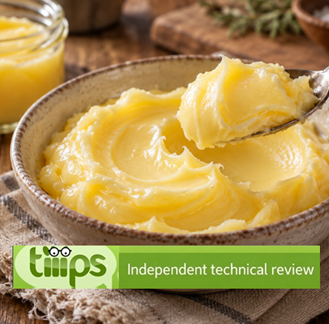
Il burro concentrato è un prodotto lattiero-caseario ottenuto dal burro o da altri prodotti del latte mediante eliminazione quasi completa di acqua e sostanze non grasse, ottenendo un ingrediente costituito prevalentemente da grasso del latte.
A seconda della specifica tipologia commerciale, il contenuto di grasso può essere almeno del 96% e arrivare, nel burro concentrato puro o nel grasso anidro del latte, a circa 99,8%.
Rispetto al burro tradizionale, che contiene una quota significativa di acqua, presenta quindi una maggiore concentrazione energetica e lipidica.
È costituito principalmente da trigliceridi del latte e contiene sia acidi grassi saturi sia monoinsaturi, con quantità inferiori di acidi grassi polinsaturi.
Contiene naturalmente anche componenti liposolubili del latte, tra cui vitamina A e piccole quantità di altre vitamine liposolubili, in misura variabile secondo materia prima e lavorazione.
Proteine, lattosio e minerali sono presenti in quantità molto basse nei prodotti maggiormente concentrati, poiché gran parte dei solidi non grassi viene eliminata durante la produzione.
Non deve essere confuso automaticamente con il ghee: entrambi sono prodotti ricchi di grasso del latte, ma il ghee presenta caratteristiche aromatiche e produttive specifiche. Il Codex classifica separatamente ghee, butter oil e grasso anidro del latte all’interno dei prodotti a base di grasso del latte.
Calorie
Il burro concentrato apporta indicativamente circa 865–900 kcal per 100 g, a seconda della percentuale effettiva di grasso.
Le versioni vicine al 99,8% di grasso del latte possono raggiungere valori prossimi a 900 kcal per 100 g.
Si tratta quindi di un ingrediente ad altissima densità energetica, utilizzato normalmente in quantità inferiori rispetto a ingredienti meno concentrati.
Utilizzi in Alimentazione
È impiegato nell’industria alimentare in prodotti da forno, biscotti, pasticceria, cioccolato, creme, ripieni e preparazioni lattiero-casearie.
Può essere utilizzato per conferire sapore di burro, cremosità e struttura senza introdurre la quantità di acqua presente nel burro tradizionale.
È particolarmente utile nelle formulazioni dove è necessario controllare con precisione il contenuto di umidità, come creme anidre, ripieni grassi e prodotti dolciari.
Può essere utilizzato anche in preparazioni culinarie e per la cottura, grazie alla ridotta presenza di acqua e solidi non grassi.
L’elevata concentrazione lipidica richiede comunque di considerarlo principalmente come una fonte di grassi e calorie.
Utilizzi in Cosmetica
I lipidi derivati dal latte possono essere utilizzati in alcune formulazioni cosmetiche per le loro proprietà emollienti e condizionanti.
Possono contribuire alla morbidezza di creme, balsami e prodotti destinati alla pelle, formando una componente lipidica che limita la perdita di acqua dalla superficie cutanea.
Il burro concentrato alimentare non è tuttavia un ingrediente cosmetico di uso particolarmente comune e non deve essere considerato equivalente a lipidi del latte purificati e standardizzati per uso cosmetico.
Allergeni
Il burro concentrato deriva dal latte, che rientra tra i principali allergeni alimentari soggetti a dichiarazione obbligatoria nell’Unione europea.
Nei prodotti fortemente concentrati le proteine del latte possono essere presenti soltanto in quantità residue, ma l’origine lattiero-casearia rimane rilevante per la dichiarazione dell’allergene latte.
Valutazione
Ingrediente molto concentrato, utile tecnologicamente e capace di conferire sapore, struttura e componente lipidica, ma caratterizzato da un contenuto estremamente elevato di grassi e calorie.
Verdetto ingrediente: fonte concentrata di grasso del latte, tecnologicamente utile soprattutto quando si desiderano le caratteristiche del burro con pochissima acqua; da utilizzare con moderazione per l’elevata densità calorica e il contenuto di grassi saturi.
Contro: Allergene; elevato contenuto di grassi saturi e calorie
Studi
In campo scientifico ormai è appurato che il consumo di burro può portare seri rischi nel sistema cardiovascolare. Questo studio che ne riassume le linee generali, è stato effettuato su 23.000 soggetti per 8 anni (1) e un altro studio approfondito su 33.000 soggetti ha riscontrato un'associazione positiva tra il burro e il rischio di infarto miocardico (2).
Il burro è anche un potenziale fattore della rigidità arteriosa che prelude a malattie cardiovascolari mentre il consumo di prodotti lattiero-caseari non si è rivelato dannoso per la rigidità arteriosa (3).
Questi dati valgono anche per il burro salato sul quale pesa il contenuto del cloruro di sodio che crea già da solo problemi cardiovascolari.
Sostanzialmente, quindi, con il burro dobbiamo usare cautela e, se proprio ci piace tanto, assaggiarlo di tanto in tanto, ma non un consumo costante e regolare. Naturalmente questa regola vale per tutti i cibi a rischio.
Inoltre è considerato un elemento a rischio correlato al tumore della prostata (4).
Esiste anche una correlazione tra il consumo regolare di burro e la malattia di Alzheimer (5).
Bibliografia___________________________________________________________________________
(1) von Ruesten A, Feller S, Bergmann MM, Boeing H. Diet and risk of chronic diseases: results from the first 8 years of follow-up in the EPIC-Potsdam study. Eur J Clin Nutr. 2013 Apr;67(4):412-9. doi: 10.1038/ejcn.2013.7.
Abstract. Background/objectives: There is still a need for scientific evidence about which foods characterize a healthy diet in terms of primary prevention of major chronic diseases. Therefore, we aimed to give a comprehensive overview on health-related foods, based on 8 years of follow-up of the European Prospective Investigation into Cancer and Nutrition (EPIC)-Potsdam study. Subjects/methods: We used data from 23,531 participants of the EPIC-Potsdam study to analyse the associations between 45 single food groups and risk of major chronic diseases, namely, cardiovascular diseases (CVD), type 2 diabetes and cancer using multivariable-adjusted Cox regression. Habitual dietary intake was assessed at baseline using food-frequency questionnaires. Incident chronic diseases were determined by self-administered follow-up questionnaires and medically verified, based on inquiry to treating physicians, cancer registries or through death certificates. Results: During follow-up, 363 incident CVD, 837 type 2 diabetes and 844 cancer cases were identified. Higher intakes of whole-grain bread, raw vegetables, coffee and cakes and cookies were found to be significantly associated with a lower risk of chronic diseases. Conversely, higher intakes of low-fat dairy, butter, red meat and sauce were associated with higher risks of chronic diseases. Conclusion: Overall, a healthy diet was characterized by a high consumption of whole-grain bread, raw vegetables and a low consumption of red meat and possibly butter, which is generally in line with previous findings. The paradoxical findings concerning the potential health benefit of coffee as well as cakes and cookies are interesting and should be investigated further.
(2) Patterson E, Larsson SC, Wolk A, Åkesson A. Association between dairy food consumption and risk of myocardial infarction in women differs by type of dairy food. J Nutr. 2013 Jan;143(1):74-9. doi: 10.3945/jn.112.166330. Epub 2012 Nov 21.
Abstract. The relation between dairy foods, particularly specific foods, and risk of cardiovascular disease (CVD) remains unclear. We examined the association between total, as well as specific, dairy food intakes and incidence of myocardial infarction (MI) in a prospective population-based cohort. We followed 33,636 women (aged 48-83 y), free from CVD, cancer, and diabetes at baseline (1997), in the Swedish Mammography Cohort. Consumption of milk, cultured milk/yogurt, cheese, cream, crème fraiche, and butter was obtained from a validated self-administered FFQ at baseline. We used Cox proportional hazards regression models to estimate HRs and 95% CIs, adjusted for relevant CVD risk factors. MI incidence was ascertained from national registries. Over 11.6 y of follow-up, we ascertained 1392 cases of MI. When the highest quintile was compared with the lowest quintile, total dairy food intake was inversely associated with MI risk [multivariable adjusted HR: 0.77 (95% CI: 0.63, 0.95)]. Among specific dairy food products, total cheese was inversely associated [HR: 0.74 (95% CI: 0.60, 0.91)] and butter used on bread but not on cooking was positively associated [HR: 1.34 (95% CI: 1.02, 1.75)] with MI risk. Other specific dairy food products were not significantly associated with MI risk. No differences were observed between consumption of specific low-fat and high-fat dairy foods, expressed as either absolute intakes or intakes relative to the total, and MI risk. Failure to consider dairy foods as a heterogeneous group in future studies could hamper important insights of relevance for the development of dietary guidelines.
(3) Livingstone KM, Lovegrove JA, Cockcroft JR, Elwood PC, Pickering JE, Givens DI. Does dairy food intake predict arterial stiffness and blood pressure in men?: Evidence from the Caerphilly Prospective Study. Hypertension. 2013 Jan;61(1):42-7. doi:10.1161/HYPERTENSIONAHA.111.00026. Epub 2012 Nov 12.
Abstract. Arterial stiffness is an independent predictor of cardiovascular disease events and mortality, and like blood pressure, may be influenced by dairy food intake. Few studies have investigated the effects of consumption of these foods on prospective measures of arterial stiffness. The present analysis aimed to investigate the prospective relationship between milk, cheese, cream, and butter consumption and aortic pulse wave velocity, augmentation index, systolic and diastolic blood pressure, as well as cross-sectional relationships between these foods and systolic and diastolic blood pressure and metabolic markers using data from the Caerphilly Prospective Study. Included in this cohort were 2512 men, aged 45 to 59 years, who were followed up at 5-year intervals for a mean of 22.8 years (number follow-up 787). Augmentation index was 1.8% lower in subjects in the highest quartiles of dairy product intake compared with the lowest (P trend=0.021), whereas in the highest group of milk consumption systolic blood pressure was 10.4 mm Hg lower (P trend=0.033) than in nonmilk consumers after a 22.8-year follow-up. Cross-sectional analyses indicated that across increasing quartiles of butter intake, insulin (P trend=0.011), triacylglycerol (P trend=0.023), total cholesterol (P trend=0.002), and diastolic blood pressure (P trend=0.027) were higher. Across increasing groups of milk intake and quartiles of dairy product intake, glucose (P trend=0.032) and triglyceride concentrations (P trend=0.031) were lower, respectively. The present results confirm that consumption of milk predicts prospective blood pressure, whereas dairy product consumption, excluding butter, is not detrimental to arterial stiffness and metabolic markers. Further research is needed to better understand the mechanisms that underpin these relationships.
(4) Vlajinac H, Ilic M, Marinkovic J, Sipetic S. Nutrition and prostate cancer. J BUON. 2010 Oct-Dec;15(4):698-703.
(5) Janssen, C. I., Jansen, D., Mutsaers, M. P., Dederen, P. J., Geenen, B., Mulder, M. T., & Kiliaan, A. J. (2016). The Effect of a High-Fat Diet on Brain Plasticity, Inflammation and Cognition in Female ApoE4-Knockin and ApoE-Knockout Mice. PloS one, 11(5), e0155307.
Abstract. Apolipoprotein E4 (ApoE4), one of three common isoforms of ApoE, is a major risk factor for late-onset Alzheimer disease (AD). ApoE-deficient mice, as well as mice expressing human ApoE4, display impaired learning and memory functions and signs of neurodegeneration. Moreover, ApoE protects against high-fat (HF) diet induced neurodegeneration by its role in the maintenance of the integrity of the blood-brain barrier. The influence of a HF diet on the progression of AD-like cognitive and neuropathological changes was assessed in wild-type (WT), human ApoE4 and ApoE-knockout (ApoE-/-) mice to evaluate the modulatory role of ApoE in this process. From 12 months of age, female WT, ApoE4, and ApoE-/- mice were fed either a standard or a HF diet (19% butter, 0.5% cholate, 1.25% cholesterol) throughout life. At 15 months of age mice performed the Morris water maze, evaluating spatial learning and memory. ApoE-/- showed increased spatial learning compared to WT mice (p = 0.009). HF diet improved spatial learning in WT mice (p = 0.045), but did not affect ApoE4 and ApoE-/- mice. Immunohistochemical analyses of the hippocampus demonstrated increased neuroinflammation (CD68) in the cornu ammonis 1 (CA1) region in ApoE4 (p = 0.001) and in ApoE-/- (p = 0.032) mice on standard diet. HF diet tended to increase CD68 in the CA1 in WT mice (p = 0.052), while it decreased in ApoE4 (p = 0.009), but ApoE-/- remained unaffected. A trend towards increased neurogenesis (DCX) was found in both ApoE4 (p = 0.052) and ApoE-/- mice (p = 0.068). In conclusion, these data suggest that HF intake induces different effects in WT mice compared to ApoE4 and ApoE-/- with respect to markers for cognition and neurodegeneration. We propose that HF intake inhibits the compensatory mechanisms of neuroinflammation and neurogenesis in aged female ApoE4 and ApoE-/- mice.




