



Anchovy paste
Anchovy paste is a condiment made mainly from anchovies (Engraulis encrasicolus, family Engraulidae) preserved in salt and then finely ground into a smooth paste.
Depending on the product, it may also contain salt, oil, water or other ingredients, while the actual proportion of anchovies may vary.
It is a concentrated source of high-quality protein and naturally contains fats, including the omega-3 fatty acids EPA and DHA.
It also provides nutrients typically found in fish, including vitamin B12, selenium, phosphorus and niacin, in amounts that vary according to formulation and processing.
Its particularly intense flavour comes from the concentration of salt, free amino acids and compounds responsible for umami taste.
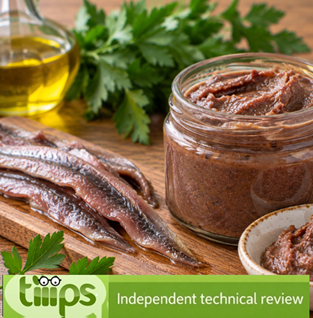
Because it is made from salt-preserved fish, anchovy paste can have a very high sodium content, which is its main nutritional drawback.
The quantities normally used are generally small because of its very concentrated flavour.
Calories
Anchovy paste provides approximately 170–220 kcal per 100 g, with considerable variation depending on the amount of oil and the formulation.
At normal seasoning amounts, usually only a few grams, the actual caloric contribution is relatively modest.
Uses in Food
It is used to flavour sauces, seasonings, pasta, pizza, crostini, vegetables, meat and fish dishes.
It may be added to pasta sauces, flavoured butter, vinaigrettes and salad dressings to increase savouriness and umami.
It is used in many Mediterranean preparations and can be added in very small amounts to provide depth of flavour without necessarily giving the finished dish a strong fish taste.
Its intense saltiness means that only a small amount is usually needed, but it should still be considered in the overall salt content of the meal.
Uses in Cosmetics
Food-grade anchovy paste is not a common cosmetic ingredient.
Fish-derived ingredients such as fish oil, marine collagen or hydrolysed proteins may instead be used in some cosmetic formulations for their emollient, film-forming or conditioning properties.
They may be found in creams, serums, hair-care products and nourishing formulations, but these are purified and specifically processed ingredients.
Food-grade anchovy paste should therefore not be considered equivalent to a standardised cosmetic ingredient.
Allergens
Anchovies are fish, one of the major food allergen categories requiring mandatory declaration in the European Union.
Anchovy paste should therefore be avoided by people with a fish allergy.
Assessment
A flavouring ingredient with useful amounts of protein, vitamin B12 and omega-3 fatty acids, but generally characterised by a very high salt content.
Ingredient verdict: a useful umami-rich flavouring ingredient, best used in small amounts because of its significant sodium content.
Cons: Allergen; high salt content

