REVIEW
Review

Al222 (26685 pt) • 2026-Sep-28 09:44
Quince
Quince is the fruit of the quince tree (Cydonia oblonga, family Rosaceae), native to Western Asia and cultivated for centuries throughout the Mediterranean region.
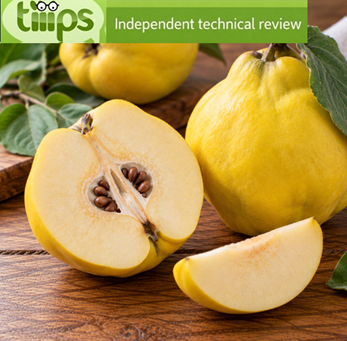
The ripe fruit has a characteristic apple- or pear-like shape, yellow skin and firm, aromatic flesh that is generally very astringent when eaten raw.
It consists mainly of water and carbohydrates, particularly naturally occurring sugars, while containing very little fat or protein.
It provides a useful amount of dietary fibre, including a significant proportion of pectin, a soluble fibre particularly abundant in the flesh and peel.
It also contains vitamin C, potassium, copper and other micronutrients, in amounts that vary according to variety, ripeness and processing.
Quince contains several polyphenols and tannins, which partly account for its astringent taste and have antioxidant activity.
Cooking softens the flesh, reduces astringency and develops a sweeter, more intense aroma, making the fruit considerably more pleasant to eat.
Because of its naturally high pectin content, quince readily forms gels during cooking, a property traditionally used in preserves and jellies.
Calories
Raw quince provides approximately 55–60 kcal per 100 g, with an average value close to 57 kcal per 100 g.
The energy value rises substantially in preparations such as quince paste, preserves and jellies when large amounts of sugar are added.
Uses in Food
Quince is mainly eaten cooked, as the raw fruit is generally hard and highly astringent.
It is used to make quince paste, preserves, jellies, compotes, jams, desserts and stewed fruit.
It can also be used in cakes, tarts, fillings and baked goods, where it provides a distinctive and intense aroma.
In savoury dishes, it may be paired with cheese, meat, game and sweet-and-sour preparations.
Its high pectin content also makes it useful for naturally improving the texture and gel formation of preserves made from fruits that are naturally low in pectin.
It can also be processed into juices, purées and concentrates, although these products have a different nutritional profile from the whole fruit.
Uses in Cosmetics
Quince extracts may be used in cosmetics for their conditioning, antioxidant and moisturising properties.
Of particular interest are the mucilages obtained from quince seeds, which are rich in polysaccharides capable of absorbing water and forming gels.
These derivatives may be found in creams, gels, masks, soothing products and hair-care formulations.
The mucilage can help form a soft, moisturising film on the skin surface.
Food-grade quince and its seeds should not, however, be considered equivalent to a purified and standardised cosmetic ingredient.
Allergens
Quince is not among the major food allergens requiring mandatory declaration in the European Union.
Rare individual reactions may nevertheless occur, including possible cross-reactivity with other fruits belonging to the Rosaceae family.
Assessment
A relatively low-calorie fruit valued particularly for its fibre, pectin, polyphenols and aromatic compounds, although it is mainly consumed after cooking.
Ingredient verdict: an aromatic fruit rich in pectin and especially useful in cooked preparations; in processed products, added sugars should be taken into account.
Cons: none specific in the fruit; potentially high sugar content in sweetened preparations
References________________________________________________________________________
Fukushima R, Yamada R, Izawa C, Shibata M. Surfactant-Free Pickering Emulsification Using Chinese Quince Fruit Fiber. J Oleo Sci. 2023;72(6):605-612. doi: 10.5650/jos.ess23002.
Abstract. Quince fruit powder can be obtained from the waste of the edible product. In this study, we modified the powder with various solvents and investigated its application in Pickering emulsification. The crushed Chinese quince fruit possessed excellent Pickering emulsifying abilities when the water-soluble components were removed. In addition to cellulose, the powder contains hydrophilic pectin and hydrophobic lignin fibers. Similarly, a powder consisting of cellulose and a small amount of lignin without pectin, which was obtained by further solvent treatment, also showed high emulsification performance. Although these two powders had different fiber compositions, their water contact angles were almost equal, and their surface hydrophilicity was lower than that of the cellulose-only powder without emulsification ability.
Najman K, Adrian S, Sadowska A, Świąder K, Hallmann E, Buczak K, Waszkiewicz-Robak B, Szterk A. Changes in Physicochemical and Bioactive Properties of Quince (Cydonia oblonga Mill.) and Its Products. Molecules. 2023 Mar 29;28(7):3066. doi: 10.3390/molecules28073066.
Abstract. Quince (Cydonia oblonga Miller) is a plant that is commonly cultivated around the world, known for centuries for its valuable nutritional and healing properties. Although quince fruit are extremely aromatic, due to their high hardness and sour, astringent, and bitter taste, they are not suitable for direct consumption in an unprocessed form. However, they are an important raw material in fruit processing, e.g., in the production of jams, jellies, and juices. Quince fruits fall under the category of temperate fruits, so their shelf life can be predicted. Considering that technological processing affects not only the organoleptic properties and shelf life but also the functional properties of fruits, the aim of this research was to determine the impact of various types of technological treatments on the physicochemical and bioactive properties of quince fruit. In fresh, boiled, and fried fruits and in freshly squeezed quince fruit juice, basic parameters, such as the content of dry matter, moisture, soluble solids (°Brix), pH, total acidity, water activity, and color parameters (L*a*b*) were determined. The content of key bioactive ingredients, i.e., tannins, carotenoids, flavonoids, phenolic acids, and total polyphenols, was also determined, as well as the antioxidant activity of raw and technologically processed (cooked, fried, and squeezed) quince fruits. The conducted research showed that fresh quince fruit and processed quince products can be a very good source of bioactive ingredients in the diet, such as tannins (3.64 ± 0.06 mg/100 g in fresh fruit; from 2.22 ± 0.02 mg/100 g to 5.59 ± 0.15 g/100 g in products), carotenoids (44.98 ± 0.18 mg/100 g in fresh fruit; from 141.88 ± 0.62 mg/100 g to 166.12 ± 0.62 mg/100 g in products), and polyphenolic compounds (246.98 ± 6.76 mg GAE/100 g in fresh fruit; from 364.53 ± 3.76 mg/100 g to 674.21 ± 4.49 mg/100 g in products). Quince fruit and quince products are also characterized by high antioxidant properties (452.41 ± 6.50 µM TEAC/100 g in fresh fruit; 520.78 ± 8.56 µM TEAC/100 g to 916.16 ± 6.55 µM TEAC/100 g in products). The choice of appropriate technological processing for the quince fruit may allow producers to obtain high-quality fruit preserves and act a starting point for the development of functional products with the addition of quince fruit in its various forms, with high health-promoting values and a wide range of applications in both the food and pharmaceutical industries.
Shimada U, Izawa C, Shibata M. Optimizing Quince Fruit Powder Particle Size for Sustainable Pickering Emulsions. J Oleo Sci. 2025;74(5):487-493. doi: 10.5650/jos.ess25006.
Abstract. Pickering emulsification, which utilizes solid particles instead of surfactants to stabilize emulsions, offers advantages such as improved safety and environmental sustainability. This study explores the potential of quince fruit powder, a plant-derived material rich in fibers such as cellulose, lignin, and pectin, as a stabilizing agent for Pickering emulsification. Quince powder, a byproduct of fruit processing, was optimized for particle size using sieving to enhance its emulsification performance.The emulsification efficiency of powders classified by particle size was evaluated through turbidity measurements, oil droplet size analysis, and Cryo-SEM observations. The results revealed that smaller particles (< 10 μm) exhibited superior emulsification performance, forming fine droplets with smooth surfaces. Medium-sized particles showed performance comparable to untreated powders, while larger particles resulted in lower turbidity and larger droplet sizes.This simple and eco-friendly particle classification method, sieving, demonstrates potential for improving the performance of Pickering emulsification.
Herrera-Rocha KM, Manjarrez-Juanes MM, Larrosa M, Barrios-Payán JA, Rocha-Guzmán NE, Macías-Salas A, Gallegos-Infante JA, Álvarez SA, González-Laredo RF, Moreno-Jiménez MR. The Synergistic Effect of Quince Fruit and Probiotics (Lactobacillus and Bifidobacterium) on Reducing Oxidative Stress and Inflammation at the Intestinal Level and Improving Athletic Performance during Endurance Exercise. Nutrients. 2023 Nov 13;15(22):4764. doi: 10.3390/nu15224764.
Abstract. Endurance exercise promotes damage at the intestinal level and generates a variety of symptoms related to oxidative stress processes, inflammatory processes, microbiota dysbiosis, and intestinal barrier damage. This study evaluated the effects of quince (Cydonia oblonga Mill.) and probiotics of the genera Lactobacillus and Bifidobacterium on intestinal protection and exercise endurance in an animal swimming model. Phytochemical characterization of the quince fruit demonstrated a total dietary fiber concentration of 0.820 ± 0.70 g/100 g and a fiber-bound phenolic content of 30,218 ± 104 µg/g in the freeze-dried fruit. UPLC-PDA-ESI-QqQ analyses identified a high content of polyphenol, mainly flavanols, hydroxycinnamic acids, hydroxybenzoic acids, flavonols, and, to a lesser extent, dihydrochalcones. The animal model of swimming was performed using C57BL/6 mice. The histological results determined that the consumption of the synbiotic generated intestinal protection and increased antioxidant (catalase and glutathione peroxidase enzymes) and anti-inflammatory (TNF-α and IL-6 and increasing IL-10) activities. An immunohistochemical analysis indicated mitochondrial biogenesis (Tom2) at the muscular level related to the increased swimming performance. These effects correlated mainly with the polyphenol content of the fruit and the effect of the probiotics. Therefore, this combination of quince and probiotics could be an alternative for the generation of a synbiotic product that improves exercise endurance and reduces the effects generated by the practice of high performance sports.




