



Hulled millet flour
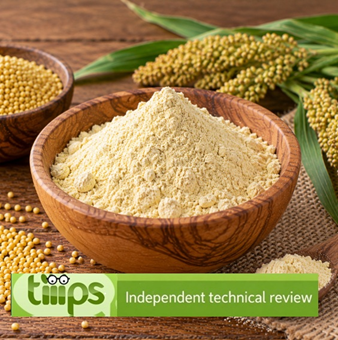
Hulled millet flour is obtained by milling millet grains (Panicum miliaceum, family Poaceae) after removal of the hard, inedible outer layers.
It is naturally gluten-free and is therefore frequently used in foods intended for gluten-free diets.
It consists mainly of complex carbohydrates, particularly starch, and also provides protein, fibre and small amounts of predominantly unsaturated fats.
It contains varying amounts of magnesium, phosphorus, manganese, copper, iron and B vitamins.
Millet proteins have useful nutritional value but are relatively low in lysine; combining millet with legumes can therefore improve the amino acid balance of a meal.
Millet also contains phenolic compounds and other bioactive plant components, whose levels depend on the variety and degree of processing.
Hulling improves palatability and removes tougher fibrous outer layers, but it may also reduce some of the fibre and micronutrients compared with less refined millet products.
The flour has a mild, slightly sweet and characteristic flavour. Because it does not form an elastic gluten network, it is often combined with other flours or structuring ingredients in leavened doughs.
Calories
Hulled millet flour provides approximately 360–380 kcal per 100 g, with variations depending on variety, fat content and moisture.
Uses in Food
It is used in bread, biscuits, cakes, pancakes, focaccia, crackers and other gluten-free baked goods.
It can be blended with rice, maize, gluten-free oat, quinoa or buckwheat flour to create different flavours and textures.
It is also used in porridge, cereal creams, polenta-style preparations, pasta doughs and breakfast foods.
Its water-absorption properties contribute to dough consistency, but the absence of gluten often requires fibres, gums or other structuring agents in leavened products.
Its mild flavour makes it suitable for both sweet and savoury preparations.
Uses in Cosmetics
Millet flour and millet starch may be used in some cosmetic formulations as absorbent, texturising and conditioning ingredients.
They may be found in masks, powder cleansers, bath products and skincare preparations.
Millet extracts are also used in some hair and scalp products, mainly as botanical conditioning ingredients.
Food-grade millet flour should not, however, be considered equivalent to a purified and standardised cosmetic ingredient.
Allergens
Millet is not among the major food allergens requiring mandatory declaration in the European Union and is naturally gluten-free.
For people with coeliac disease, however, it is still advisable to choose products specifically labelled gluten-free to minimise the risk of cross-contamination during processing and packaging.
Assessment
A naturally gluten-free flour with a useful content of complex carbohydrates, minerals and protein, particularly suitable in flour blends used as alternatives to wheat.
Ingredient verdict: a good naturally gluten-free flour that is versatile in both sweet and savoury preparations, although hulling reduces some fibre compared with less refined forms.
Cons: lower fibre content than less refined versions

