



Savoy
Savoy cabbage is a leafy vegetable belonging to Brassica oleracea var. sabauda, family Brassicaceae.
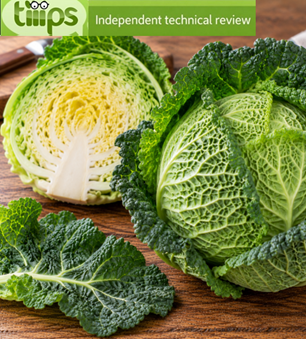
It is characterised by green, crinkled and strongly veined leaves forming a compact or semi-compact head.
It consists mainly of water and has a very low energy density.
It provides fibre, carbohydrates and small amounts of protein, while its fat content is almost negligible.
It contains useful amounts of vitamin C, vitamin K, folate and provitamin A, together with potassium, calcium, manganese and other minerals.
Like other Brassicaceae vegetables, it contains glucosinolates, plant compounds that can be converted during chopping and chewing into substances such as isothiocyanates.
It also provides carotenoids, flavonoids and other phenolic compounds with antioxidant activity.
Its fibre content contributes to normal bowel function and may help promote satiety.
Prolonged cooking can reduce some vitamin C and other heat-sensitive compounds, while brief steaming generally preserves a greater proportion.
In sensitive individuals, especially when eaten in large amounts, it may cause bloating and intestinal gas because of its fibre and fermentable carbohydrates.
Calories
Raw Savoy cabbage provides approximately 25–30 kcal per 100 g, with an average value close to 27 kcal per 100 g.
Cooking without added fats has little effect on its overall energy content.
Uses in Food
Savoy cabbage can be eaten raw, boiled, steamed, stewed, sautéed or baked.
It is used in soups, stews, stuffed cabbage rolls, risottos, dishes with pulses, side dishes and meat-based preparations.
The larger outer leaves are particularly suitable for stuffed rolls, while the more tender inner leaves may also be used in salads.
Brief steaming or sautéing helps preserve texture, colour and micronutrients.
It is useful for increasing the volume and fibre content of meals with very few calories.
Uses in Cosmetics
Savoy cabbage itself is not a common cosmetic ingredient.
Extracts of Brassica oleracea may nevertheless be used in some formulations because of their antioxidant and conditioning compounds.
They may occasionally be found in creams, masks, serums and botanical skincare preparations.
Food-grade Savoy cabbage should not be considered equivalent to a purified and standardised cosmetic extract.
Allergens
Savoy cabbage is not among the major food allergens requiring mandatory declaration in the European Union.
Rare individual reactions to Brassicaceae vegetables may nevertheless occur.
Assessment
A very low-calorie vegetable with a useful content of fibre, vitamin C, vitamin K and glucosinolates.
Ingredient verdict: an excellent low-energy vegetable rich in fibre and micronutrients, suitable for frequent consumption as part of a varied diet.
Cons: possible intestinal bloating in sensitive individuals

