



Dextrins
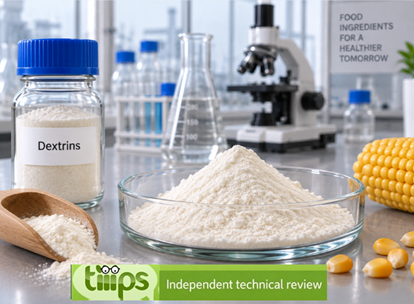
Dextrins are a family of carbohydrates obtained through the partial breakdown of starch by heat, acids or enzymes.
They can be produced from starches derived from maize, potato, tapioca, rice, wheat or other plant sources.
They consist of chains of glucose units that are shorter than those in the original starch, with structures and degrees of branching that vary according to the manufacturing process.
They generally appear as white or slightly yellowish powders, readily dispersible or soluble in water and with a neutral or mildly sweet taste.
From a nutritional point of view, many conventional dextrins are readily digestible carbohydrates and can be rapidly converted into glucose.
However, resistant dextrins also exist. These are modified to resist digestion in the small intestine and behave mainly as fermentable dietary fibre.
The generic term “dextrins” therefore does not describe a single nutritional behaviour: digestibility, glycaemic impact and energy value depend on the specific type.
Dextrins do not normally provide significant amounts of protein, fat, vitamins or minerals.
Calories
Digestible dextrins provide approximately 380–400 kcal per 100 g, similar to other available carbohydrates.
Resistant dextrins may have a considerably lower energy value, often close to that assigned to fermentable fibre, around 200 kcal per 100 g.
Uses in Food
Dextrins are used in baked goods, snacks, cereals, confectionery, sauces, beverages, instant preparations and powdered foods.
They may act as thickeners, binders, bulking agents, stabilisers or carriers for flavours and colours.
In baked goods and snacks, they can help improve crispness, coating adhesion and surface structure.
They are also used to improve the dispersion of powdered ingredients and enhance the solubility and flow properties of dry mixes.
Resistant dextrins are mainly used to increase the dietary fibre content of beverages, bars and nutritional products.
Uses in Cosmetics
Dextrins may be used in cosmetics as binding, film-forming, absorbent and stabilising ingredients.
They may be found in cosmetic powders, masks, creams, hair-care products and compact formulations, where they contribute to texture and product integrity.
They may also be used as carriers for other ingredients and to improve the uniform distribution of powders and pigments.
Food-grade dextrin should not automatically be considered equivalent to a specifically purified and standardised cosmetic ingredient.
Allergens
The allergen profile depends on the source material and degree of purification.
Dextrins derived from maize, rice or potato are not normally among the major food allergens.
If derived from wheat, the allergen relevance and residual gluten content must be assessed according to the specific product and manufacturing process.
Assessment
A mainly technological ingredient, with very different nutritional characteristics depending on whether the dextrin is digestible or resistant.
Ingredient verdict: useful for structure, stability and ingredient delivery; nutritionally limited in digestible form, while resistant dextrins can contribute dietary fibre.
Cons: possible high glycaemic impact in digestible dextrins

