



Red and green lentils
Red and green lentils are the seeds of Lens culinaris, a legume belonging to the Fabaceae family.
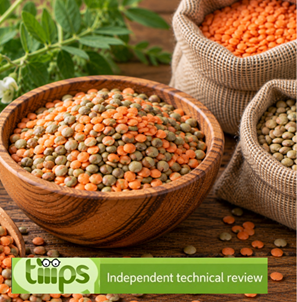
Green lentils are generally sold whole and with their seed coat, while red lentils are often dehulled and split, giving them their characteristic orange-red colour.
They are a good source of plant protein, complex carbohydrates and fibre, while naturally containing very little fat.
They provide useful amounts of folate, iron, magnesium, phosphorus, potassium, zinc and manganese.
Lentil proteins are relatively low in some sulfur-containing amino acids, particularly methionine; combining them with cereals therefore improves the protein complementarity of the meal.
Because green lentils retain their seed coat, they generally contain more fibre and hold their shape better during cooking.
Dehulled red lentils cook more quickly, become softer and are particularly suitable for soups, purées and creamy preparations.
They also contain resistant starch, polyphenols and other bioactive plant compounds.
Like other legumes, lentils naturally contain phytates and other antinutritional compounds, which may partly reduce the absorption of certain minerals. Soaking, cooking and sprouting can reduce their levels.
Fermentable oligosaccharides may cause bloating and flatulence in sensitive individuals.
Calories
Dried lentils provide approximately 340–360 kcal per 100 g.
Once cooked and rehydrated, they generally provide around 110–125 kcal per 100 g, depending on the variety and the amount of water absorbed.
Uses in Food
They are used in soups, stews, salads, curries, side dishes and cereal-based meals.
Red lentils are particularly suitable for soups, dhal, purées, sauces and plant-based burgers, as they tend to break down during cooking.
Green lentils are better suited to salads, side dishes and preparations where the lentils are intended to remain whole.
They can also be processed into lentil flour, which is used in pasta, baked goods, snacks and high-protein foods.
Uses in Cosmetics
Lentils are not a common cosmetic ingredient, but lentil extracts, proteins and polysaccharides may be used in some formulations.
They may be found in hair-care products, creams, masks and conditioning formulations, particularly as plant-derived ingredients.
Lentil flour may also be used in traditional cosmetic preparations as an absorbent or texturising ingredient.
Food-grade lentils should not, however, be considered equivalent to a purified and standardised cosmetic ingredient.
Allergens
Lentils are not among the major food allergens requiring mandatory declaration in the European Union.
However, individual allergic reactions and cross-reactivity with other legumes may occur, particularly in people already allergic to chickpeas, peas or peanuts.
Assessment
A nutritionally valuable legume due to its content of plant protein, fibre, folate and minerals, combined with a low fat content and good culinary versatility.
Ingredient verdict: an excellent plant source of protein and fibre; green lentils generally provide more fibre, while red lentils cook faster and are especially useful in creamy preparations.
Cons: possible bloating and flatulence in sensitive individuals

