



Mung beans
Mung beans are the seeds of Vigna radiata, a legume belonging to the Fabaceae family. In some markets they are also referred to as “green azuki beans”, although botanically they are distinct from true azuki beans, which are generally red and belong to the species Vigna angularis.
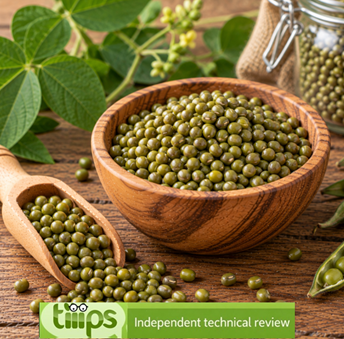
They are a good source of plant protein, complex carbohydrates and fibre, while naturally containing very little fat.
Dried mung beans contain approximately 24 g of protein and 16 g of fibre per 100 g, together with useful amounts of folate, iron, magnesium, phosphorus, potassium and copper.
Like other legumes, their proteins do not provide an optimal balance of all essential amino acids on their own; combining them with cereals provides better nutritional complementarity.
They also contain resistant starch, polyphenols and other bioactive plant compounds.
Like many dried legumes, they naturally contain phytates, enzyme inhibitors and other antinutritional compounds, whose levels can be reduced through soaking, sprouting and, especially, proper cooking.
Fermentable carbohydrates present in legumes may cause bloating and flatulence in sensitive individuals.
Calories
Dried mung beans provide approximately 347 kcal per 100 g, with about 24 g of protein and 16 g of fibre.
Once cooked and rehydrated, they provide approximately 105 kcal per 100 g, mainly because they absorb a considerable amount of water.
Uses in Food
Mung beans are used in soups, stews, curries, salads, rice dishes, side dishes and legume-based preparations.
In Asian cuisine they are also used to make pastes, purées, desserts and noodles produced from mung bean starch.
They can be sprouted: mung bean sprouts are widely used in Asian dishes, salads and stir-fries.
Soaking before cooking can shorten preparation time and help reduce some fermentable and antinutritional compounds.
Thanks to their good protein and fibre content, mung beans can also be used in plant-based burgers, legume spreads and high-protein formulations.
Uses in Cosmetics
Vigna radiata seed extract may be used in cosmetics as a skin-conditioning ingredient.
Extracts obtained from mung bean sprouts may also be used in formulations for their antioxidant properties.
These derivatives may be found in creams, serums, masks and skincare products, although food-grade mung beans should not be considered equivalent to a standardised cosmetic extract.
Allergens
Mung beans are not among the major food allergens requiring mandatory declaration in the European Union.
Rare individual allergic reactions may nevertheless occur, including possible cross-reactivity with other legumes.
Assessment
A nutritionally valuable legume due to its good content of plant protein, fibre, folate and minerals, combined with a very low fat content.
Ingredient verdict: an excellent plant source of protein and fibre, particularly valuable as part of a varied diet when properly cooked.
Cons: possible bloating and flatulence in sensitive individuals

