



Pearl barley
Pearl barley is obtained from barley grains (Hordeum vulgare, family Poaceae) that are dehulled and then polished to remove part of the outer layers of the grain.
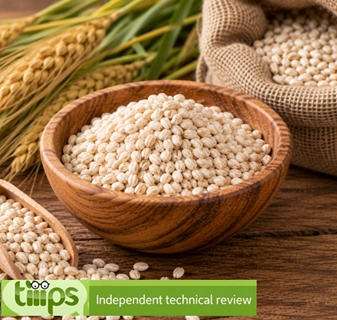
Pearling makes barley lighter in colour, more tender and quicker to cook, but it also removes part of the bran and therefore reduces some of its fibre, vitamins and minerals compared with hulled barley.
It consists mainly of complex carbohydrates, particularly starch, and also provides protein, fibre and small amounts of fat.
Barley is particularly valuable for its beta-glucans, soluble fibres that contribute to the maintenance of normal blood cholesterol levels when consumed in appropriate amounts.
It also provides varying amounts of magnesium, phosphorus, manganese, selenium, iron and B vitamins.
Its fibre content supports normal bowel function and satiety, although pearl barley contains less fibre than less refined barley.
During cooking, it absorbs a considerable amount of water, substantially reducing the energy density per 100 g of the cooked product.
Calories
Dry pearl barley provides approximately 350–355 kcal per 100 g.
Once cooked in water, it generally provides around 120–125 kcal per 100 g, depending on the amount of water absorbed.
Uses in Food
It is mainly used in soups, stews, barley risottos, salads, side dishes and complete meals.
It can replace rice or other cereals in risotto-style dishes, fillings and preparations with vegetables or pulses.
Thanks to the water-binding properties of its starch and beta-glucans, it develops a soft and slightly creamy texture during cooking.
Compared with hulled barley, it generally requires shorter cooking times and does not always need pre-soaking.
Uses in Cosmetics
Pearl barley itself is not a common cosmetic ingredient.
Barley extracts and cereal-derived ingredients may, however, be used in some formulations for their conditioning, emollient and moisturising properties.
They may be found in creams, cleansers, masks and hair-care products, while barley-derived starches and polysaccharides may contribute to formulation texture.
Food-grade barley should not be considered equivalent to a purified or standardised cosmetic ingredient.
Allergens
Barley contains gluten and is one of the cereals subject to mandatory allergen declaration in the European Union.
It is therefore unsuitable for people with coeliac disease and should also be avoided by people with barley allergy.
Assessment
A nutritionally interesting cereal because of its complex carbohydrates and beta-glucan content, although pearling reduces some fibre and micronutrients compared with less refined barley.
Ingredient verdict: a good cereal for soups and complete dishes, valuable for its beta-glucans but lower in fibre than hulled barley.
Cons: Allergen

