



Citrus fibre
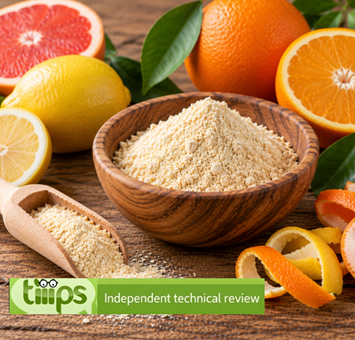
Citrus fibre is an ingredient obtained mainly from the fibrous parts of oranges, lemons and other citrus fruits (Citrus spp., family Rutaceae), often recovered from by-products of juice production.
It consists primarily of insoluble and soluble dietary fibre, including cellulose, hemicelluloses and pectins, in proportions that vary according to the raw material and manufacturing process.
It has a high capacity to absorb and retain water and, in some formulations, also oils and fats. For this reason, it is used both to increase fibre content and as a technological ingredient.
From a nutritional point of view, sufficiently purified citrus fibre generally contains little sugar or fat and can help increase overall dietary fibre intake.
The soluble fraction can be partly fermented by the gut microbiota, while the insoluble fraction mainly contributes to stool bulk and normal bowel function.
It may also help promote satiety, particularly when incorporated into foods rich in water and fibre.
Unlike whole citrus fruit, citrus fibre is not a significant source of vitamin C, much of which is lost or separated during processing.
It may, however, retain varying amounts of pectins, flavonoids and other phenolic compounds naturally present in citrus peel and fibrous tissues.
Calories
When composed mainly of dietary fibre, it provides approximately 180–220 kcal per 100 g, taking into account the conventional energy value assigned to fermentable fibre.
The actual value may vary considerably depending on purity and residual carbohydrate content.
Uses in Food
It is used in bread, biscuits, baked goods, sauces, meat preparations, plant-based foods, desserts and fibre-enriched products.
Thanks to its water-holding capacity, it can improve softness, texture, yield and stability.
It may help reduce moisture loss during cooking and storage and can be used as a thickener, structuring agent or partial fat replacer.
In baked goods, it can help maintain softness for longer and increase the fibre content.
It is also used in some gluten-free formulations to improve water retention and dough structure.
Uses in Cosmetics
Citrus fibres, pectins and related derivatives may be used in cosmetics as absorbent, texturising, stabilising and film-forming ingredients.
They may be found in masks, scrubs, cleansers, powders, creams and skincare products.
Citrus-derived polysaccharides may also contribute to viscosity and emulsion stability.
Food-grade citrus fibre, however, should not automatically be considered equivalent to a purified and standardised cosmetic ingredient.
Allergens
Citrus fruits are not among the major food allergens requiring mandatory declaration in the European Union.
Rare individual reactions may nevertheless occur, particularly in people already sensitive to citrus fruits.
Assessment
An interesting ingredient from both a nutritional and technological point of view, thanks to its high fibre content and its ability to improve texture, water retention and food consistency.
Ingredient verdict: a useful concentrated source of plant fibre and a versatile technological ingredient, particularly valuable for increasing fibre content and improving product structure.
Cons: possible gastrointestinal discomfort when consumed in large amounts

