



Mustard powder
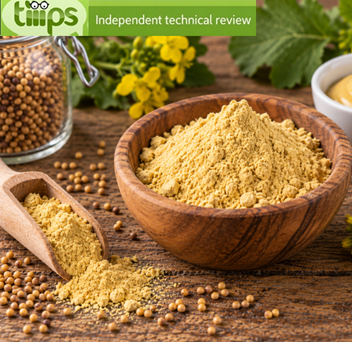
Mustard powder is obtained by grinding the seeds of several mustard species, mainly Sinapis alba, Brassica juncea and Brassica nigra, belonging to the Brassicaceae family.
It may be pale yellow, beige or brown and its flavour intensity varies according to the mustard species used.
It contains significant amounts of protein, predominantly unsaturated fats, fibre and carbohydrates, together with minerals such as calcium, magnesium, phosphorus, potassium and selenium.
Mustard seeds naturally contain glucosinolates. When the powder is mixed with water, the enzyme myrosinase promotes the formation of isothiocyanates, which are responsible for mustard’s characteristic pungent flavour.
Yellow mustard generally has a milder flavour, while brown and black varieties can develop a much stronger pungency.
Heat can reduce myrosinase activity and alter the aromatic profile; mustard added towards the end of cooking may therefore retain a more intense flavour.
From a nutritional point of view, mustard powder is relatively nutrient-dense, but it is normally consumed in small amounts, so its overall contribution to the diet is limited.
Calories
Ground mustard seed provides approximately 500–510 kcal per 100 g; a commonly cited reference value is about 508 kcal per 100 g.
The quantities normally used as a spice are, however, very small.
Uses in Food
Mustard powder is used to make prepared mustard, sauces, dressings, mayonnaise, marinades and seasonings.
It can be added to meat, fish, vegetables, cheese, egg dishes, curries and spice blends.
In food preparations it can also provide flavouring and emulsifying properties, thanks to components naturally present in mustard seeds.
The dry powder has a relatively moderate aroma, while the addition of water or other liquids activates the reactions responsible for its characteristic pungency.
Uses in Cosmetics
Mustard powder and mustard-seed derivatives may be used in some cosmetic or traditional preparations for their warming and stimulating effects.
They may be found in hair and scalp treatments, wraps and massage formulations.
However, mustard’s pungent compounds can be strongly irritating to the skin and mucous membranes, particularly at high concentrations.
Food-grade mustard powder should therefore not be applied directly to the skin as a substitute for a properly formulated and standardised cosmetic ingredient.
Allergens
Mustard is a major food allergen requiring mandatory declaration in the European Union.
Even very small amounts may cause reactions in people with mustard allergy, and cooking does not reliably eliminate the risk.
Assessment
A concentrated and nutritionally interesting spice, rich in protein, unsaturated fats and glucosinolates, mainly valued for its characteristic pungent flavour.
Ingredient verdict: a useful aromatic and technological ingredient, but it should be completely avoided by people with mustard allergy.
Cons: Allergen

