



BARLEY malt vinegar
Barley malt vinegar is a vinegar made from barley (Hordeum vulgare, family Poaceae) that undergoes malting followed by fermentation.
During malting, controlled germination activates enzymes that convert part of the starch into fermentable sugars, particularly maltose.
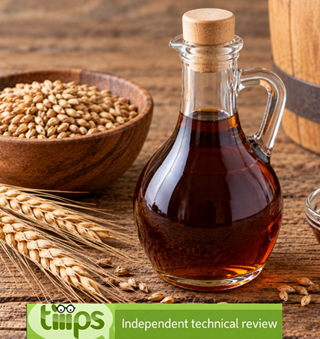
The sugars are first converted by yeasts into ethyl alcohol, after which acetic acid bacteria convert the alcohol mainly into acetic acid.
The result is a vinegar that is generally amber to brown in colour, with a characteristic acidic, malty and slightly toasted flavour, more aromatic than spirit vinegar.
It consists mainly of water and acetic acid, together with small amounts of malt-derived compounds that contribute to its colour and flavour.
From a nutritional point of view, it provides very small amounts of carbohydrates, protein and fat and is not a significant source of fibre, vitamins or minerals.
Its acidity also contributes to food preservation by creating conditions that inhibit the growth of many microorganisms.
Calories
Its energy contribution is very low. Typical malt vinegar provides approximately 15–25 kcal per 100 ml, depending on composition.
Uses in Food
It is used as a seasoning, acidifying agent and preservative, particularly in British and Northern European cuisine.
It is traditionally served with potatoes, fish and chips, vegetables, salads, sauces and savoury dishes.
It is also commonly used in pickles, chutneys, marinades, sauces and preserved vegetables.
Compared with spirit vinegar, it provides a stronger aromatic component due to the characteristics of barley malt.
It can also be used to regulate pH, improve shelf life and contribute to flavour development in food preparations.
Uses in Cosmetics
Barley malt vinegar is not a commonly used cosmetic ingredient.
In cosmetics, acetic acid, other vinegars or their derivatives are more commonly used as acidifying agents and pH regulators, particularly in some hair-care formulations.
Food-grade malt vinegar should not be used directly as an equivalent to a formulated and standardised cosmetic ingredient, as its acidity may cause irritation to the skin, eyes and mucous membranes.
Allergens
It is derived from BARLEY, a gluten-containing cereal and a major allergen requiring declaration in the European Union.
It is therefore generally unsuitable for people with coeliac disease or barley allergy.
Assessment
A very low-calorie condiment valued mainly for its acidity and characteristic malty flavour, with useful technological and preservative properties.
Ingredient verdict: a flavourful, low-calorie condiment, but its barley origin makes it unsuitable for people who need to avoid gluten.
Cons: Allergen

