



Kale
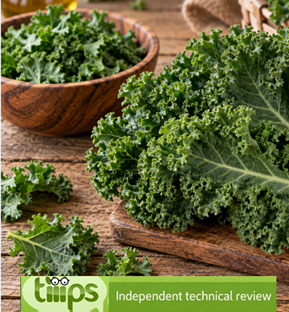
Kale is a leafy vegetable belonging to Brassica oleracea, family Brassicaceae, characterised by strongly curled green or purple leaves.
It is a low-calorie food with a high concentration of micronutrients and bioactive plant compounds.
It provides a good amount of fibre and contains vitamins C, K and provitamin A in the form of carotenoids, together with folate and several minerals.
Its main bioactive compounds include lutein, zeaxanthin, flavonoids and glucosinolates, which are characteristic of Brassicaceae vegetables.
Glucosinolates can be converted during chopping and chewing into compounds such as isothiocyanates, which have been widely studied for their biological activity.
Vitamin C and some other nutrients may decrease with prolonged cooking, while moderate cooking can soften the leaves and improve digestibility.
Kale also contains oxalates, although generally in lower amounts than some other leafy vegetables such as spinach.
Uses in Food
It can be eaten raw in salads, often massaged with dressing to soften the leaves, or cooked by steaming, sautéing, boiling or adding to soups and stews.
It is also used in smoothies, pesto, kale chips, side dishes and plant-based preparations.
Short steaming generally helps preserve colour, texture and a good proportion of its micronutrients.
Uses in Cosmetics
Kale extracts may be used in cosmetics as antioxidant and skin-conditioning ingredients, thanks to their content of polyphenols, carotenoids and other plant compounds.
They may be found in creams, serums, masks and skincare products, particularly in formulations that feature botanical extracts.
Food-grade kale, however, should not automatically be considered equivalent to a standardised cosmetic extract.
Calories
Raw kale provides approximately 35–50 kcal per 100 g, with variations depending on variety and water content.
Allergens
Kale is not among the major food allergens requiring mandatory declaration in the European Union. Rare individual reactions may nevertheless occur.
Assessment
A nutritionally valuable vegetable due to its content of fibre, vitamins, carotenoids and glucosinolates, combined with a very low energy density.
Ingredient verdict: a nutrient-dense leafy vegetable rich in micronutrients and plant compounds, particularly valuable as part of a varied diet.
Cons: none specific at normal dietary amounts

