



Semi-whole spelt flour
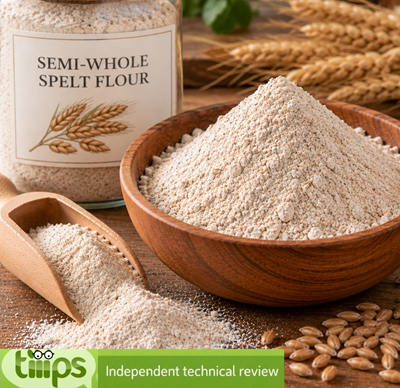
Semi-whole spelt flour is obtained by milling spelt (Triticum spp., family Poaceae) to an intermediate degree of refinement between white flour and wholemeal flour.
The semi-whole milling process retains a significant proportion of the outer layers of the grain and the germ, preserving more fibre and micronutrients than refined flour.
It consists mainly of complex carbohydrates, particularly starch, and also contains protein, fibre and small amounts of fat.
It provides varying amounts of B vitamins, magnesium, phosphorus, iron, zinc and manganese.
Its higher fibre content compared with refined flours may contribute to normal bowel function and satiety.
It is used in bread, pizza, focaccia, biscuits, cakes and other baked goods, giving them a characteristic flavour that is generally aromatic and slightly rustic.
Spelt proteins form gluten when mixed with water, allowing the preparation of leavened doughs.
Spelt is sometimes considered more digestible than common wheat, but this characteristic cannot be generalised and does not make it suitable for people with coeliac disease.
Calories
It provides approximately 330–360 kcal per 100 g, with variations depending on the type of spelt, degree of refinement and moisture content.
Allergens
Spelt is a type of wheat and contains gluten. It should therefore be avoided by people with coeliac disease or wheat allergy.
Assessment
An interesting flour offering a good balance between fibre content, micronutrients and technological properties, and nutritionally more complete than highly refined flours.
Ingredient verdict: a good semi-wholemeal choice, with more fibre and micronutrients than refined flour, but containing gluten.
Cons: Allergen

