



Senatore Cappelli durum wheat semolina
Senatore Cappelli durum wheat semolina is obtained by milling durum wheat (Triticum turgidum subsp. durum, family Poaceae) of the historic Senatore Cappelli cultivar, selected by Nazareno Strampelli in 1915.
It has the typical coarse texture of semolina, with larger particles than remilled semolina, and a characteristic yellow-amber colour.
It consists mainly of complex carbohydrates, particularly starch, and has a good protein content.
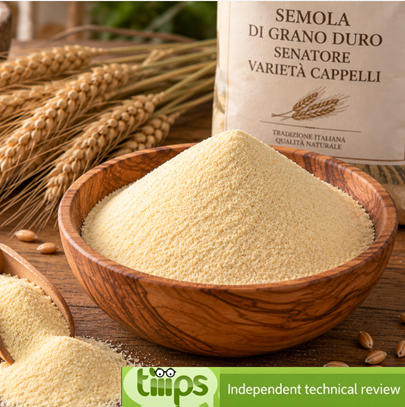
The Senatore Cappelli variety is characterised by a relatively high protein concentration, while its gluten is considered comparatively weak by current industrial standards.
It also provides varying amounts of fibre, B vitamins, iron, magnesium, phosphorus and other minerals, depending on the degree of refinement.
It is particularly appreciated for the production of pasta, bread, focaccia and other baked goods, to which it contributes distinctive aroma and flavour.
Senatore Cappelli wheat is often described as more digestible than modern wheat varieties, but this characteristic cannot be considered universally established and does not make the product suitable for people who need to avoid gluten.
As a refined semolina, it contains less fibre and fewer micronutrients than the corresponding wholegrain product.
Calories
It provides approximately 340–360 kcal per 100 g, with variations depending on moisture and product composition.
Allergens
It is derived from wheat and contains gluten. It should therefore be avoided by people with coeliac disease or wheat allergy.
Assessment
A semolina with good technological and sensory qualities, particularly valued for its traditional wheat variety, protein content and characteristic flavour.
Ingredient verdict: a good traditional durum wheat semolina, appreciated for its quality and flavour, but nutritionally not radically different from other refined semolinas.
Cons: Allergen

