



Sunfloweroyl Methylglucamide: properties, uses, pros, cons, safety
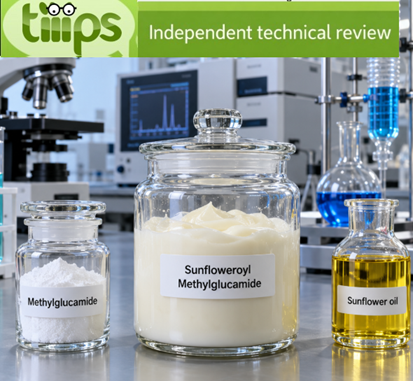
Sunfloweroyl Methylglucamide is a non-ionic sugar-based surfactant obtained by reacting Methylglucamine with sunflower-derived fatty acid chlorides.
Its structure combines a hydrophilic methylglucamine portion with lipophilic fatty-acid chains derived from sunflower oil, giving the ingredient both cleansing activity and a relatively conditioning sensory profile.
Its documented cosmetic functions are Cleansing, Hair Conditioning, Skin Conditioning, Solvent, and Surfactant – Cleansing.
No specific Cosmetics Regulation provisions are identified under Annexes II–VI of the EU Cosmetics Regulation.
Description
Sunfloweroyl Methylglucamide belongs to the family of N-acyl methylglucamides, surfactants obtained by combining fatty-acid chains with a sugar-derived amino alcohol.
The molecule contains:
a hydrophilic methylglucamine-derived head group with several hydroxyl groups;
an amide linkage;
a lipophilic fatty-acid chain.
Because sunflower-derived fatty acids comprise several chain types, the commercial ingredient is normally a mixture of related glucamides rather than one single molecular species.
The sunflower fraction is typically dominated by C18 fatty acids, particularly derivatives corresponding to:
oleic acid;
linoleic acid;
smaller amounts of saturated fatty acids.
The exact distribution depends on the sunflower feedstock used.
Sunfloweroyl Methylglucamide is non-ionic and should be distinguished from:
anionic sulfates and sulfonates;
betaine surfactants;
alkyl polyglucosides;
ethoxylated surfactants;
Cocoyl Methyl Glucamide;
Lauroyl/Myristoyl Methyl Glucamide.
It contains no sulfate group and does not require ethoxylation as part of its intrinsic chemical structure.
Manufacturing process
The official ingredient definition describes it as the product obtained by reaction of Methylglucamine with sunflower acid chloride.
Production may include:
preparation or sourcing of sunflower fatty acids;
conversion to the corresponding activated fatty-acid derivative;
reaction with Methylglucamine;
formation of the fatty-acid methylglucamide;
removal of unreacted starting materials;
purification;
adjustment of active-matter concentration;
filtration;
standardization;
quality control.
Methylglucamine, also known as N-methyl-D-glucamine, is derived from a sugar-related polyol structure and provides the strongly hydrophilic portion of the surfactant.
The finished commercial material may be supplied either as:
a highly concentrated or nearly pure glucamide;
a liquid preparation diluted with water or another suitable carrier.
The percentage of commercial raw material used in a formula should therefore not be confused with the actual percentage of Sunfloweroyl Methylglucamide.
Identification data and specifications
| Characteristic | Value | Note |
|---|---|---|
| INCI name | Sunfloweroyl Methylglucamide | cosmetic ingredient name |
| Definition | product obtained by reaction of Methylglucamine with sunflower acid chloride | fatty-acid glucamide mixture |
| Chemical category | N-acyl methylglucamide / non-ionic surfactant | sugar-based surfactant |
| Molecular formula | not represented by one single formula | fatty-acid distribution varies |
| Molecular weight | not unique | depends on the fatty-acid chain |
| CAS | 1591782-99-8 | mixture identifier |
| EC | not specifically assigned | — |
| CosIng reference | 94441 | cosmetic ingredient reference |
| Cosmetic functions | Cleansing; Hair Conditioning; Skin Conditioning; Solvent; Surfactant – Cleansing | documented functions |
| Current EU glossary | entry 28106 | SUNFLOWEROYL METHYLGLUCAMIDE |
| Cosmetics Regulation provisions | no specific provision identified | no specific Annex II–VI provision identified |
Indicative physicochemical properties
| Characteristic | Indicative value | Note |
|---|---|---|
| Commercial form | liquid, paste, concentrated solid, or high-active material | supplier-dependent |
| Color | colorless to pale yellow/cream | grade-dependent |
| Charge | non-ionic | important for formulation compatibility |
| Water compatibility | generally good in formulated grades | depends on active concentration |
| Foam profile | creamy, relatively dense | formulation-dependent |
| Cleansing performance | moderate to high | depends on concentration and surfactant blend |
| Refatting/conditioning effect | possible | particularly reported for specific commercial grades |
| Volatility | very low | long-chain glucamide |
| Stability | generally good under normal cosmetic conditions | pH and temperature should be verified for the grade |
| Electrolyte behavior | formulation-dependent | may influence viscosity in mixed surfactant systems |
Cosmetics
Sunfloweroyl Methylglucamide is used mainly in:
shampoos;
conditioners;
shower gels;
facial cleansers;
liquid soaps;
syndet bars;
solid shampoos;
cleansing bars;
body washes;
wipes;
mild cleansing systems;
sulfate-free formulations.
Its particular interest lies in combining cleansing performance with a softer after-feel than is typically associated with strongly degreasing anionic surfactants.
In mixed surfactant systems it can contribute to:
creamy foam;
easier rinsing;
smoother skin feel;
improved hair combability;
reduced perception of dryness;
viscosity adjustment.
Specific commercial grades have been developed especially for formulations in which conditioning and cleansing need to be combined without relying heavily on cationic polymers or conventional refatting agents.
Hair conditioning
Unlike strongly anionic detergents, the non-ionic glucamide structure can be incorporated into hair-cleansing systems without adding a strong negative charge.
Supplier application studies on specific grades report improvements in:
wet and dry combability;
softness;
smoothness;
conditioned after-feel;
reduction of friction.
These properties can be useful in:
conditioning shampoos;
products for dry or damaged hair;
solid shampoos;
children's cleansing products;
sulfate-free systems.
Such effects depend on the complete formulation and should not be regarded as universal quantitative performance characteristics of every Sunfloweroyl Methylglucamide grade.
Skin feel and mildness
Methylglucamide surfactants have been developed partly to provide cleansing with a milder sensory profile than many conventional high-detergency surfactants.
Specific Sunfloweroyl Methylglucamide grades are described as having:
good compatibility with skin proteins and lipids;
refatting properties;
a smooth after-feel;
creamy foam.
This makes the ingredient attractive for facial cleansers and body products intended to minimize the tight or dry sensation that can follow washing.
However, “mild surfactant” does not mean incapable of irritation.
Irritation depends on:
active concentration;
total surfactant level;
contact time;
pH;
other surfactants;
eye exposure;
rinse-off efficiency;
individual skin condition.
Comparison with sulfates
Sunfloweroyl Methylglucamide differs fundamentally from sulfate surfactants such as:
Sodium Lauryl Sulfate;
Sodium Laureth Sulfate;
Ammonium Coco-Sulfate.
It is non-ionic rather than anionic and contains no sulfate group.
This can provide advantages in formulations requiring:
sulfate-free positioning;
improved mildness;
compatibility with different ionic surfactants;
conditioning sensory properties.
It should nevertheless not be assumed that replacing a sulfate with Sunfloweroyl Methylglucamide at the same concentration will automatically produce equivalent foam, viscosity, cleansing power, or preservation behavior.
The surfactant system needs to be reformulated as a whole.
Comparison with alkyl polyglucosides
Sunfloweroyl Methylglucamide and alkyl polyglucosides are both non-ionic, sugar-derived surfactant families, but their chemical structures differ.
Sunfloweroyl Methylglucamide contains:
an amide linkage;
an N-methylglucamine-derived hydrophilic group.
Alkyl polyglucosides instead contain:
glycosidic linkages;
an alkyl chain directly linked to one or more glucose units.
These structural differences can influence:
foam texture;
viscosity;
sensory profile;
compatibility;
conditioning behavior.
Commercial-grade considerations
Commercial grades can differ considerably.
For example, highly concentrated grades are available containing approximately 95% Sunfloweroyl Methylglucamide, making them suitable for concentrated or waterless formulations.
Other commercial grades are supplied as liquids at approximately 50% active matter and are intended mainly as sensory or refatting additives in rinse-off systems.
Supplier-specific claims may include:
sulfate-free;
palm-free;
high renewable-carbon content;
readily biodegradable;
COSMOS-compatible;
vegan-compatible;
suitable for solid formulations.
These properties should be attributed only to the specific commercial grade for which they have been documented, not automatically to every raw material carrying the same INCI name.
Pros
Non-ionic cleansing surfactant.
Provides creamy foam.
Can contribute to a softer after-feel on skin and hair.
Useful in sulfate-free formulations.
Can improve conditioning in shampoos and cleansers.
Compatible with many mixed surfactant systems.
Available in very high-active grades for concentrated and solid products.
Does not require ethoxylation.
Sunflower-derived fatty chains can provide an alternative to tropical-oil-derived surfactants.
Specific commercial grades show favorable biodegradability.
Cons
It is a relatively recent cosmetic ingredient, with less independent toxicological literature than long-established surfactants.
Much of the detailed performance information comes from suppliers.
Commercial grades may differ greatly in active concentration.
Foam, viscosity, and cleansing performance depend strongly on the complete surfactant system.
Non-ionic character does not guarantee absence of eye or skin irritation.
It may require combination with other surfactants to achieve the desired detergency or foam profile.
Sustainability claims cannot automatically be transferred between suppliers.
Safety and regulation
No specific SCCS or CIR assessment dedicated exclusively to Sunfloweroyl Methylglucamide has been identified that establishes a universal maximum cosmetic concentration.
The publicly available safety database is more limited than for older surfactants.
Available information does not indicate a major systemic safety concern, while the most relevant practical issue for cosmetic use remains local tolerability, particularly eye irritation in cleansing products.
Skin and eye tolerability
As with other surfactants, evaluation should focus on:
skin irritation;
eye irritation;
concentration of active matter;
rinse-off conditions;
product pH;
combined surfactant system.
A material that is mild in one formulation may behave differently when used at higher concentration or combined with other detergents.
Finished-product testing is therefore more informative than judging tolerability solely from the INCI name.
Ethoxylation impurities
Sunfloweroyl Methylglucamide is not an ethoxylated ingredient.
Therefore, 1,4-dioxane associated with ethoxylation is not an intrinsic process impurity of this chemical class.
This does not eliminate the need to control other manufacturing impurities and residual starting materials.
EU Cosmetics Regulation provisions
No specific:
Cosmetics Regulation provisions
are identified for Sunfloweroyl Methylglucamide under Annexes II–VI of Regulation (EC) No 1223/2009.
The ingredient is included in the current EU glossary as:
28106 – SUNFLOWEROYL METHYLGLUCAMIDE
The absence of a specific Annex restriction does not mean that any concentration is automatically appropriate. The safety assessment of the finished cosmetic product remains necessary.
Raw-material control
For professional evaluation, it is advisable to obtain:
updated SDS;
Certificate of Analysis (COA);
technical data sheet;
active-matter content;
fatty-acid chain profile;
residual Methylglucamine;
residual fatty acids;
unreacted material;
water content;
pH;
color;
odor;
residual process reagents where relevant;
microbiological specifications for aqueous grades;
skin-irritation data;
eye-irritation data;
biodegradability data;
stability data;
storage conditions.
It is particularly important to know the active-matter percentage, because commercial products carrying the same INCI name may range from concentrated solid materials to diluted liquid grades.
Environment
The environmental profile can be favorable when the ingredient is produced from renewable sunflower-derived fatty chains and sugar-related raw materials.
Specific commercial grades have demonstrated ready biodegradability and are marketed with high renewable-carbon content.
Potential environmental advantages include:
use of sunflower-derived fatty chains;
absence of ethoxylation;
availability of palm-free grades;
suitability for concentrated or waterless products;
biodegradability of selected grades.
The overall assessment should nevertheless consider:
agricultural origin of sunflower oil;
land and water use;
fertilizer and pesticide inputs;
chemical activation of fatty acids;
energy use;
purification;
wastewater treatment;
transport.
Conclusion
Sunfloweroyl Methylglucamide is a non-ionic glucamide surfactant obtained from Methylglucamine and sunflower-derived fatty acids, designed to combine effective cleansing with favorable skin and hair sensory properties.
Its documented functions include cleansing, hair conditioning, skin conditioning, solvent action, and surfactant-cleansing activity.
It is particularly interesting for mild, sulfate-free, solid, concentrated, and conditioning cleansing formulations.
No specific Cosmetics Regulation provisions are identified for the ingredient.
Sunfloweroyl Methylglucamide can be considered a promising and generally favorable cosmetic surfactant when the commercial grade and finished formulation are adequately characterized, with particular attention to active concentration, fatty-acid profile, residual starting materials, skin and eye tolerability, formulation compatibility, biodegradability, and supplier-specific composition.

