



Ammonium Coco-Sulfate: properties, uses, pros, cons, safety
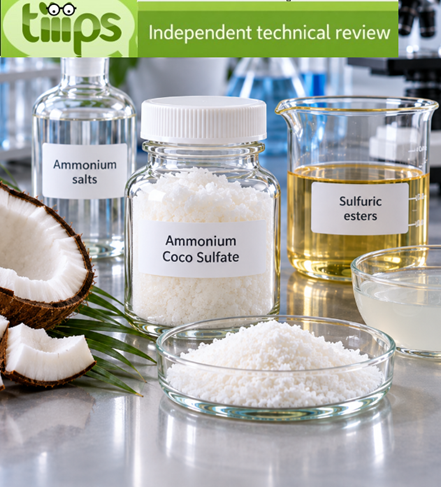
Ammonium Coco-Sulfate is an anionic surfactant consisting of a mixture of ammonium salts of sulfuric esters of fatty alcohols derived from the lipid fraction of coconut.
Its alkyl-chain distribution reflects the fatty alcohols present in the raw material and mainly includes medium- and long-chain homologues, with an important proportion of lauryl derivatives.
It is used primarily in cleansing products because of its strong ability to remove oils and dirt and generate foam.
No specific Cosmetics Regulation provisions are identified under Annexes II–VI of the EU Cosmetics Regulation.
Description
Ammonium Coco-Sulfate belongs to the family of alkyl sulfates.
Its general structure contains:
a long lipophilic hydrocarbon chain;
a strongly hydrophilic sulfate group;
ammonium as the counterion.
This amphiphilic structure allows the molecules to position themselves at the interface between water and oily substances, lowering surface tension and forming micelles that incorporate sebum, oils, and dirt.
Unlike a single defined chemical substance, Ammonium Coco-Sulfate is a mixture of homologues with different alkyl-chain lengths.
It should not be confused with:
Ammonium Lauryl Sulfate, composed mainly of ammonium lauryl sulfate;
Ammonium Laureth Sulfate, which contains ethylene oxide units;
Sodium Coco-Sulfate, in which sodium is the counterion;
“cocoyl” surfactants, which are generally derived from coconut fatty acids through different chemical structures.
Ammonium Coco-Sulfate is not an ethoxylated surfactant.
Manufacturing process
Production generally starts from a fraction of coconut fatty alcohols.
The process may include:
obtaining the lipid raw material;
converting fatty acids into fatty alcohols;
separating or standardizing the chain-length distribution;
sulfating the alcohols;
neutralizing with ammonia;
adjusting active-matter content;
purification;
drying or preparation of the commercial grade.
Industrial sulfation may be carried out using reagents such as sulfur trioxide, followed by neutralization of the acidic product with ammonia.
The finished raw material should be controlled particularly for:
unsulfated material;
residual fatty alcohols;
inorganic salts;
residual acidity or alkalinity;
active-matter content.
The term “coco” describes the fatty-alcohol distribution used in production and does not mean that the finished ingredient is simply coconut oil: it is a chemically transformed derivative.
Characteristic composition
The mixture contains ammonium salts of alkyl sulfates derived from coconut fatty alcohols.
It may contain mainly derivatives of:
lauryl alcohol;
myristyl alcohol;
caprylic/capric alcohols in smaller proportions;
cetyl alcohol;
other alcohols present in the natural coconut-derived distribution.
The relative proportions of individual homologues depend on the fatty-alcohol fraction selected by the manufacturer, so there is no universal percentage composition applicable to every commercial grade.
Identification data and specifications
| Characteristic | Value | Note |
|---|---|---|
| INCI name | Ammonium Coco-Sulfate | cosmetic ingredient name |
| Chemical definition | Sulfuric acid, coco alkyl mono-ester, ammonium salt | alkyl sulfate mixture |
| Chemical category | anionic surfactant / alkyl sulfate | mixture of homologues |
| Molecular formula | not applicable | mixture with different alkyl chains |
| Molecular weight | not applicable | varies according to the homologue |
| General structure | R–OSO₃⁻ NH₄⁺ | R represents coconut-derived alkyl chains |
| CAS | 90989-98-3 | mixture identifier |
| EC | 292-758-6 | European identifier |
| CosIng reference | 74390 | cosmetic ingredient reference |
| Cosmetic functions | Cleansing; Foaming; Surfactant – Cleansing; Surfactant – Emulsifying | documented functions |
| Current EU glossary | entry 1776 | AMMONIUM COCO-SULFATE |
| Cosmetics Regulation provisions | no specific provision identified | no specific Annex II–VI provision identified |
Indicative physicochemical properties
| Characteristic | Indicative value | Note |
|---|---|---|
| Commercial form | powder, granules, needles, paste, or solution | grade-dependent |
| Color | white to yellowish | depends on purity and formulation |
| Odor | weak, characteristic | variable |
| Water affinity | high | ionic surfactant |
| Charge | anionic | sulfate group |
| Foaming capacity | high | particularly in cleansing products |
| Cleansing power | high | effectively removes sebum and oils |
| Critical micelle behavior | dependent on chain-length distribution | multicomponent mixture |
| Electrolyte compatibility | formulation-dependent | salts can modify viscosity and micellar structure |
| Stability | generally good under normal cosmetic conditions | extreme pH and temperature require control |
Cosmetics
Ammonium Coco-Sulfate is used mainly in:
shampoos;
shower gels;
body cleansers;
facial cleansers;
liquid soaps;
bath products;
solid shampoos;
solid cleansers or syndets;
shaving products.
It is particularly useful when the formulation requires:
strong cleansing;
abundant foam;
easy rinsing;
effective sebum removal;
efficient micelle formation in aqueous systems.
In well-designed products, it is often combined with milder amphoteric or non-ionic surfactants to balance cleansing performance, foam, and tolerability.
Ammonium Coco-Sulfate and Sodium Coco-Sulfate
These two ingredients belong to the same chemical family.
The main difference is the counterion:
Ammonium Coco-Sulfate → NH₄⁺
Sodium Coco-Sulfate → Na⁺
Both remain anionic alkyl sulfates.
Changing sodium to ammonium can influence solubility and formulation behavior, but it does not mean that one is automatically milder than the other.
Tolerability depends mainly on:
active concentration;
composition of the surfactant mixture;
other surfactants present;
pH;
contact time;
overall formulation.
Comparison with Ammonium Laureth Sulfate
Ammonium Coco-Sulfate is a non-ethoxylated sulfate.
Ammonium Laureth Sulfate contains a polyoxyethylene chain introduced through ethoxylation.
This difference affects:
hydrophilic head-group size;
micellar behavior;
cleansing performance;
formulation compatibility;
irritation potential.
Because Ammonium Coco-Sulfate does not require ethoxylation, formation of 1,4-dioxane as an ethoxylation by-product is not an intrinsic feature of its manufacture.
General raw-material purity still requires appropriate control.
Pros
High cleansing power.
Produces abundant foam.
Effective at removing sebum and oily substances.
Suitable for both liquid and solid cleansing products.
Not ethoxylated.
Compatible with many cleansing systems.
Can be produced from fatty alcohols derived from a renewable vegetable source.
Has a favorable safety assessment within the relevant alkyl-sulfate group.
Cons
Can be irritating or drying, especially at high concentrations.
Excessive cleansing may remove part of the skin's surface lipids.
May increase scalp dryness in sensitive individuals.
Eye contact can be irritating.
Should not automatically be considered “mild” simply because it is coconut-derived.
It is not suitable for products marketed as sulfate-free.
Tolerability depends strongly on the complete formulation rather than on the INCI name alone.
Safety and tolerability
The principal issue is not systemic toxicity but the irritation potential typical of anionic cleansing surfactants.
Alkyl sulfates can interact with:
stratum-corneum proteins;
surface lipids;
cell membranes;
particularly when used at high concentrations or left in prolonged contact with the skin.
Possible effects include:
dryness;
tightness;
irritation;
eye stinging;
temporary disturbance of the skin barrier.
For this reason, Ammonium Coco-Sulfate is generally more appropriate in rinse-off products.
The presence of:
betaines;
amphoteric surfactants;
non-ionic surfactants;
conditioning polymers;
lipids;
humectants
can significantly modify the tolerability of the finished formulation.
It is therefore not scientifically appropriate to classify a cleanser as harsh or mild solely on the basis of the presence of Ammonium Coco-Sulfate.
CIR assessment
Ammonium Coco-Sulfate has been included in the Cosmetic Ingredient Review assessment of Sodium Cetearyl Sulfate and related alkyl sulfates.
The Expert Panel also considered data from structurally related substances and concluded that the evaluated ingredients, including Ammonium Coco-Sulfate, are safe in the practices and concentrations of use described in the assessment.
This conclusion should be interpreted in the context of its surfactant function: a cleansing product still needs to demonstrate adequate skin and eye tolerability as a finished formulation.
EU Cosmetics Regulation provisions
No specific:
Cosmetics Regulation provisions
are identified for Ammonium Coco-Sulfate under Annexes II–VI of Regulation (EC) No 1223/2009.
The ingredient is included in the current EU glossary as:
1776 – AMMONIUM COCO-SULFATE
The absence of a specific regulatory maximum does not mean that every use level is automatically appropriate. Concentration, use pattern, and tolerability of the finished formula must be considered in the safety assessment.
Raw-material control
For professional evaluation, it is advisable to obtain:
updated SDS;
Certificate of Analysis (COA);
technical data sheet;
active-matter content;
alkyl-chain distribution;
unsulfated material;
free fatty alcohols;
inorganic sulfates;
ammonium content;
pH;
water content;
color;
odor;
metals where relevant;
microbiological specifications for aqueous grades;
origin of the fatty alcohols;
residual solvents or process reagents where relevant;
stability data;
skin- and eye-irritation data.
When comparing commercial grades, the percentage of active matter is particularly important because products with the same INCI name may be supplied at very different concentrations.
Environment
Linear alkyl sulfates generally show good potential for biodegradation, although the actual environmental profile depends on the specific mixture and released concentration.
Relevant considerations include:
biodegradability;
aquatic toxicity of the concentrated raw material;
amount used;
wastewater treatment;
origin of the fatty alcohols;
energy and reagents used during sulfation.
Possible coconut-derived sourcing provides a renewable origin for the lipid chain, but this does not make the surfactant automatically free from environmental impact.
Conclusion
Ammonium Coco-Sulfate is a mixture of ammonium alkyl sulfates derived from coconut fatty alcohols, used mainly as a cleansing and foaming surfactant.
It is effective at removing sebum and generating foam, but, like other anionic alkyl sulfates, it can be drying or irritating when used in inadequately balanced formulations.
It has a favorable safety assessment under evaluated cosmetic conditions, and no specific Cosmetics Regulation provisions are identified in the European Union.
Ammonium Coco-Sulfate can be considered an effective surfactant with a favorable safety profile in properly formulated products, especially rinse-off formulations, with particular attention to active concentration, combination with other surfactants, pH, skin and eye irritation, purity, and overall raw-material quality.

