



Dendrobium Nobile Extract: properties, uses, pros, cons, safety
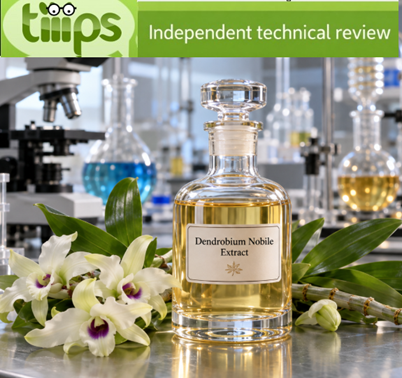
Dendrobium Nobile Extract is an extract of the whole plant of Dendrobium nobile Lindl., an orchid belonging to the family Orchidaceae, native to a broad Asian region extending from the Himalayas to southern China and Indochina.
It is a complex botanical extract that may contain, in proportions depending on the extraction process, polysaccharides, sesquiterpene alkaloids, phenolic compounds, bibenzyls, phenanthrenes, flavonoids, and other plant metabolites.
Its documented cosmetic function is Skin Conditioning.
No specific Cosmetics Regulation provisions are identified for the ingredient under Annexes II–VI of the EU Cosmetics Regulation.
Description
Dendrobium nobile is an epiphytic or lithophytic orchid with fleshy segmented stems, also widely cultivated as an ornamental plant.
The species has a long history of use in Asian traditional practices and has attracted considerable scientific interest because of its rich phytochemical profile.
The INCI definition refers to an extract of the whole plant. This is important because many phytochemical studies instead investigate:
stems;
leaves;
flowers;
specific fractions;
polysaccharide-enriched extracts;
alkaloid-enriched extracts.
Results obtained from one plant part or a purified fraction should therefore not automatically be attributed to every cosmetic Dendrobium Nobile Extract.
Manufacturing process
The process depends on the commercial grade and may include:
botanical identification;
selection and cleaning of the biomass;
drying;
grinding;
extraction with water, ethanol, hydroalcoholic mixtures, glycerin, glycols, or other suitable solvents;
filtration;
concentration;
optional deproteinization or fractionation;
purification;
standardization;
microbiological control;
stabilization of the raw material.
Aqueous extraction, including hot-water extraction, is frequently used to recover polysaccharides, while hydroalcoholic solvents may favor extraction of phenolic compounds, bibenzyls, and other less-polar metabolites.
Modern techniques may also include:
ultrasound-assisted extraction;
enzyme-assisted extraction;
microwave-assisted extraction;
chromatographic separation.
Solvent, temperature, and plant part strongly influence the final profile.
Main characteristic compounds
Among the most extensively studied phytochemical classes of Dendrobium nobile are:
polysaccharides composed of different combinations of monosaccharides;
sesquiterpene alkaloids, including dendrobine;
dendramines;
nobilonines;
other related alkaloids;
bibenzyls, including gigantol and related compounds;
phenanthrenes;
flavonoids;
phenolic compounds;
terpenoids.
The species is particularly known for dendrobine-type alkaloids, while numerous structurally distinct polysaccharides have also been described.
The composition of an ordinary cosmetic extract should not be confused with that of a concentrated pharmacological extract or purified fraction.
Identification data and specifications
| Characteristic | Value | Note |
|---|---|---|
| INCI name | Dendrobium Nobile Extract | cosmetic ingredient name |
| Definition | extract of the whole plant of Dendrobium nobile | botanical ingredient |
| Botanical name | Dendrobium nobile Lindl. | accepted species |
| Botanical family | Orchidaceae | orchid family |
| Order | Asparagales | botanical classification |
| Part used | whole plant | according to the INCI definition |
| Category | multicomponent botanical extract | complex mixture |
| Molecular formula | not applicable | not a single substance |
| Molecular weight | not applicable | contains numerous compounds |
| CAS | no specific unique identifier reliably assigned | botanical mixture |
| EC | not specifically assigned | botanical mixture |
| CosIng reference | 55726 | cosmetic ingredient reference |
| Cosmetic function | Skin Conditioning | documented function |
| Current EU glossary | entry 8331 | DENDROBIUM NOBILE EXTRACT |
| Cosmetics Regulation provisions | no specific provision identified | no specific Annex II–VI provision identified |
Indicative physicochemical properties
| Characteristic | Indicative value | Note |
|---|---|---|
| Commercial form | liquid, hydroglycolic extract, concentrate, or powder | supplier-dependent |
| Color | yellow, amber, or brown | concentration-dependent |
| Odor | characteristic botanical odor | variable |
| Solubility | dependent on solvent and grade | aqueous/hydroglycolic grades are generally compatible with water-based systems |
| pH | variable | verify TDS/COA |
| Dry matter | variable | important for comparing commercial grades |
| Oxidative stability | requires control | some phenolic constituents may oxidize |
| Light stability | requires control | depends on extract profile |
| Microbiological sensitivity | relevant in aqueous grades | appropriate preservation required |
| Compositional variability | high | typical of botanical extracts |
Cosmetics
Dendrobium Nobile Extract may be used in:
facial creams;
serums;
moisturizing products;
anti-aging products;
eye-area creams;
masks;
lotions;
after-sun products;
products for stressed skin;
hair and scalp formulations.
Its documented cosmetic role is to help maintain the skin in good condition.
Additional interest derives mainly from research on polysaccharides and phenolic compounds from the species, which have been investigated for possible effects on oxidative stress and photoaging.
Polysaccharides and photoaging
Specific Dendrobium nobile polysaccharides have been studied in human fibroblasts exposed to UVA radiation.
In experimental models, they have shown effects such as:
reduction of reactive oxygen species;
attenuation of UVA-induced cellular damage;
reduced activation of the JNK/c-Jun pathway;
reduced expression of matrix metalloproteinases;
better preservation of extracellular-matrix components.
These findings provide an interesting rationale for use in anti-aging-oriented formulations.
They should nevertheless be interpreted correctly: they concern specifically isolated polysaccharides studied mainly in vitro and do not demonstrate that every cosmetic extract produces the same clinical effect.
The ingredient is not a UV filter and cannot replace an authorized sunscreen.
Antioxidant and anti-inflammatory activity
Extracts and fractions of Dendrobium nobile have shown in experimental systems:
antioxidant activity;
modulation of inflammatory mediators;
cellular protection against oxidative stress;
effects on signaling pathways involved in cellular aging.
Animal studies have also reported favorable effects on skin-related parameters associated with oxidative stress and inflammation.
The species has additionally been investigated in experimental models of atopic dermatitis, in which certain extracts modulated cytokines and immune-cell responses.
These findings do not justify presenting Dendrobium Nobile Extract as a treatment for dermatitis, eczema, or other skin diseases.
Pros
Botanical ingredient with a documented Skin Conditioning function.
Rich and extensively studied phytochemical profile.
Polysaccharides from the species have shown interesting effects against UVA-induced damage in cellular models.
Specific fractions show experimental antioxidant activity.
Suitable for formulations intended for dry, stressed, or mature skin.
Hydroglycolic grades can be incorporated into aqueous formulations.
The plant can be cultivated, reducing dependence on wild harvesting.
Cons
It is a highly variable botanical extract.
The INCI name does not specify solvent, concentration, or degree of standardization.
Whole-plant composition may differ substantially from stem-only or other plant-part extracts.
Many biological effects derive from purified fractions or concentrated extracts.
Specific clinical evidence for ordinary cosmetic grades remains limited.
Biologically active alkaloids require adequate characterization in concentrated materials.
Specific skin-sensitization data are less extensive than for long-established cosmetic ingredients.
Botanical raw materials require pesticide, metal, and microbiological control.
Safety and regulation
The overall toxicological profile of experimentally studied Dendrobium nobile extracts appears relatively favorable, but data specifically addressing long-term cosmetic dermal exposure are less extensive than pharmacological and oral studies.
Safety should therefore be assessed using the actual commercial grade.
Alkaloids
Dendrobium nobile is particularly rich in sesquiterpene alkaloids, including dendrobine.
These compounds are biologically active and have been investigated mainly for neurological, anti-inflammatory, and antioxidant effects.
Their presence does not mean that an ordinary cosmetic extract is inherently toxic, but concentrated grades should ideally be characterized for:
total alkaloids;
dendrobine;
other selected markers where relevant.
An alkaloid-enriched material should not automatically be considered equivalent to a conventional diluted cosmetic extract.
Irritation and sensitization
Available information does not indicate a recurring major irritation concern, but specific dermatological documentation remains limited.
For leave-on products, commercial-grade testing may therefore usefully include:
skin irritation;
sensitization;
eye irritation where relevant;
phototoxicity where appropriate.
The absence of a well-established allergenic history does not prove that every extract is non-sensitizing.
EU Cosmetics Regulation provisions
No specific:
Cosmetics Regulation provisions
are identified for Dendrobium Nobile Extract under Annexes II–VI of Regulation (EC) No 1223/2009.
The ingredient is included in the current EU glossary as:
8331 – DENDROBIUM NOBILE EXTRACT
Glossary inclusion establishes the ingredient name for labeling but does not replace safety assessment of the finished cosmetic.
Raw-material control
For professional evaluation, it is advisable to obtain:
updated SDS;
Certificate of Analysis (COA);
technical data sheet;
botanical identification;
confirmation that the whole plant is used;
geographical origin;
cultivation or harvesting information;
extraction solvent;
plant-to-extract ratio;
actual extract percentage in the commercial raw material;
dry matter;
total polysaccharides where standardized;
total alkaloids;
dendrobine or another marker where relevant;
phenolic compounds where standardized;
chromatographic profile;
pesticide analysis;
metals;
residual solvents;
microbiological specifications;
preservative system;
pH;
stability data;
irritation and sensitization data.
For liquid grades, it is particularly important to distinguish between the percentage of commercial raw material added to a formulation and the actual amount of botanical extract it contains.
Sustainability and CITES
Dendrobium nobile belongs to the Orchidaceae, a family subject to important international wildlife-trade controls.
The species is included in CITES Appendix II, which regulates international trade to prevent exploitation from becoming incompatible with the conservation of wild populations.
For a cosmetic raw material, important points therefore include:
origin from controlled cultivation;
traceability;
CITES documentation where applicable;
absence of illegal wild harvesting;
preference for artificially propagated biomass.
The species is now widely cultivated, but wild collection has historically placed pressure on natural populations in parts of Asia.
Environment
The environmental profile also depends on:
cultivation system;
water consumption;
fertilizers;
pesticides;
drying;
extraction solvent;
solvent recovery;
energy required for concentration and purification;
management of residual biomass.
Extracts produced from cultivated plants and fully traceable supply chains are preferable to material of undocumented wild origin.
Conclusion
Dendrobium Nobile Extract is an extract of the whole plant of Dendrobium nobile Lindl., family Orchidaceae, used in cosmetics as a Skin Conditioning ingredient.
The species has an interesting phytochemical profile, characterized especially by polysaccharides, sesquiterpene alkaloids, and phenolic compounds. Specific fractions have shown antioxidant, anti-inflammatory, and protective effects in experimental photoaging models, but much of the evidence remains preclinical.
No specific Cosmetics Regulation provisions are identified for the ingredient.
Dendrobium Nobile Extract can be considered an interesting and generally favorable cosmetic ingredient when the commercial grade is adequately standardized and traceable, with particular attention to extraction solvent, actual extract concentration, polysaccharide and alkaloid markers, pesticides, metals, microbiological quality, skin tolerability, and sourcing compliant with the conservation and trade requirements applicable to the species.

