



Beta-Caryophyllene: properties, uses, pros, cons, safety
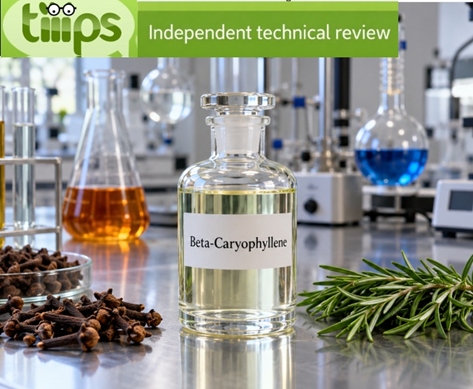
Beta-Caryophyllene (β-caryophyllene) is a bicyclic sesquiterpene naturally present in the essential oils and aromatic fractions of many plants, including clove, black pepper, hops, rosemary, and copaiba.
It is a volatile terpene hydrocarbon with a woody, spicy, dry, slightly clove-like odor. In cosmetics, it is used mainly as a fragrance component and for skin conditioning.
Its documented cosmetic functions are Fragrance, Perfuming, and Skin Conditioning.
Beta-Caryophyllene is also a regulated fragrance allergen in the European Union and is subject to the specific Cosmetics Regulation provision III/332.
Description
Beta-Caryophyllene belongs to the sesquiterpene family, compounds built from three isoprene units and containing a total of 15 carbon atoms.
Its characteristic structure includes:
a nine-membered ring;
a cyclobutane ring;
two double bonds;
several methyl groups.
This bicyclic structure distinguishes it from many linear terpenes found in essential oils.
The most common natural material corresponds predominantly to trans-(E)-β-caryophyllene.
It should not be confused with:
Caryophyllene Oxide, an oxidized epoxide derivative;
α-humulene, another sesquiterpene frequently present in the same essential oils;
generic mixtures described simply as “caryophyllene”.
The INCI name specifically identifies BETA-CARYOPHYLLENE.
Origin and production
Beta-Caryophyllene can be obtained:
by isolation from essential oils;
through fractional distillation;
by purification of terpene fractions;
through synthetic or semisynthetic processes.
Natural sources may include essential oils rich in β-caryophyllene, such as those derived from:
clove;
copaiba;
black pepper;
hops;
rosemary;
cinnamon;
various aromatic species.
Industrial processing may include:
distillation of the essential oil;
fractionation;
concentration of the sesquiterpene fraction;
vacuum distillation;
purification;
GC or GC-MS control;
standardization;
packaging under conditions that limit oxidation.
Commercial grades may consist of high-purity Beta-Caryophyllene or of a fraction containing small amounts of other C₁₅ terpene hydrocarbons.
Identification data and specifications
| Characteristic | Value | Note |
|---|---|---|
| INCI name | Beta-Caryophyllene | cosmetic ingredient name |
| Synonyms | β-Caryophyllene; trans-Caryophyllene; (E)-β-Caryophyllene | commonly used names |
| Chemical name | (1R,4E,9S)-4,11,11-Trimethyl-8-methylenebicyclo[7.2.0]undec-4-ene | stereochemical denomination |
| Chemical category | bicyclic sesquiterpene | terpene hydrocarbon |
| Molecular formula | C₁₅H₂₄ | defined substance |
| Molecular weight | 204.35 g/mol | molecular value |
| CAS | 87-44-5 | principal identifier |
| EC | 201-746-1 | European identifier |
| CosIng reference | 54743 | cosmetic ingredient reference |
| Cosmetic functions | Fragrance; Perfuming; Skin Conditioning | documented functions |
| Current EU glossary | entry 3319 | BETA-CARYOPHYLLENE |
| Cosmetics Regulation provisions | III/332 | fragrance allergen |
| Leave-on declaration threshold | > 0.001% | finished product |
| Rinse-off declaration threshold | > 0.01% | finished product |
Indicative physicochemical properties
| Characteristic | Indicative value | Note |
|---|---|---|
| Physical state | oily liquid | at room temperature |
| Color | colorless to very pale yellow | purity-dependent |
| Odor | woody, spicy, dry, clove-like | characteristic |
| Water solubility | practically insoluble | hydrocarbon structure |
| Solubility in oils | high | typical of lipophilic terpenes |
| Solubility in ethanol | good | useful in perfumery |
| Boiling point | approximately 256 °C | indicative value |
| Relative density | approximately 0.899–0.908 | grade-dependent |
| Refractive index | approximately 1.498–1.504 | quality-control parameter |
| Volatility | moderate | lower than lighter monoterpenes |
| Stability in air | limited | subject to autoxidation |
| Light and heat stability | requires control | prolonged exposure promotes degradation |
Cosmetics
Beta-Caryophyllene may be present in:
perfumes;
eau de parfum;
eau de toilette;
deodorants;
creams;
lotions;
cosmetic oils;
cleansers;
shampoos;
conditioners;
shaving products;
body-care products;
formulations containing essential oils.
From an olfactory standpoint, it is used mainly to provide or reinforce:
woody;
spicy;
balsamic;
dry;
warm notes.
It may also be introduced indirectly through essential oils or aromatic extracts containing significant amounts of it.
For regulatory purposes, the total concentration must therefore include all sources present in the finished product, not only Beta-Caryophyllene added as an isolated substance.
Experimental biological activities
Beta-Caryophyllene has been extensively studied beyond perfumery.
A particularly well-known characteristic is its interaction with the cannabinoid CB2 receptor. Experimental models have investigated possible:
anti-inflammatory;
antioxidant;
analgesic;
antimicrobial;
tissue-repair-modulating
effects.
Its cannabinoid-related activity is mainly associated with CB2, and does not imply the psychoactive effects typically linked to CB1 activation.
Dermatological and preclinical studies have also explored possible topical roles in:
skin inflammation;
wound healing;
acne;
barrier alterations;
oxidative stress.
However, the evidence remains largely preclinical and does not make Beta-Caryophyllene an authorized dermatological active ingredient.
In ordinary cosmetics, its documented cosmetic functions remain the relevant regulatory functions, while deeper pharmacological effects require separate evidence.
Oxidation
Oxidation is one of the most important quality issues for this raw material.
Beta-Caryophyllene can react with atmospheric oxygen and generate several oxidation products. One of the main products is:
Caryophyllene Oxide
which is chemically distinct from the parent substance.
During autoxidation, prolonged exposure to air progressively reduces Beta-Caryophyllene content and increases oxidized derivatives.
This is relevant to:
odor quality;
stability;
purity;
skin tolerability.
The raw material should therefore preferably be stored in tightly closed containers protected from air, light, and heat.
Skin sensitization
Beta-Caryophyllene is recognized as a fragrance contact allergen.
Its sensitizing potential may also be influenced by oxidation.
Caryophyllene Oxide, which can form during aging of the raw material, has shown experimental sensitizing activity, while air-oxidized Beta-Caryophyllene may have a less favorable allergenic profile than fresh material.
This makes the following particularly important:
initial purity;
age of the raw material;
storage conditions;
oxidation control.
The presence of the ingredient does not mean that a product will necessarily cause allergy, but previously sensitized individuals may react at relatively low concentrations.
EU Cosmetics Regulation provisions
Beta-Caryophyllene is subject to:
Cosmetics Regulation provision III/332
The provision concerns:
(1R,4E,9S)-4,11,11-Trimethyl-8-methylenebicyclo[7.2.0]undec-4-ene – Beta-Caryophyllene
and requires the substance to be declared individually in the ingredient list when its concentration in the finished product exceeds:
0.001% in leave-on products;
0.01% in rinse-off products.
The provision does not establish a general maximum concentration of use. It is primarily an individual labeling requirement related to contact-allergy risk.
From 1 August 2026, newly placed products on the EU market must comply with this requirement.
Products that were already placed on the market by 31 July 2026 may continue to be made available until 31 July 2028.
Food use
Beta-Caryophyllene is also used as a flavoring substance.
Main identifiers include:
FLAVIS 01.007;
JECFA 1324;
FEMA 2252.
It has been evaluated for food-flavor use without safety concern at current levels of intake.
Food use should nevertheless be distinguished from cosmetic use, where the key specific issue is skin sensitization and fragrance-allergen declaration.
Pros
Provides a distinctive woody and spicy fragrance note.
Naturally occurs in many essential oils.
Can be used in perfumery and many cosmetic categories.
Is chemically well defined and readily monitored by GC.
Has good compatibility with oils and ethanol.
Shows interesting experimental biological activities.
Does not produce cannabinoid-like psychoactive effects associated mainly with CB1.
Is also used as a food flavoring substance.
Cons
It is a recognized contact allergen.
It is subject to the specific Cosmetics Regulation provision III/332.
It must be declared individually above the applicable regulatory thresholds.
It can autoxidize during storage.
Oxidation products may increase sensitization concerns.
It is practically insoluble in water.
Experimental anti-inflammatory or dermatological effects do not equal proven clinical efficacy.
Total exposure from essential oils and fragrance mixtures must be included in regulatory calculations.
Safety
The main point of caution is contact sensitization, rather than a particular systemic toxicity concern at normal cosmetic concentrations.
Safety depends on:
concentration in the product;
frequency of use;
formulation type;
leave-on or rinse-off exposure;
oxidation status;
presence of other fragrance allergens;
individual sensitization.
Raw-material quality control is therefore especially important in:
leave-on products;
frequently applied products;
facial products;
formulations for sensitive skin;
products containing high levels of essential oils.
Raw-material control
For professional evaluation, it is advisable to obtain:
updated SDS;
Certificate of Analysis (COA);
technical data sheet;
Beta-Caryophyllene assay;
GC or GC-MS profile;
stereochemical identity;
other terpenes present;
Caryophyllene Oxide;
oxidation products;
acid value;
density;
refractive index;
color;
odor;
natural or synthetic origin;
residual solvents where relevant;
stability data;
production date;
storage conditions;
documentation of compliance with III/332.
When the substance is supplied through essential oils or fragrance compounds, the actual percentage of Beta-Caryophyllene in each raw material should also be known in order to calculate the final concentration correctly.
Environment
Beta-Caryophyllene is a terpene naturally produced by many plant species and can be naturally emitted into the atmosphere by vegetation.
Its industrial environmental profile depends on:
raw-material origin;
cultivation of aromatic plants;
distillation;
energy use;
solvents where applicable;
purification;
transport;
process-water treatment.
Production from residual fractions of the essential-oil industry may improve biomass valorization.
Its plant origin does not, however, mean that concentrated discharges should be considered environmentally harmless.
Conclusion
Beta-Caryophyllene is a natural bicyclic sesquiterpene used in cosmetics mainly for its woody and spicy fragrance profile and as a skin-conditioning ingredient.
It is also scientifically interesting because of its interaction with the CB2 receptor and several experimental biological activities, but dermatological evidence remains predominantly preclinical.
The main point of caution is skin sensitization, particularly in relation to oxidation of the substance.
It is subject to the specific Cosmetics Regulation provision III/332 and must be declared individually when present above 0.001% in leave-on products or 0.01% in rinse-off products.
Beta-Caryophyllene can be considered a useful cosmetic ingredient, but one that requires caution because of its sensitization profile, with particular attention to total concentration, oxidation status, purity, Caryophyllene Oxide content, correct storage, and compliance with the labeling requirement under III/332.

