



Hydrolyzed Pearl: properties, uses, pros, cons, safety
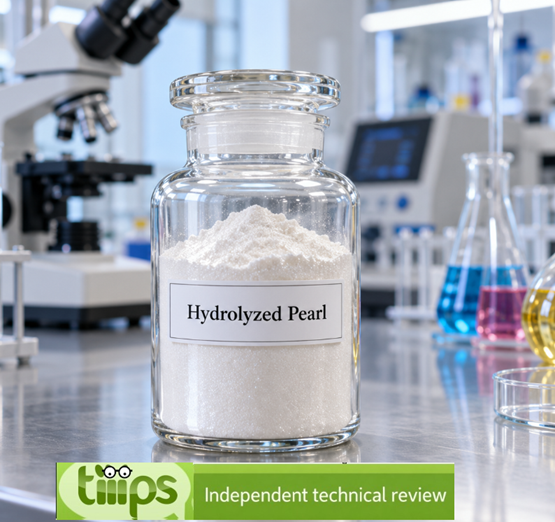
Hydrolyzed Pearl is the hydrolysate of natural pearl, a biomineral material produced by pearl-forming mollusks. Hydrolysis makes components of the pearl's organic matrix more accessible, particularly by breaking proteins into smaller peptides and amino acids that are more readily dispersed or solubilized.
The original pearl is composed predominantly of crystalline calcium carbonate, together with a small but complex organic matrix containing proteins, glycoproteins, and other constituents.
Its documented cosmetic function is Skin Conditioning.
No specific Cosmetics Regulation provisions are identified under Annexes II–VI of the EU Cosmetics Regulation.
Description
Pearls are produced by certain mollusks through the progressive deposition of mineral and organic layers.
Pearl structure consists mainly of:
calcium carbonate, predominantly in the form of aragonite;
organic matrix proteins;
glycoproteins;
peptides;
amino acids;
polysaccharides and other minor organic components;
trace elements in variable amounts.
The protein fraction is sometimes generically described as conchiolin, although this term actually encompasses several structural and biomineralization-related proteins.
Hydrolyzed Pearl should be distinguished from:
Pearl Powder;
Pearl Extract;
Hydrolyzed Mother of Pearl Extract;
mother-of-pearl powder;
simple Calcium Carbonate.
Hydrolysis produces a material with a greater proportion of solubilized organic components than simple micronized pearl.
Manufacturing process
Manufacturing can vary considerably between suppliers.
In general, it may include:
selection of pearls;
washing;
grinding or micronization;
pretreatment to facilitate access to the organic matrix;
acid, alkaline, or enzymatic hydrolysis;
separation of insoluble material;
neutralization where required;
filtration;
concentration;
optional ultrafiltration;
purification;
drying or freeze-drying;
standardization of the commercial grade.
Enzymatic hydrolysis can break proteins into smaller peptides under relatively controlled conditions.
Acid processing can also alter or solubilize part of the mineral fraction. Consequently, the final proportions of:
calcium;
carbonates;
peptides;
amino acids
can differ substantially between commercial materials.
The INCI name alone therefore does not define the quantitative composition of the hydrolysate.
Characteristic components
The hydrolyzed organic fraction may contain:
peptides derived from pearl-matrix proteins;
free amino acids;
glycopeptides;
other small organic constituents generated during hydrolysis.
Numerous amino acids have been identified in pearl material, including glycine, alanine, serine, aspartic acid, leucine, and phenylalanine, with profiles varying according to mollusk species and origin.
Specific seawater pearl hydrolysates have also been shown to contain numerous matrix proteins associated with biomineralization and calcium binding.
The residual mineral fraction depends strongly on manufacturing and should not be assumed to be constant.
Identification data and specifications
| Characteristic | Value | Note |
|---|---|---|
| INCI name | Hydrolyzed Pearl | cosmetic ingredient name |
| Definition | Hydrolysate of pearl | pearl-derived hydrolysate |
| Origin | mollusk biomineral | generally animal-derived |
| Category | natural multicomponent hydrolysate | variable peptides, amino acids, and mineral components |
| Molecular formula | not applicable | complex mixture |
| Molecular weight | not applicable | distribution of peptides and other constituents |
| CAS | no specific CAS assigned to the CosIng entry | avoid identifiers belonging to individual components |
| EC | no specific EC number assigned | mixture |
| CosIng reference | 34447 | cosmetic ingredient reference |
| Cosmetic function | Skin Conditioning | documented function |
| EU glossary | HYDROLYZED PEARL | recognized common ingredient name |
| Cosmetics Regulation provisions | no specific provision identified | no specific Annex II–VI provision identified |
Indicative physicochemical properties
| Characteristic | Indicative value | Note |
|---|---|---|
| Commercial form | powder, solution, or concentrate | supplier-dependent |
| Color | white, cream, or very pale yellow | variable |
| Odor | weak or characteristic | process-dependent |
| Water solubility/dispersibility | greater than non-hydrolyzed pearl | depends on degree of hydrolysis |
| Peptide content | variable | grade-specific parameter |
| Mineral content | variable | depends on separation of the calcium-rich fraction |
| pH | commercial-grade dependent | important after hydrolysis and neutralization |
| Volatility | negligible | non-volatile material |
| Stability | dependent on water content, pH, temperature, and preservation system | verify supplier specifications |
Cosmetics
Hydrolyzed Pearl may be used in:
facial creams;
serums;
eye-area products;
masks;
moisturizing products;
brightening formulations;
anti-aging products;
after-sun products;
shampoos;
conditioners;
hair-care products.
Its most plausible cosmetic effects arise mainly from peptides, amino acids, and other water-compatible components that can contribute to skin softness and superficial conditioning.
Depending on the commercial grade, it may also contribute to sensory properties and superficial moisturization.
Research on photoaging
Specific seawater pearl hydrolysates have been investigated in experimental models of UVA- and UVB-induced skin damage.
In cellular systems, selected hydrolysates have shown:
reduced formation of reactive oxygen species;
increased activity of cellular antioxidant systems;
reduced oxidative-stress markers;
lower apoptosis following UVA or UVB exposure;
reduced MMP-1 expression in UVA-irradiated fibroblasts;
better preservation of collagen I in the cellular models studied;
modulation of pathways involved in autophagy and stress response.
These findings indicate an interesting research potential in photoaging, but they concern specific hydrolysates and predominantly in vitro models.
They do not demonstrate that every Hydrolyzed Pearl:
clinically prevents photoaging;
stimulates dermal collagen in humans;
protects the skin as a sunscreen;
automatically increases SPF.
Hydrolyzed Pearl is not an authorized UV filter and cannot replace approved sunscreen filters.
Pros
Provides peptides and amino acids derived from the pearl organic matrix.
Hydrolysis improves the formulation availability of the organic fraction compared with untreated pearl.
Can contribute to skin conditioning and softness.
Specific hydrolysates have shown antioxidant activity in cellular models.
Recent studies have investigated UVA- and UVB-related effects.
Can be incorporated into several skin-care and hair-care categories.
Depending on the supply chain, it may allow cosmetic use of pearls unsuitable for ornamental applications.
Cons
Composition can vary considerably according to origin and hydrolysis process.
The INCI name does not indicate peptide, calcium, or amino-acid content.
Evidence for anti-photoaging activity remains mainly preclinical.
It should not be presented as a UV filter.
It is generally not compatible with vegan product positioning.
Marine- or aquaculture-derived raw materials require contaminant control.
Acid or alkaline hydrolysis requires careful control of process residues and neutralization.
Residual proteins and peptides require appropriate tolerability assessment.
No universal maximum cosmetic concentration has been specifically established for this INCI.
Safety and regulation
No specific SCCS or CIR assessment dedicated exclusively to Hydrolyzed Pearl has been identified that establishes a universal maximum concentration.
Safety should therefore be assessed using the actual commercial grade.
Biological origin
Pearls are produced by mollusks, so Hydrolyzed Pearl should generally be regarded as an animal-derived ingredient, unless specific documentation demonstrates a different production technology.
The raw material should not be equated with mollusk muscle proteins.
Major food allergens of mollusks, such as tropomyosin, are not necessarily representative of the proteins found in the pearl matrix. However, it would also be inappropriate to assume that every grade is completely free from potentially immunoreactive proteins without analytical evidence.
For products intended for particularly sensitive individuals, useful information may therefore include:
residual protein content;
peptide-size distribution;
irritation data;
sensitization data.
Metals and contaminants
Biomineralization can incorporate traces of elements present in the aquatic environment.
Cosmetic-grade material should therefore be appropriately controlled for:
lead;
cadmium;
mercury;
arsenic;
other elements relevant to the farming or collection area.
The geographical origin of the pearl and the quality of the cultivation water are therefore important parameters.
EU Cosmetics Regulation provisions
No specific:
Cosmetics Regulation provisions
are identified for Hydrolyzed Pearl under Annexes II–VI of Regulation (EC) No 1223/2009.
The name HYDROLYZED PEARL is included in the European cosmetic ingredient glossary.
The absence of a specific Annex provision does not mean that every grade or concentration is automatically safe. Safety assessment of the finished cosmetic product remains necessary.
Raw-material control
For professional evaluation, it is advisable to obtain:
- updated SDS;
- Certificate of Analysis (COA);
- technical data sheet;
- species or origin of the pearls;
- seawater or freshwater pearl source;
- hydrolysis method;
- solvents and reagents used;
- degree of hydrolysis;
- protein/peptide content;
- peptide molecular-weight distribution where available;
- free amino acids;
- calcium and other minerals;
- dry matter;
- pH;
- residual acids or alkalis;
- residual enzymes where relevant;
- metals;
- microbiological specifications;
- preservation system for liquid grades;
- stability data;
- irritation and sensitization data.
It is particularly important to determine the actual concentration of Hydrolyzed Pearl in liquid commercial raw materials, which may consist predominantly of water, glycols, glycerin, or other carriers.
Environment
The environmental profile depends mainly on the source of the pearls and the subsequent processing method.
Relevant factors include:
- mollusk aquaculture;
- water quality;
- impact on aquatic ecosystems;
- energy consumption;
- chemical or enzymatic treatment;
- water use;
- neutralization of processing solutions;
- management of mineral residues;
- wastewater treatment.
Cosmetic utilization of pearls unsuitable for jewelry may represent a form of raw-material valorization, but the environmental benefit depends on the actual supply chain.
Conclusion
Hydrolyzed Pearl is a hydrolysate of natural pearl in which processing makes peptides, amino acids, and other components of the pearl organic matrix more accessible for cosmetic formulation.
Its documented cosmetic function is Skin Conditioning.
Recent studies on specific seawater pearl hydrolysates have produced interesting results in cellular models of UVA- and UVB-induced photoaging, but these findings remain predominantly in vitro and do not make the ingredient a sunscreen or a clinically proven dermatological active.
No specific Cosmetics Regulation provisions are identified for the ingredient.
Hydrolyzed Pearl can be considered an interesting and generally favorable cosmetic ingredient when the commercial grade is well characterized, with particular attention to pearl origin, hydrolysis method, actual peptide and amino-acid content, process residues, metals, microbiological quality, tolerability, and the effective concentration of the hydrolysate in the commercial raw material.

