



Glycosphingolipids: properties, uses, pros, cons, safety
Glycosphingolipids are a family of complex lipids consisting of a sphingolipid component, generally based on ceramide, covalently linked to a carbohydrate group.
They are amphiphilic molecules, with a hydrophobic lipid portion and a more hydrophilic sugar-containing head group. They occur naturally in the cell membranes of animals, plants, and fungi and comprise many different molecular species.
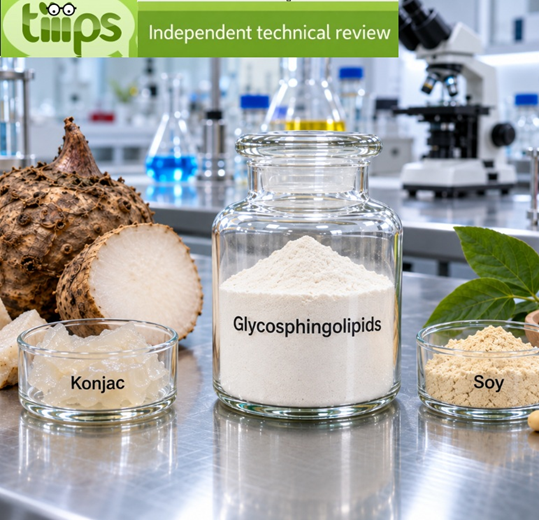
In cosmetics, they are used mainly for skin conditioning and emollient action, with particular interest in formulations designed for dry skin and support of the skin barrier.
No specific Cosmetics Regulation provisions are identified under Annexes II–VI of the EU Cosmetics Regulation.
Description
The basic structure generally includes:
a sphingoid base;
a fatty acid linked through an amide bond, forming the ceramide portion;
one or more sugars attached to the lipid structure.
The simplest glycosphingolipids include:
glucosylceramides (GlcCer), containing glucose;
galactosylceramides (GalCer), containing galactose.
More complex structures may contain several carbohydrate units or charged groups.
In plant-derived cosmetic materials, glucosylceramides are particularly important and may be obtained from cereals and other botanical sources.
The INCI name Glycosphingolipids does not specify:
biological origin;
type of carbohydrate;
sphingoid base;
fatty-acid profile;
chain length;
purity;
actual proportion of individual glycosphingolipids.
Commercial raw materials bearing the same INCI name may therefore have substantially different lipid profiles.
Manufacturing process
Cosmetic glycosphingolipids may be obtained from several sources.
Plant-derived raw materials rich in glucosylceramides may include, depending on the manufacturer:
rice;
corn;
wheat;
soybean;
konjac;
other sphingolipid-rich botanical materials.
Fungal and biotechnology-derived sources are also possible.
Production may include:
preparation of the biomass;
drying and grinding;
extraction of the lipid fraction;
removal of unwanted lipids;
fractionation;
concentration of the sphingolipid fraction;
purification;
optional chromatography;
removal of solvents;
standardization;
analytical control by HPLC, LC-MS, or equivalent techniques.
The quality of the ingredient depends largely on the ability to separate the target fraction from triglycerides, phospholipids, sterols, fatty acids, and other accompanying lipids.
Main types present in cosmetic grades
Depending on the source, cosmetic fractions may contain:
glucosylceramides;
other monoglycosylceramides;
oligoglycosylceramides;
variable amounts of free ceramides;
sphingoid bases;
associated minor lipids.
In plant glucosylceramides, both the sphingoid base and fatty-acid composition may differ significantly from the ceramide species predominant in human stratum corneum.
Plant-derived glycosphingolipids should therefore not automatically be described as identical to human skin ceramides.
Identification data and specifications
| Characteristic | Value | Note |
|---|---|---|
| INCI name | Glycosphingolipids | cosmetic ingredient name |
| Definition | sphingolipids containing a carbohydrate group covalently linked to the sphingolipid structure | lipid family |
| Chemical category | glycolipids / glycosylated sphingolipids | mixture of molecular species |
| Molecular formula | not applicable | depends on the individual glycosphingolipid |
| Molecular weight | not applicable | broad distribution of molecular species |
| CAS | no single CAS adequately represents the entire INCI family | avoid using the CAS of one individual species |
| EC | no single specific number for the complete family | composition-dependent |
| CosIng reference | 76480 | cosmetic ingredient reference |
| Cosmetic functions | Skin Conditioning; Skin Conditioning – Emollient | documented functions |
| Current EU glossary | entry 11345 | GLYCOSPHINGOLIPIDS |
| Cosmetics Regulation provisions | no specific provision identified | no specific Annex II–VI provision identified |
Indicative physicochemical properties
| Characteristic | Indicative value | Note |
|---|---|---|
| Nature | amphiphilic lipids | lipid portion + carbohydrate group |
| Commercial form | powder, dispersion, or lipid concentrate | supplier-dependent |
| Color | white, cream, or yellowish | purity-dependent |
| Water solubility | generally low | may be dispersible in suitable systems |
| Affinity for lipid phases | high | related to the ceramide portion |
| Self-organization ability | significant | typical of amphiphilic lipids |
| Volatility | negligible | relatively high molecular mass |
| Oxidative sensitivity | variable | depends on the degree of unsaturation |
| Heat stability | requires control | excessive heat may alter the material |
| Formulation compatibility | system-dependent | appropriate dispersion is important |
Cosmetics
Glycosphingolipids are particularly suitable for:
moisturizing creams;
barrier-support creams;
lipid serums;
emulsions for dry skin;
anti-aging products;
products for sensitive skin;
masks;
lip products;
formulations containing ceramides, cholesterol, and fatty acids.
Their cosmetic interest is closely related to the biochemical connection between glycosphingolipids and ceramides.
Relationship with the skin barrier
In the epidermis, glucosylceramides are important metabolic precursors of ceramides.
During formation of the stratum corneum, lipids secreted by lamellar bodies undergo enzymatic processing. In particular, β-glucocerebrosidase removes glucose from glucosylceramides, generating ceramides that contribute to the extracellular lipid matrix.
Together with:
cholesterol;
free fatty acids;
ceramides form lamellar structures that reduce water loss and support barrier function.
This physiological relationship makes glycosphingolipids scientifically interesting in formulations designed for dry or barrier-impaired skin.
It is nevertheless important to distinguish between:
the physiological role of epidermally produced glycosphingolipids
and
the effect of glycosphingolipids applied topically in a cosmetic.
Topical application does not automatically mean that the applied material will be converted into ceramides and incorporated into the barrier in the same way as endogenous epidermal precursors.
Evidence relating to the skin barrier
The importance of ceramides in skin-barrier function is well established, as is the benefit of certain formulations combining ceramides, cholesterol, and fatty acids in suitable proportions.
For Glycosphingolipids as a specific INCI, independent clinical evidence is less extensive.
Research on plant- and fungal-derived glucosylceramides suggests potential benefits for hydration and skin-lipid metabolism, but these findings should not be generalized to every commercial raw material carrying the INCI name Glycosphingolipids.
Performance depends on:
molecular species present;
purity;
concentration;
delivery system;
emulsion structure;
accompanying lipids;
dispersion quality.
Importance of formulation
The addition of ceramide-related lipids alone does not guarantee improvement of barrier function.
The lipids must be:
properly solubilized or dispersed;
mutually compatible;
present in suitable ratios;
correctly organized within the formulation.
Poor dispersion can substantially reduce performance.
For Glycosphingolipids, formulation quality is therefore at least as important as the ingredient name itself.
Pros
Biochemically related to ceramide metabolism.
Particularly interesting in formulations for dry skin and barrier support.
Can contribute to softness and skin comfort.
Can be combined rationally with ceramides, cholesterol, and fatty acids.
Plant-derived and biotechnology-derived grades are available.
Negligible volatility.
Suitable for advanced formulations inspired by stratum-corneum lipid physiology.
Cons
The INCI represents a highly heterogeneous family, not a single molecule.
Origin and detailed composition cannot be determined from the name alone.
Plant-derived species are not necessarily identical to human skin ceramides.
Clinical evidence for the generic INCI is less extensive than that available for ceramides.
Poor dispersion may reduce performance.
Commercial grades may contain very different percentages of active glycosphingolipids.
Plant-derived materials require control of contaminants and process residues.
Unsaturated lipid species may be susceptible to oxidation.
Therapeutic claims for dermatitis, eczema, or other skin diseases are not justified solely by the presence of this ingredient.
Safety and regulation
Glycosphingolipids are naturally occurring components of biological membranes, but the INCI encompasses materials with different compositions. Safety should therefore be assessed using the specific commercial grade.
No specific SCCS or CIR assessment dedicated exclusively to the generic INCI Glycosphingolipids has been identified that establishes a universal maximum cosmetic concentration.
The broader scientific literature on ceramides and related sphingolipids generally supports a favorable topical profile, but this should not be used to assume identical safety for every glycosphingolipid mixture.
Skin penetration
Many glycosphingolipids are relatively large amphiphilic molecules.
Systemic penetration of intact molecules through a normal skin barrier is therefore expected to be limited compared with small lipophilic molecules.
Their expected cosmetic activity is mainly associated with:
the skin surface;
the stratum corneum;
interactions with superficial epidermal lipids.
Claims involving deeper biological effects require specific supporting data.
Raw-material origin
The source should be known because it may influence:
molecular profile;
impurities;
residual proteins;
allergens;
pesticides;
solvents;
microbiological contaminants.
For ingredients obtained from food sources such as wheat or soybean, the purified lipid fraction should not automatically be treated as equivalent to the allergenic protein fraction. However, in less-purified materials, control of residual proteins is appropriate.
EU Cosmetics Regulation provisions
No specific:
Cosmetics Regulation provisions
are identified for Glycosphingolipids under Annexes II–VI of Regulation (EC) No 1223/2009.
The ingredient appears in the current EU glossary as:
11345 – GLYCOSPHINGOLIPIDS
The absence of a specific restriction does not remove the requirement for safety assessment of the raw material and finished cosmetic product.
Raw-material control
For professional evaluation, it is advisable to obtain:
updated SDS;
Certificate of Analysis (COA);
technical data sheet;
biological origin;
extraction or fermentation process;
actual glycosphingolipid content;
glucosylceramide content;
sphingoid-base profile;
fatty-acid profile;
free ceramides;
other associated lipids;
purity;
water content;
peroxide value or other appropriate oxidation parameters;
residual solvents;
pesticide data for plant-derived grades;
residual proteins where relevant;
metals;
microbiological specifications;
stability data;
storage conditions;
irritation and sensitization data.
It is particularly important to know the actual percentage of Glycosphingolipids in the commercial raw material, since some products may be supplied as dispersions or lipid complexes containing only a limited proportion of the active fraction.
Environment
The environmental profile depends strongly on the source.
For plant-derived materials, relevant factors include:
cultivation;
water consumption;
fertilizers and pesticides;
extraction;
solvents;
purification.
For fermentation-derived materials, important factors include:
fermentation substrates;
energy;
water consumption;
separation and purification;
management of residual biomass.
The use of plant by-products or biotechnology may offer environmental advantages, but sustainability should be demonstrated for the actual production process.
Conclusion
Glycosphingolipids are a family of glycolipids composed of a sphingolipid component linked to one or more sugars. In cosmetics, they are used mainly for skin conditioning and emollient support, particularly in formulations designed for dry skin and the skin barrier.
Their scientific interest is well founded because epidermal glucosylceramides are precursors of the ceramides that form an essential part of the stratum-corneum lipid matrix. This does not mean, however, that every topically applied glycosphingolipid will automatically be converted and used by the skin in the same way.
No specific Cosmetics Regulation provisions are identified for the ingredient.
Glycosphingolipids can be considered generally favorable cosmetic ingredients and particularly interesting in formulations for dry skin and barrier support, provided that the commercial grade is adequately characterized. The main parameters to verify are origin, actual glucosylceramide/glycosphingolipid content, lipid profile, purity, oxidation, extraction residues, possible residual proteins, and the quality of the formulation used to deliver them.

