



Polyglyceryl-3 Betainate Citrate: properties, uses, pros, cons, safety
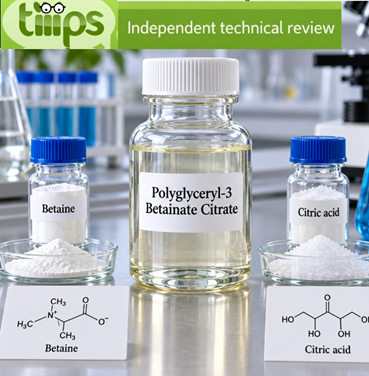
Polyglyceryl-3 Betainate Citrate is a relatively recent cosmetic ingredient obtained by esterifying Polyglycerin-3 with Betaine, followed by neutralization with Citric Acid.
Its betaine-derived groups give the material a cationic character, which is particularly useful in hair-care products because damaged hair surfaces tend to carry negative charges and therefore have an affinity for cationic conditioning substances.
Its documented cosmetic functions are Antistatic, Hair Conditioning, Skin Conditioning – Humectant, and Skin Conditioning – Miscellaneous.
No specific Cosmetics Regulation provisions are identified for the ingredient under Annexes II–VI of the EU Cosmetics Regulation.
Description
The structure combines three principal elements:
Polyglycerin-3, composed on average of three glycerol units;
Betaine, containing a quaternary ammonium group;
citrate, derived from citric acid during the neutralization stage.
Esterification produces a material with properties different from a simple mixture of the starting substances.
Its cationic character promotes deposition onto hair, particularly on damaged and negatively charged areas. This electrostatic affinity is one of the mechanisms underlying the performance of many cationic hair-conditioning ingredients.
Compared with some conventional Polyquaterniums, Polyglyceryl-3 Betainate Citrate has also been developed as a potentially more readily biodegradable conditioning alternative for modern hair- and skin-care formulations.
The origin of the individual raw materials may vary. The INCI name alone does not establish that every commercial grade is necessarily plant-derived or naturally sourced.
Manufacturing process
The general manufacturing process may include:
production or sourcing of Polyglycerin-3;
sourcing of Betaine;
esterification of Betaine with hydroxyl groups of the polyglycerol structure;
reaction control;
neutralization with citric acid;
purification;
adjustment of concentration where required;
filtration;
microbiological control;
standardization of the commercial grade.
Polyglycerin-3 can be produced by controlled condensation of glycerol.
Industrial Betaine may, depending on the supply chain, be derived from sugar-beet processing, but this origin is not intrinsic to the INCI name.
Important manufacturing specifications include:
degree of esterification;
unreacted starting materials;
pH;
active matter;
process residues;
stability;
microbiological quality.
Chemical structure
Polyglyceryl-3 Betainate Citrate should not be treated as a perfectly uniform low-molecular-weight substance.
The term Polyglyceryl-3 indicates an average degree of polymerization, and the commercial material may contain a distribution of molecular species with different degrees of esterification.
A single definitive molecular formula or theoretical molecular weight is therefore not appropriate.
Identification data and specifications
| Characteristic | Value | Note |
|---|---|---|
| INCI name | Polyglyceryl-3 Betainate Citrate | cosmetic ingredient name |
| Definition | organic compound obtained by esterifying Polyglycerin-3 with Betaine and subsequently neutralizing with Citric Acid | ingredient definition |
| Chemical category | cationic polyglycerol betaine derivative | conditioning material |
| Molecular formula | not represented by a single formula | structurally distributed material |
| Molecular weight | not unique | depends on polymerization and degree of esterification |
| CAS | 2953229-03-1 | ingredient identifier |
| EC | not indicated | no specific EC number reported |
| CosIng reference | 104556 | cosmetic ingredient reference |
| Cosmetic functions | Antistatic; Hair Conditioning; Skin Conditioning – Humectant; Skin Conditioning – Miscellaneous | documented functions |
| Current EU glossary | entry 21853 | POLYGLYCERYL-3 BETAINATE CITRATE |
| Cosmetics Regulation provisions | no specific provision identified | no specific Annex II–VI provision identified |
Indicative physicochemical properties
| Characteristic | Indicative value | Note |
|---|---|---|
| Commercial form | liquid or concentrated solution | grade-dependent |
| Appearance | generally clear in liquid grades | supplier-specific |
| Water affinity | high | water-soluble grades are available |
| Ionic character | cationic | relevant to deposition on hair and skin |
| Volatility | very low | polyglycerol-derived material |
| Surface behavior | adsorbing and conditioning | particularly on negatively charged substrates |
| Formulation compatibility | good in suitable aqueous systems | compatibility with surfactants and polymers should be checked |
| pH | grade-dependent | verify TDS/COA |
| Stability | dependent on pH, temperature, and formulation | finished-product testing required |
Cosmetics
The ingredient is particularly useful in hair-care products, where it can help:
reduce static electricity;
improve wet and dry combability;
increase softness and slip;
reduce frizz;
improve hair-surface feel;
reduce friction between fibers.
It may be incorporated into:
shampoos;
conditioners;
hair masks;
leave-in products;
styling creams;
hair sprays;
hair mists;
serums;
facial and body cleansers;
moisturizing skin-care formulations.
Its humectant properties can also help retain water in the superficial layers of the skin.
Hair-surface deposition
Application studies on specific commercial grades indicate that the material can form a thin film on hair and skin surfaces.
On hair, this deposition may reduce fiber-to-fiber friction and contribute to easier combing.
Specific commercial-grade studies have also reported:
improved combability;
increased shine;
frizz control;
reduced breakage during manipulation;
improved skin feel.
These results are useful for understanding its formulation behavior, but they are largely supplier-generated application data and should not be interpreted as universal clinical outcomes for every formulation.
Comparison with Polyquaterniums
Polyglyceryl-3 Betainate Citrate has been developed partly as an alternative to certain conventional cationic polymers, including:
Polyquaternium-7;
Polyquaternium-10.
These substances are not chemically equivalent.
Polyquaterniums comprise a large family of polymers with different structures, molecular weights, and formulation properties.
Polyglyceryl-3 Betainate Citrate is especially interesting when the formulation requires:
cationic conditioning;
good water solubility;
reduced static electricity;
particular attention to biodegradability.
Substitution should nevertheless be tested experimentally because viscosity, deposition, foam behavior, and surfactant compatibility may change.
Commercial-grade data
One known commercial grade based on Polyglyceryl-3 Betainate Citrate is also formulated with:
1,2-Hexanediol and Caprylyl Glycol.
For this specific raw material, the supplier indicates:
clear liquid form;
water solubility;
suggested use level of 2–4% of the commercial raw material;
use in both rinse-off and leave-on products;
ready biodegradability;
naturally derived content according to ISO 16128;
partial use of raw materials derived from valorized sugar-beet processing streams.
These characteristics are not universal specifications for Polyglyceryl-3 Betainate Citrate.
In particular, the 2–4% level refers to that specific commercial preparation and is not a regulatory maximum concentration for the pure ingredient.
Pros
Good hair-conditioning performance.
Reduces static electricity.
Can improve wet and dry combability.
May reduce friction and frizz.
Provides humectant properties useful in skin care.
Water-soluble grades are available.
Can provide an alternative to certain conventional cationic polymers.
Specific commercial grades show favorable biodegradability.
Suitable for both rinse-off and leave-on formulations.
Cons
It is a relatively new ingredient, with less independent public toxicological documentation than conditioning agents used for many decades.
Much of the available performance data comes from suppliers.
The INCI name does not indicate the degree of esterification or active concentration of the commercial raw material.
Performance can vary between commercial grades.
Cationic materials require compatibility testing with anionic surfactants and other polymers.
Effects on viscosity and deposition must be verified in the actual formulation.
Claims relating to natural origin or biodegradability should not automatically be extended to every supplier.
Safety and regulation
Polyglyceryl-3 Betainate Citrate is a relatively recent cosmetic ingredient.
No specific SCCS or CIR assessment dedicated exclusively to this ingredient has been identified that establishes a universal maximum cosmetic concentration.
This does not itself indicate a safety concern, but evaluation should rely particularly on:
supplier safety data;
purity;
impurities;
concentration;
exposure;
skin and eye irritation;
sensitization;
finished-product characteristics.
Tolerability
A cationic ingredient can interact efficiently with biological surfaces, which is useful for conditioning but also makes tolerability testing important at the concentrations actually used.
Particular attention is advisable for:
products used around the eyes;
shampoos and cleansers that may contact the eyes;
leave-on formulations;
very sensitive or compromised skin.
Safety should not be inferred solely from the natural origin of some starting materials.
EU Cosmetics Regulation provisions
No specific:
Cosmetics Regulation provisions
are identified for Polyglyceryl-3 Betainate Citrate under Annexes II–VI of Regulation (EC) No 1223/2009.
The ingredient is included in the current EU glossary as:
21853 – POLYGLYCERYL-3 BETAINATE CITRATE
Inclusion in the glossary establishes the accepted ingredient name for labeling purposes but does not by itself represent a safety approval for use at any concentration.
Raw-material control
For professional evaluation, it is advisable to obtain:
updated SDS;
Certificate of Analysis (COA);
technical data sheet;
actual Polyglyceryl-3 Betainate Citrate content;
degree of esterification where available;
residual Polyglycerin-3;
residual Betaine;
Citric Acid/citrate;
synthesis by-products;
residual solvents or catalysts where relevant;
pH;
dry matter;
density;
microbiological specifications;
preservative system of the commercial grade;
stability data;
skin-irritation data;
eye-irritation data;
sensitization data;
biodegradability;
compatibility with surfactants and polymers.
It is particularly important to verify the complete INCI composition of the commercial raw material, since the supplied product may contain additional functional ingredients besides Polyglyceryl-3 Betainate Citrate.
Environment
The environmental profile is one of the more interesting aspects of this ingredient.
Specific commercial grades have been designed as alternatives to conventional cationic polymers and are described as readily biodegradable.
Some grades are also marketed with high naturally derived content and partial use of raw materials obtained through valorization of sugar-beet processing streams.
These characteristics should be attributed to the specific commercial grade for which they have been demonstrated, not automatically to every product carrying the same INCI name.
A broader environmental assessment should consider:
origin of glycerol;
origin of Betaine;
energy required for synthesis;
process by-products;
water consumption;
biodegradability;
aquatic toxicity;
wastewater treatment;
packaging and transport.
Conclusion
Polyglyceryl-3 Betainate Citrate is a modern cationic cosmetic ingredient derived from Polyglycerin-3, Betaine, and Citric Acid, particularly useful in hair-conditioning products and humectant skin-care formulations.
Its technical profile is favorable: it can improve combability, softness, static control, frizz management, and surface feel, while specific commercial grades also show interesting biodegradability characteristics.
No specific Cosmetics Regulation provisions are identified for the ingredient.
Its principal limitation is its relative novelty, since independent public safety and efficacy data remain less extensive than for long-established conditioning agents.
Polyglyceryl-3 Betainate Citrate can be considered a promising and generally favorable cosmetic ingredient when the commercial grade is adequately characterized, with particular attention to active concentration, purity, process residues, formulation compatibility, skin and eye tolerability, biodegradability, and supplier technical documentation.

