



Pistacia Vera Seed Oil: properties, uses, pros, cons, safety
Pistacia Vera Seed Oil is the fixed oil obtained from the edible kernels/seeds of the pistachio tree, Pistacia vera L., family Anacardiaceae.
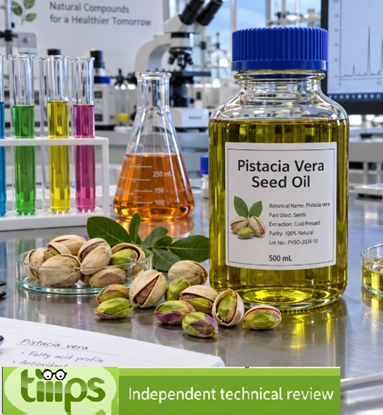
It is mainly composed of triglycerides rich in oleic and linoleic acids, with smaller amounts of palmitic and other fatty acids. Less-refined grades may also retain phytosterols, tocopherols, squalene, pigments, and other components of the unsaponifiable fraction.
Its documented cosmetic function is SKIN CONDITIONING.
No specific Cosmetics Regulation provisions are identified for the ingredient under Annexes II–VI of the EU Cosmetics Regulation.
Description
Pistacia vera L. is the botanical species that produces the pistachio nut.
Its kernel has a high lipid content and can be pressed or extracted to obtain a fluid vegetable oil, typically ranging from pale yellow to greenish in color.
From a formulation standpoint, the oil is valued for:
good spreadability;
emollient properties;
compatibility with skin lipids;
high monounsaturated-fatty-acid content;
a lighter sensory profile than many heavier vegetable oils.
Its composition varies according to cultivar, climate, geographical origin, ripeness, extraction method, and degree of refining.
Manufacturing process
Production may include:
cleaning and selection of pistachios;
removal of shells;
crushing of kernels;
mechanical pressing, including cold pressing;
or solvent extraction;
filtration;
optional degumming;
neutralization;
bleaching;
deodorization;
final filtration;
oxidative-quality control;
packaging protected from light and oxygen.
A virgin or cold-pressed oil generally retains more pigments, characteristic odor, and unsaponifiable constituents.
A refined grade usually has:
a lighter color;
less pronounced odor;
lower levels of some minor constituents;
greater batch-to-batch uniformity;
more standardized cosmetic characteristics.
Main compounds present
The fatty-acid profile is generally dominated by:
oleic acid (C18:1);
linoleic acid (C18:2);
palmitic acid (C16:0);
stearic acid (C18:0);
palmitoleic acid (C16:1);
small amounts of linolenic acid (C18:3).
Oleic acid is usually predominant, while the oleic-to-linoleic ratio can vary significantly between cultivars and production areas.
Minor lipophilic constituents may include:
β-sitosterol and other phytosterols;
tocopherols;
squalene;
lipid-soluble pigments.
Refining can reduce part of this minor fraction.
Identification data and specifications
| Characteristic | Value | Note |
|---|---|---|
| INCI name | Pistacia Vera Seed Oil | cosmetic ingredient name |
| Common name | Pistachio Seed Oil / Pistachio Oil | vegetable oil |
| Botanical species | Pistacia vera L. | accepted species |
| Botanical family | Anacardiaceae | pistachio family |
| Part used | seed/kernel | oil-bearing material |
| Chemical category | fixed vegetable oil / triglyceride mixture | natural mixture |
| Molecular formula | not applicable | not a single substance |
| Molecular weight | not applicable | depends on triglyceride composition |
| CAS | 90082-81-8 | oil identifier |
| EC | 290-173-0 | European identifier |
| CosIng reference | 80025 | cosmetic ingredient reference |
| Cosmetic function | Skin Conditioning | documented function |
| Current EU glossary | entry 21265 | PISTACIA VERA SEED OIL |
| Cosmetics Regulation provisions | no specific provision indicated | no specific Annex II–VI provision identified |
Indicative physicochemical properties
| Characteristic | Indicative value | Note |
|---|---|---|
| Physical state | oily liquid | at room temperature |
| Appearance | clear | in filtered/refined grades |
| Color | pale yellow to light green | depends on origin and refining |
| Odor | mild and oily; more characteristic in unrefined grades | variable |
| Water solubility | practically insoluble | typical of vegetable oils |
| Oil-phase compatibility | high | readily incorporated into lipid phases |
| Relative density at 20 °C | approximately 0.91–0.92 | typical commercial values |
| Refractive index at 20 °C | approximately 1.466–1.475 | useful quality-control parameter |
| Oxidative stability | moderate | influenced by unsaturated-fatty-acid content |
| Light and heat sensitivity | present | may accelerate rancidity |
Cosmetics
Pistacia Vera Seed Oil may be used in:
facial creams;
body creams;
cosmetic oils;
balms;
lip products;
oil serums;
products for dry skin;
hair-care products;
masks;
conditioners;
massage products.
It acts primarily as an emollient skin-conditioning oil, improving softness, spreadability, and skin feel.
Its oleic-rich profile gives it good fluidity and helps it spread readily over the skin.
The linoleic-acid fraction may be useful in formulations designed to support the lipid environment of the stratum corneum, but this should not be converted automatically into therapeutic or clinically proven skin-barrier repair claims.
Hair care
In hair products, it can help:
improve slip;
reduce the sensation of dryness;
increase softness and shine;
lubricate the surface of the hair fiber;
improve combability.
These are mainly physical conditioning effects.
There is insufficient evidence to regard the oil itself as a treatment for:
hair loss;
alopecia;
scalp diseases;
deep structural repair of damaged hair.
Pros
It is a plant-derived emollient oil.
It has good spreadability and sensory properties.
Its high oleic-acid content makes it suitable for many skin-care formulations.
It can improve softness and comfort on dry skin.
It can enhance hair smoothness and shine.
Less-refined grades may retain useful amounts of tocopherols and phytosterols.
It is readily incorporated into the oil phase of cosmetic formulations.
Cons
It is susceptible to oxidation and rancidity.
Shelf life depends strongly on initial quality and storage conditions.
Fatty-acid composition varies according to cultivar and geographical origin.
Cold-pressed grades may show greater batch variability than refined oils.
High use levels may feel too rich or greasy in some formulations.
Biological properties of minor constituents should not automatically be translated into clinical benefits.
Because it is derived from pistachio, possible residual allergenic proteins deserve attention, especially in unrefined or cold-pressed grades.
Safety and regulation
The general cosmetic safety profile is favorable when the oil is of suitable purity, properly preserved, and used in an appropriately formulated product.
Pistachio allergy
Pistachio can cause IgE-mediated food allergy in sensitized individuals.
The relevant allergens are proteins, not the triglycerides that make up most of the oil.
Effective refining generally reduces residual protein content substantially. However, compared with highly refined oils, higher residual protein levels may be more likely in:
virgin oils;
cold-pressed oils;
minimally refined oils.
For products intended for consumers with known tree-nut allergies, it is therefore useful to know the residual protein content of the commercial grade.
It would be incorrect either to assume that every Pistacia Vera Seed Oil necessarily causes reactions in pistachio-allergic individuals or to assume that every grade is automatically free of allergenic proteins.
Oxidation
Oxidative degradation can generate:
peroxides;
aldehydes;
ketones;
free fatty acids;
other secondary oxidation products.
An oxidized oil may show:
unpleasant odor;
poorer sensory quality;
reduced stability;
potentially greater irritation.
Important quality parameters therefore include:
peroxide value;
acid value;
storage temperature;
exposure to light and oxygen;
antioxidant protection where appropriate.
CIR status
Pistacia Vera Seed Oil has been included in the Cosmetic Ingredient Review evaluation program within the group of edible plant-derived oils.
The available assessment remains in the draft-review process, so it should not be presented as having a final ingredient-specific CIR safety conclusion until that process is completed.
EU Cosmetics Regulation provisions
No specific Cosmetics Regulation provision is indicated for Pistacia Vera Seed Oil under Annexes II–VI of Regulation (EC) No 1223/2009.
The ingredient is included in the current EU cosmetic ingredient glossary as:
21265 – PISTACIA VERA SEED OIL
The absence of a specific Annex restriction does not replace the safety assessment of the finished cosmetic product.
Raw-material control
For professional evaluation, it is advisable to obtain:
updated SDS;
Certificate of Analysis (COA);
technical data sheet;
botanical origin;
geographical source;
extraction method;
degree of refining;
fatty-acid profile;
acid value;
peroxide value;
iodine value;
density;
refractive index;
unsaponifiable matter;
tocopherols and phytosterols where standardized;
residual proteins/allergens where relevant;
pesticide data;
metals;
residual solvents for solvent-extracted grades;
oxidative-stability data;
storage conditions.
The distinction between refined and virgin/cold-pressed oil is particularly important because purity, residual protein content, odor, and oxidative stability may differ.
Environment
The environmental profile depends mainly on pistachio cultivation and oil-processing methods.
Relevant factors include:
agricultural water use;
climate in production regions;
fertilizer and pesticide use;
energy required for drying and extraction;
solvent use where applicable;
refining;
transport;
valorization of processing residues.
Cosmetic use of oils or fractions originating from the food-production chain may help valorize raw materials and by-products, but sustainability depends on the actual supply chain.
Conclusion
Pistacia Vera Seed Oil is a vegetable oil obtained from the kernels of Pistacia vera L., with a lipid profile typically rich in oleic and linoleic acids.
It is used in cosmetics mainly as a skin-conditioning emollient and is also suitable for hair-care formulations because of its lubricating and smoothing properties.
No specific Cosmetics Regulation provisions are identified for the ingredient.
Its overall profile is favorable, but commercial-grade quality is important. The main aspects to control are oxidative stability, refining level, peroxide value, acidity, purity, and possible residual pistachio proteins, particularly in virgin or minimally refined oils.
Pistacia Vera Seed Oil can be considered a generally favorable cosmetic ingredient when it is fresh, well characterized, and adequately protected against oxidation.

