



Yucca Filamentosa Extract: properties, uses, pros, cons, safety
Yucca Filamentosa Extract is an extract obtained from the whole plant of Yucca filamentosa L., a perennial species native mainly to the southeastern United States and currently classified in the family Asparagaceae.
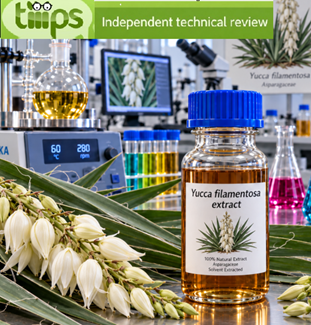
The historical cosmetic definition still refers to the family Agavaceae, whereas modern botanical classification places Yucca filamentosa in Asparagaceae, order Asparagales.
It is a multicomponent botanical extract that may contain mainly steroidal saponins, together with phenolic compounds, sugars, organic acids, and other plant constituents.
The documented cosmetic function of Yucca Filamentosa Extract is FRAGRANCE, meaning that it contributes to the odor of the product and/or the skin. The natural presence of saponins may also give some extracts experimental surfactant and cleansing properties, but these should not be confused with the officially documented cosmetic function of the INCI ingredient.
Description
Yucca filamentosa L., commonly known as Adam’s Needle, Common Yucca, or Bear Grass, is an evergreen plant characterized by a rosette of long, rigid, fibrous leaves.
It is botanically distinct from other Yucca species commonly used commercially, particularly:
Yucca schidigera;
Yucca brevifolia;
Yucca glauca;
Yucca aloifolia.
This distinction is important because much of the commercial and scientific information generally referring to “yucca” concerns Yucca schidigera rather than Yucca filamentosa and should not automatically be transferred to this species.
The INCI definition Yucca Filamentosa Extract refers to an extract of the whole plant.
It should therefore be distinguished from:
Yucca Filamentosa Root;
Yucca Filamentosa Root Extract;
which are separate cosmetic ingredients and may have different phytochemical profiles.
Manufacturing process
The manufacturing method depends on the commercial grade.
In general, it may include:
botanical identification of the raw material;
harvesting of the plant material;
cleaning;
washing;
drying;
grinding;
extraction with water, ethanol, hydroalcoholic mixtures, glycerin, glycols, or other suitable solvents;
filtration;
separation of insoluble material;
concentration;
optional purification;
standardization;
microbiological control;
stabilization of the commercial grade.
Hydroglycolic extracts intended for cosmetic use may be supplied directly in a mixture containing, for example:
water;
glycerin;
Yucca Filamentosa Extract;
optional preservatives.
The INCI name alone therefore does not indicate the actual amount of botanical material present in the commercial raw material.
The extraction process can substantially influence:
saponin content;
saponin profile;
phenolic content;
color;
odor;
dry residue;
surfactant activity;
tolerability.
Main compounds present
The most important phytochemical characteristic of the genus Yucca is the presence of steroidal saponins.
Numerous saponins of the following structural types have been identified in Yucca filamentosa:
spirostanol;
furostanol.
Compounds described in the species include:
yuccoside C;
protoyuccoside C;
yuccaloeside B;
yuccaloeside C;
yuccaloeside E;
other steroidal saponins;
glycosides derived from steroidal sapogenins.
Saponins containing structures related to the following sapogenins have also been identified:
gitogenin;
tigogenin;
sarsasapogenin;
other steroidal sapogenins.
Leaf extracts may additionally contain:
phenolic compounds;
organic acids;
sugars;
flavonoids, including kaempferol derivatives;
other plant metabolites.
Comparative LC-MS and NMR studies have confirmed that steroidal saponins are one of the predominant phytochemical classes in Yucca species.
Composition can nevertheless vary considerably according to:
plant part;
solvent;
geographical origin;
season;
extraction method;
degree of purification.
Identification data and specifications
| Characteristic | Value | Note |
|---|---|---|
| INCI name | Yucca Filamentosa Extract | cosmetic ingredient name |
| Botanical name | Yucca filamentosa L. | accepted species |
| Common names | Adam’s Needle; Common Yucca; Bear Grass | common denominations |
| Cosmetic definition | extract of the whole plant of Yucca filamentosa | botanical ingredient |
| Modern botanical family | Asparagaceae | current classification |
| Family in the historical cosmetic definition | Agavaceae | previous classification |
| Part used | whole plant | according to the INCI definition |
| Chemical category | multicomponent botanical extract | complex mixture |
| Molecular formula | not applicable | not a single substance |
| Molecular weight | not applicable | contains numerous constituents |
| CAS | 90147-58-3 | extract identifier |
| EC | 290-450-6 | European identifier |
| CosIng reference | 60213 | cosmetic ingredient reference |
| Cosmetic function | Fragrance | documented function |
| Cosmetics Regulation provisions | no specific provision indicated | no specific Annex II–VI provision identified |
Indicative physicochemical properties
| Characteristic | Indicative value | Note |
|---|---|---|
| Commercial form | liquid extract, hydroglycolic extract, concentrate, or dry extract | supplier-dependent |
| Color | yellow, amber, green-brown, or brown | variable |
| Odor | characteristic botanical odor | influenced by solvent and concentration |
| Solubility | dependent on extract type | hydroglycolic extracts are readily incorporated into aqueous systems |
| pH | variable | verify commercial-grade specification |
| Dry residue | variable | important for evaluating actual concentration |
| Surface activity | possible in saponin-rich grades | concentration-dependent |
| Foaming tendency | possible | characteristic of saponins |
| Oxidative stability | requires control | depends on phytochemical profile |
| Microbiological sensitivity | relevant in aqueous grades | appropriate preservation required |
Cosmetics
Yucca Filamentosa Extract may be used in:
shampoos;
hair cleansers;
conditioners;
scalp products;
facial cleansers;
body cleansers;
creams;
lotions;
serums;
masks;
formulations containing botanical complexes.
Its documented cosmetic function is FRAGRANCE.
The extract can therefore contribute to the olfactory profile of the formulation or modify its overall odor.
Saponins and cleansing
Saponins have an amphiphilic structure, consisting of:
a relatively lipophilic steroidal portion;
one or more hydrophilic sugar chains.
This structure allows them to interact with both water and lipophilic substances and explains their ability to:
reduce surface tension;
produce foam;
disperse lipophilic substances;
behave as natural surfactants.
Saponin-rich Yucca extracts are therefore studied and used in several sectors as surface-active additives.
For this reason, a Yucca filamentosa extract may contribute in certain formulations to mild cleansing or foam formation.
It is nevertheless important to distinguish this phytochemical behavior from the regulatory function attributed to the INCI ingredient:
the documented function of Yucca Filamentosa Extract remains FRAGRANCE.
It should therefore not automatically be treated as a primary surfactant equivalent to cosmetic surfactants specifically designed for cleansing.
Experimental biological activities
The saponins of Yucca filamentosa have been extensively investigated from a phytochemical standpoint.
Experimental studies have reported:
antioxidant activity;
anti-inflammatory activity;
antimicrobial activity;
antiparasitic activity;
interactions with biological membranes.
Studies using standardized leaf extracts have identified a predominance of steroidal saponins, together with sucrose, organic acids, phenolic acids, and kaempferol, and have observed antioxidant and anti-inflammatory effects in experimental models.
Other investigations have isolated specific Yucca filamentosa saponins with marked biological activity.
These findings should not be interpreted as evidence that an ordinary cosmetic containing Yucca Filamentosa Extract automatically has:
therapeutic anti-inflammatory activity;
antimicrobial activity;
antiparasitic effects;
clinically demonstrated dermatological efficacy.
Most of these studies use concentrated extracts, purified fractions, or individual saponins under exposure conditions very different from normal cosmetic use.
Pros
It is a plant-derived ingredient.
It naturally contains steroidal saponins.
Saponins may provide surfactant and foaming properties.
It may contribute to cleansing in appropriate formulations.
It can be incorporated into shampoos and cleansing products.
It has an interesting phytochemical profile relatively rich in saponins.
LC-MS and NMR techniques can be used to characterize the saponin profile.
Specific extracts have shown experimental antioxidant and anti-inflammatory activity.
Hydroglycolic grades can be readily incorporated into aqueous formulations.
The botanical species is well defined and recognized.
Cons
It is a variable botanical extract.
The INCI name does not specify the extraction solvent.
It does not indicate the actual percentage of extract in the commercial grade.
Saponin levels can vary considerably between manufacturers and batches.
Many studies on the genus Yucca concern Yucca schidigera rather than Yucca filamentosa.
At high concentrations, saponins can interact strongly with biological membranes.
A very high saponin content may increase irritation potential.
Experimental biological activities do not equal clinical effects in the finished cosmetic.
Botanical variability makes analytical standardization useful.
Aqueous grades require appropriate microbiological control.
Safety and regulation
No specific SCCS or CIR assessment dedicated exclusively to Yucca Filamentosa Extract has been identified that establishes a universally safe maximum cosmetic concentration.
Safety should therefore be assessed according to:
extract concentration;
actual percentage of botanical material;
extraction solvent;
saponin content;
sapogenin profile;
impurities;
contaminants;
preservatives;
product type;
leave-on or rinse-off exposure;
irritation;
sensitization.
Saponins and membrane interaction
Steroidal saponins are biologically active substances.
Their surfactant behavior is partly related to their interaction with lipids in biological membranes.
At sufficiently high concentrations, some saponins may show:
cytotoxicity;
increased membrane permeability;
hemolytic activity;
irritation.
The presence of saponins in a cosmetic extract does not automatically imply these effects because risk depends mainly on:
structure of the individual saponins;
concentration;
purity;
formulation matrix;
route of exposure.
A normal diluted cosmetic extract should therefore not be considered equivalent to a concentrated saponin fraction or an isolated saponin used in pharmacological studies.
EU Cosmetics Regulation provisions
No specific “Cosmetics Regulation provisions / Cosmetic restrictions” are indicated for Yucca Filamentosa Extract under Annexes II–VI of the EU Cosmetics Regulation.
The ingredient is included in the European glossary of common cosmetic ingredient names.
The absence of a specific restriction does not mean that every concentration or type of extract is automatically safe. Safety assessment of the finished product remains necessary.
Botanical identity
The historical cosmetic definition refers to:
Yucca filamentosa L., Agavaceae.
Modern botanical classification recognizes:
Yucca filamentosa L. – Asparagaceae.
The species is accepted, and its natural distribution includes mainly the southeastern United States.
This change in botanical family does not alter the INCI name, which remains:
YUCCA FILAMENTOSA EXTRACT
The difference simply reflects changes in modern taxonomic classification.
Raw-material control
For professional evaluation, it is advisable to obtain:
an updated SDS;
a Certificate of Analysis (COA);
technical data sheet;
botanical identification;
confirmation of the species;
confirmation that the whole plant is used;
geographical origin;
cultivation or harvesting method;
extraction solvent;
plant-to-extract ratio;
actual percentage of extract in the commercial grade;
dry residue;
total saponin content;
saponin profile where available;
LC-MS markers;
free sapogenins where relevant;
phenolic compounds where standardized;
pesticide analysis;
metal analysis;
microbiological specifications;
residual solvents;
pH;
preservative system;
stability data;
irritation and sensitization data.
For commercial liquid extracts, it is particularly important to know the actual percentage of Yucca Filamentosa Extract, since the supplied material may consist predominantly of water, glycerin, or glycols.
Environment
Yucca filamentosa is a hardy perennial species adapted to relatively demanding environmental conditions.
From a sustainability standpoint, the impact of the extract depends on:
cultivation or harvesting;
geographical origin;
water consumption;
pesticide use;
drying;
transport;
extraction solvent;
energy required for concentration;
solvent recovery;
management of plant residues;
treatment of process water.
Plant origin is potentially favorable, but it does not automatically ensure a low environmental impact. Extraction technology and supply-chain management remain important.
Conclusion
Yucca Filamentosa Extract is an extract of the whole plant of Yucca filamentosa L., a species currently classified in the family Asparagaceae.
Its documented cosmetic function is FRAGRANCE.
From a phytochemical standpoint, the extract is particularly interesting because of its steroidal saponins, including numerous spirostanol and furostanol structures. These compounds may provide surfactant and foaming properties and help explain the use of yucca extracts in some cleansing formulations.
These properties do not, however, alter the documented cosmetic function of Yucca Filamentosa Extract and do not justify automatically classifying it as a primary surfactant or therapeutic active ingredient.
No specific Cosmetics Regulation provisions are identified for this ingredient.
Yucca Filamentosa Extract can be considered a generally favorable cosmetic ingredient when the commercial grade is properly identified and characterized, with particular attention to actual extract concentration, extraction solvent, saponin content and profile, pesticides, metals, microbiological quality, residual solvents, stability, and skin tolerability.

