



Cetraria Islandica Extract: properties, uses, pros, cons, safety
Cetraria Islandica Extract is an extract obtained from Iceland moss, Cetraria islandica (L.) Ach., a lichen belonging to the family Parmeliaceae. Despite the common English name Iceland moss, it is not a moss but a lichen, a symbiotic organism consisting primarily of a fungus associated with a photosynthetic partner.
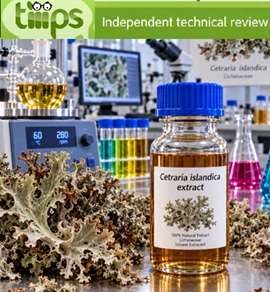
Taxonomically, Cetraria islandica belongs to the kingdom Fungi, division Ascomycota, class Lecanoromycetes, and order Lecanorales.
The cosmetic ingredient is a complex mixture that may contain mainly lichen polysaccharides, such as lichenan and isolichenan, together with lichen acids and other secondary metabolites.
Its documented cosmetic functions are Cleansing, Skin Conditioning – Emollient, Smoothing, and Soothing.
Description
Cetraria islandica is a fruticose lichen that grows mainly in cold, mountainous, subarctic, and boreal environments.
The visible part of the organism is the thallus, a branched structure without the true roots, leaves, and stems characteristic of higher plants.
The cosmetic name Cetraria Islandica Extract generically identifies an extract of the lichen. It should be distinguished from Cetraria Islandica Thallus Extract, which is a separate INCI entry explicitly identifying an extract of the thallus.
The composition of the extract can vary considerably depending on:
geographical origin;
biological material used;
season and environmental conditions;
drying method;
extraction solvent;
temperature;
pH;
lichen-to-solvent ratio;
extraction time;
subsequent purification;
concentration of the commercial grade.
An aqueous extract rich in polysaccharides may therefore have substantially different characteristics from a hydroalcoholic or hydroglycolic extract richer in secondary metabolites.
Manufacturing process
Production may include:
harvesting the lichen;
taxonomic identification;
removal of soil, foreign plant material, and impurities;
washing where required;
controlled drying;
grinding;
extraction with water, ethanol, water/ethanol mixtures, glycerin, glycols, or other suitable solvents;
filtration;
separation of the insoluble fraction;
concentration;
optional fractionation;
standardization;
microbiological control;
stabilization of the commercial grade.
Hot-water extraction particularly favors recovery of polysaccharides such as lichenan, isolichenan, and galactomannans.
Hydroalcoholic or more organic solvent systems may instead increase recovery of various lichen acids and more lipophilic metabolites.
The manufacturing process is therefore fundamental in determining the chemical profile, and commercial ingredients bearing the same INCI name should not automatically be considered equivalent.
Main compounds present
Cetraria islandica contains two major groups of substances: polysaccharides and lichen-specific secondary metabolites.
Compounds described in the species include:
lichenan (lichenin), a β-glucan containing β-(1→3) and β-(1→4) linkages;
isolichenan (isolichenin), an α-glucan containing α-(1→3) and α-(1→4) linkages;
galactomannans;
other water-soluble polysaccharides;
fumarprotocetraric acid;
protocetraric acid;
protolichesterinic acid;
lichesterinic acid;
cetraric acid;
variable small amounts of usnic acid;
sterols and sterol derivatives;
fatty acids;
sugars and polyols.
Fumarprotocetraric acid is one of the most characteristic secondary metabolites of the species, although the concentration of individual lichen acids can vary considerably according to the origin of the material.
Polysaccharides are particularly relevant in aqueous grades, whereas extracts obtained with more organic solvent systems may contain relatively higher proportions of lichen acids.
Identification data and specifications
| Characteristic | Value | Note |
|---|---|---|
| INCI name | Cetraria Islandica Extract | cosmetic ingredient name |
| Common name | Iceland Moss Extract | despite the name, it is a lichen |
| Species | Cetraria islandica (L.) Ach. | lichen |
| Kingdom | Fungi | lichenized organism |
| Division | Ascomycota | fungal classification |
| Class | Lecanoromycetes | taxonomic classification |
| Order | Lecanorales | taxonomic classification |
| Family | Parmeliaceae | lichen family |
| Chemical category | multicomponent natural extract | complex mixture |
| Molecular formula | not applicable | not a single substance |
| Molecular weight | not applicable | contains different molecules and polymers |
| CAS | 84776-25-0 | extract identifier |
| EC | 283-950-0 | European identifier |
| CosIng reference | 32588 | cosmetic ingredient reference |
| Cosmetic functions | Cleansing; Skin Conditioning – Emollient; Smoothing; Soothing | documented functions |
| Current EU glossary | entry 5946 | CETRARIA ISLANDICA EXTRACT |
| Cosmetics Regulation provisions | no specific provision indicated | no specific Annex II–VI provision identified |
Indicative physicochemical properties
| Characteristic | Indicative value | Note |
|---|---|---|
| Commercial form | liquid, concentrate, or dry extract | depends on the process |
| Color | yellow-amber, brown, or dark brown | concentration-dependent |
| Odor | characteristic botanical/lichen-like odor | may be weak in purified grades |
| Solubility | dependent on extract type | strongly influenced by solvent |
| Water compatibility | generally good in aqueous/hydroglycolic grades | depends on the carrier |
| pH | variable | verify commercial-grade specification |
| Viscosity | variable | may increase in polysaccharide-rich concentrates |
| Oxidative stability | requires control | some metabolites may oxidize |
| Light stability | requires control | depends on extract profile |
| Compositional variability | high | typical of natural extracts |
| Microbiological sensitivity | relevant in aqueous grades | appropriate preservation required |
Cosmetics
Cetraria Islandica Extract may be used in:
facial creams;
body creams;
serums;
lotions;
cleansers;
products for dry or sensitive skin;
soothing products;
anti-aging formulations;
masks;
shampoos;
scalp products;
after-shave products;
formulations intended to improve skin comfort.
Its documented cosmetic functions support mainly:
emollient activity, helping soften the skin;
smoothing activity, improving the feel of the skin surface;
soothing activity, helping reduce sensations of discomfort;
cleansing activity, when used in appropriate formulations.
The polysaccharide fraction may also contribute to the formation of a thin surface film and to water interaction, characteristics that can be useful in formulations for dry or stressed skin.
Recent cosmetic research
A 2026 study specifically investigated the cosmetic potential of a commercial hydroglycolic extract of Cetraria islandica.
In the experimental systems used, the specific extract showed:
antioxidant activity;
reduction of the inflammatory response in stimulated human keratinocytes;
decreased production of IL-6, IL-8, CXCL9, CXCL10, and CCL5;
reduced expression of MT1-MMP;
inhibition of human tyrosinase activity.
These findings are scientifically interesting for research into skin-protective and anti-aging-oriented formulations.
They should, however, be interpreted cautiously.
The study was conducted primarily in vitro, using one specific hydroglycolic extract and defined cellular models. It therefore does not demonstrate that every Cetraria Islandica Extract has the same activity or that a cosmetic containing it will automatically produce clinically significant anti-aging, anti-inflammatory, or depigmenting effects.
In the same study, tyrosinase inhibition occurred at relatively high concentrations, near a range in which cellular tolerability required careful consideration.
The ingredient should therefore not automatically be regarded as a clinically proven skin-lightening agent on the basis of these data alone.
Pros
It has several documented cosmetic functions: Cleansing, Skin Conditioning – Emollient, Smoothing, and Soothing.
It is rich in characteristic lichen polysaccharides.
It contains lichenan and isolichenan.
Polysaccharides may contribute to film-forming and sensory properties.
It is particularly interesting for formulations intended for dry, sensitive, or uncomfortable skin.
Specific extracts have shown antioxidant activity in vitro.
A recent 2026 study reported interesting effects in human keratinocyte models.
Specific extracts reduced several inflammatory mediators in the cellular systems tested.
It can be used in a wide range of skin-care and hair-care products.
Its phytochemical profile is relatively well studied compared with many other lichens used in cosmetics.
Cons
It is a highly variable natural extract.
The INCI name does not specify the extraction solvent.
It does not indicate the actual concentration of Cetraria islandica in the commercial grade.
A commercial ingredient may contain substantial amounts of water, glycols, glycerin, or other carrier components.
Polysaccharide and lichen-acid content varies according to the manufacturing process.
Effects observed in vitro do not equal clinical efficacy.
Some lichen metabolites are biologically active and require appropriate characterization.
Extracts may contain variable amounts of usnic acid and other lichen acids.
Lichens can accumulate environmental contaminants.
Wild harvesting requires particular attention to traceability and sustainability.
Safety and regulation
No specific SCCS or CIR assessment dedicated exclusively to Cetraria Islandica Extract has been identified that establishes a universal safe cosmetic concentration.
Safety should therefore be assessed according to the actual commercial grade, with particular attention to:
solvent;
concentration;
phytochemical profile;
lichen acids;
possible usnic acid;
impurities;
environmental contaminants;
preservatives;
irritation;
sensitization;
expected exposure.
Recent cellular data
In the recent study performed with a specific hydroglycolic extract, tolerability was preliminarily assessed in HaCaT keratinocytes.
The maximum experimental concentration selected for subsequent cellular assays was based on maintaining approximately 90% or more cell viability.
This is useful information for that particular experimental material but does not represent a general maximum cosmetic concentration.
Grades obtained with different solvents or more highly concentrated in lichen acids may have a substantially different safety profile.
Lichen acids
Cetraria islandica contains characteristic lichen compounds, including:
fumarprotocetraric acid;
protocetraric acid;
protolichesterinic acid;
lichesterinic acid;
usnic acid in variable amounts.
These compounds show various biological activities in experimental systems.
Their presence does not automatically represent a problem at the concentrations found in cosmetic extracts, but it makes chemical characterization of the commercial grade advisable, particularly for concentrated extracts.
EU Cosmetics Regulation provisions
No specific “Cosmetics Regulation provisions / Cosmetic restrictions” are indicated for Cetraria Islandica Extract under Annexes II–VI of the EU Cosmetics Regulation.
The ingredient is included in the current European cosmetic ingredient glossary as:
5946 – CETRARIA ISLANDICA EXTRACT
The absence of a specific Annex provision does not constitute an unconditional authorization for use at any concentration. The normal safety assessment of the finished cosmetic and quality control of the raw material remain necessary.
Contaminants
Lichens are particularly responsive to environmental conditions and may accumulate substances from the atmosphere and surrounding substrate.
This behavior makes them useful as organisms for environmental monitoring, but it is also an important quality consideration for cosmetic raw materials.
Appropriate control may include:
lead;
cadmium;
mercury;
arsenic;
other metals relevant to the collection area;
environmental contaminants;
foreign material;
microbiological contamination.
The geographical origin of the biomass should therefore be adequately documented.
Raw-material control
For professional evaluation, it is advisable to obtain:
an updated SDS;
a Certificate of Analysis (COA);
technical data sheet;
taxonomic identification;
confirmation of the species;
part of the organism used;
geographical origin;
harvesting method;
drying method;
extraction solvent;
lichen-to-extract ratio;
actual percentage of extract in the commercial ingredient;
dry matter content;
polysaccharide content where standardized;
lichenan/isolichenan where used as markers;
fumarprotocetraric acid;
protolichesterinic acid;
usnic acid where relevant;
chromatographic profile;
residual solvents;
metals;
environmental contaminants;
microbiological specifications;
pH;
preservative system;
stability data;
irritation and sensitization data for the commercial grade.
A particularly important point is to verify how much Cetraria Islandica Extract is actually present in the commercial ingredient, because some liquid extracts may consist predominantly of an aqueous or hydroglycolic carrier.
Environment
Cetraria islandica is a naturally occurring lichen that may be harvested from wild populations.
Lichens generally grow relatively slowly, and recovery of biomass after intensive harvesting may take considerable time.
Important considerations therefore include:
documented origin;
controlled harvesting;
protection of natural populations;
prevention of overharvesting;
supply-chain traceability;
sustainable management of collection areas.
The environmental impact of the extract also depends on:
biomass transport;
drying;
water consumption;
extraction solvent;
solvent recovery;
concentration process;
energy use;
management of extraction residues.
An extract produced using aqueous solvents or efficient solvent-recovery systems may offer advantages, but natural origin alone does not guarantee a low environmental impact.
Conclusion
Cetraria Islandica Extract is an extract of the lichen Cetraria islandica (L.) Ach., family Parmeliaceae, containing characteristic polysaccharides such as lichenan and isolichenan together with several lichen acids.
Its documented cosmetic functions are Cleansing, Skin Conditioning – Emollient, Smoothing, and Soothing.
Recent 2026 research has added interesting data on the cosmetic potential of a specific hydroglycolic extract, showing in vitro antioxidant activity, modulation of inflammatory responses in keratinocytes, reduction of MT1-MMP, and inhibition of tyrosinase. These findings are promising but remain preclinical and specific to the experimental material tested.
No specific Cosmetics Regulation provisions are identified for this ingredient.
Cetraria Islandica Extract can be considered an interesting and generally favorable cosmetic ingredient when the commercial grade is adequately characterized, with particular attention to extraction solvent, actual extract concentration, polysaccharides, lichen acids, usnic acid, environmental contaminants, metals, microbiological quality, skin tolerability, and biomass traceability.

