



Abies Sibirica Needle Oil: properties, uses, pros, cons, safety
Abies Sibirica Needle Oil is the essential oil obtained by distillation from the needles and branches of Siberian fir, Abies sibirica Ledeb., a conifer belonging to the family Pinaceae.
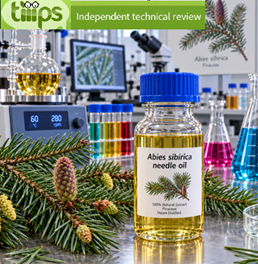
It is a natural mixture of volatile substances composed mainly of esters and monoterpenes, typically including bornyl acetate, α-pinene, camphene, limonene, δ-3-carene, and other terpenes.
Its documented cosmetic function is PERFUMING: it is therefore used mainly to provide cosmetics with a fresh, balsamic, resinous, and typically coniferous fragrance.
The ingredient is subject to a specific Cosmetics Regulation provision III/106: the peroxide value must be below 10 mmol/L. This limit applies to the raw material and is particularly important because oxidation of terpenes can increase the sensitizing potential of the oil.
Description
Abies sibirica is an evergreen conifer native mainly to the boreal regions of Eurasia and particularly widespread in Siberia.
The needles and young branches contain glands and secretory tissues rich in volatile aromatic substances. Distillation produces an essential oil with a characteristic olfactory profile that may be described as:
fresh;
balsamic;
resinous;
green;
woody;
distinctly fir-like and coniferous.
The cosmetic definition of Abies Sibirica Needle Oil includes an essential oil distilled from the needles and branches of the plant.
Its composition is not constant. It may vary according to:
geographical origin;
season;
age of the needles;
part of the plant distilled;
climatic conditions;
harvesting period;
duration of distillation;
extraction technology;
storage conditions.
The ingredient should therefore be regarded as a natural multicomponent mixture, not as a single chemical substance.
Manufacturing process
The traditional production method is steam distillation.
The process may include:
harvesting the needles and branches;
removal of foreign material;
optional chopping;
loading of the plant material into the still;
passage of steam through the biomass;
volatilization of aromatic components;
condensation of the vapors;
separation of the essential oil from the aqueous phase;
drying of the oil to remove traces of water;
filtration;
standardization;
analytical control by GC or GC-MS;
packaging in containers protected from light, heat, and oxygen.
More modern techniques, such as microwave-assisted distillation, may also be used and can modify both yield and the relative composition of the oil.
Because oxidation is a critical parameter, production and storage should minimize:
exposure to air;
light;
high temperatures;
prolonged storage in partially empty containers.
Compatible antioxidant systems may also be used where appropriate to help maintain a low peroxide value.
Main compounds present
The essential-oil profile may contain mainly:
bornyl acetate;
α-pinene;
camphene;
β-pinene;
δ-3-carene;
limonene;
myrcene;
phellandrenes;
tricyclene;
santene;
other monoterpenes;
terpene esters;
alcohols and other minor aromatic constituents.
Traditional cosmetic descriptions indicate approximately 40% esters calculated as bornyl acetate, but this should not be interpreted as a fixed composition for every commercial batch.
Bornyl acetate is generally one of the most characteristic constituents of the oil and contributes significantly to its balsamic and resinous odor.
The relative proportions of bornyl acetate, α-pinene, camphene, and other terpenes may vary considerably. Extraction method can also influence the chemical profile.
Identification data and specifications
| Characteristic | Value | Note |
|---|---|---|
| INCI name | Abies Sibirica Needle Oil | cosmetic ingredient name |
| Common name | Siberian Fir Needle Oil | Siberian fir essential oil |
| Definition | essential oil distilled from the needles and branches of Abies sibirica | natural aromatic mixture |
| Botanical species | Abies sibirica Ledeb. | Siberian fir |
| Botanical family | Pinaceae | conifer |
| Part used | needles and branches | according to the ingredient definition |
| Chemical category | essential oil / mixture of terpenes and esters | multicomponent substance |
| Molecular formula | not applicable | natural mixture |
| Molecular weight | not applicable | depends on the individual constituents |
| CAS | 91697-89-1 | regulatory identifier |
| EC | 294-351-9 | European identifier |
| CosIng reference | 41328 | cosmetic ingredient reference |
| Cosmetic function | Perfuming | documented function |
| Current EU glossary | entry 433 | ABIES SIBIRICA NEEDLE OIL |
| Cosmetics Regulation provisions | III/106 | Abies sibirica oil and extract |
| Specific condition | peroxide value < 10 mmol/L | limit applying to the raw material |
Indicative physicochemical properties
| Characteristic | Indicative value | Note |
|---|---|---|
| Physical state | liquid | at room temperature |
| Appearance | clear liquid | may vary between batches |
| Color | colorless, pale yellow, or yellow-green | depends on the raw material |
| Odor | balsamic, fresh, resinous, coniferous | characteristic |
| Water solubility | very low | typical of essential oils |
| Oil-phase solubility | good | compatible with lipid systems |
| Volatility | high | rich in monoterpenes |
| Oxidative stability | limited | protection from air required |
| Light stability | limited | store protected from light |
| Heat sensitivity | moderate | high temperatures accelerate degradation and volatilization |
| Peroxide value | < 10 mmol/L | specific regulatory requirement |
Cosmetics
Abies Sibirica Needle Oil may be used in:
shampoos;
conditioners;
hair masks;
shower gels;
soaps;
cleansers;
body creams;
deodorant products;
bath products;
scalp products;
cosmetic balms;
perfumes;
aromatic formulations.
Its principal role is perfuming.
It is particularly suitable for formulations with a:
forest-like;
balsamic;
fresh;
herbal;
coniferous;
woody
olfactory profile.
Biological activities of Abies sibirica essential oil have also been investigated. Specific oils obtained using different extraction methods have shown antifungal and antiradical activity in vitro.
These findings are interesting from a phytochemical standpoint but do not alter the documented cosmetic function of the ingredient.
It is not appropriate to automatically claim that a cosmetic containing Abies Sibirica Needle Oil is:
antifungal;
antibacterial;
anti-inflammatory;
clinically effective as an antioxidant;
therapeutic.
Such effects would require specific data on the finished product and, where relevant, a different regulatory classification.
Pros
It provides a distinctive fresh, balsamic, and resinous fragrance.
It is a plant-derived aromatic ingredient.
It has a profile rich in aromatic terpenes and esters.
Bornyl acetate contributes to the characteristic fir-like odor.
It can be used in many cosmetic categories.
It is particularly suitable for shampoos, cleansers, and bath products.
Specific samples have shown antiradical activity in vitro.
Specific oils have shown experimental antifungal activity.
It is clearly defined from a European regulatory standpoint.
Cons
It is subject to the specific Cosmetics Regulation provision III/106.
The peroxide value must remain below 10 mmol/L.
It is sensitive to oxidation.
Oxidation of terpenes may increase the risk of skin sensitization.
It may naturally contain limonene and other fragrance allergens.
Composition varies according to origin, season, and distillation method.
Odor quality may deteriorate during improper storage.
It is not directly soluble in water.
Particular caution is advisable in leave-on products intended for sensitive skin.
Biological activities observed in vitro do not constitute proof of therapeutic efficacy.
Safety, regulation and environment
EU Cosmetics Regulation provision
Abies Sibirica Needle Oil is subject to:
Cosmetics Regulation provision III/106
The entry concerns:
Abies sibirica oil and extract
and includes:
Abies Sibirica Oil;
Abies Sibirica Needle Extract;
Abies Sibirica Needle Oil.
The specific condition is:
peroxide value below 10 mmol/L.
No universal maximum concentration of the ingredient in the finished cosmetic product is specified under this entry.
The peroxide limit applies to the substance used as a raw material, not to the finished cosmetic product.
This requirement is one of the most important aspects in the evaluation of the ingredient.
Oxidation and sensitization
Conifer essential oils contain significant amounts of unsaturated terpenes.
Compounds such as:
limonene;
α-pinene;
β-pinene;
δ-3-carene
can slowly oxidize when exposed to oxygen.
Oxidation may generate:
hydroperoxides;
peroxides;
other oxidized products.
Some of these oxidation products have a greater sensitizing potential than the corresponding non-oxidized terpenes.
An old, oxidized, or poorly stored oil may therefore have a less favorable tolerability profile than a fresh material that complies with specifications.
The peroxide value is therefore not only a technical quality parameter but is directly relevant to skin safety.
Fragrance allergens
The oil may naturally contain components subject to European fragrance-allergen labeling requirements, particularly Limonene, and other regulated fragrance substances may be present depending on the actual composition of the batch.
When their concentrations in the finished product exceed the applicable thresholds, they must be declared individually in the ingredient list.
The commonly applicable thresholds are:
0.001% in leave-on products;
0.01% in rinse-off products.
The allergen profile should therefore be verified using up-to-date analytical documentation from the supplier rather than inferred solely from the INCI name.
Irritation
Like other essential oils, it may cause:
skin irritation;
eye irritation;
individual reactions in sensitized persons.
Risk depends mainly on:
concentration;
degree of oxidation;
composition;
product type;
frequency of application;
area of skin exposed;
duration of contact.
Natural origin does not automatically imply absence of irritation or sensitization.
Raw-material control
For professional evaluation, it is advisable to obtain:
an updated SDS;
a Certificate of Analysis (COA);
technical data sheet;
botanical identification;
plant part distilled;
geographical origin;
distillation method;
GC-MS or GC-FID profile;
bornyl acetate content;
α-pinene;
camphene;
β-pinene;
δ-3-carene;
limonene;
other relevant markers;
fragrance-allergen profile;
peroxide value;
relative density;
refractive index;
optical rotation where used as an authenticity parameter;
adulteration control;
pesticide data where relevant;
metals and contaminants where relevant;
stability data;
production date;
storage conditions.
The peroxide value must be below 10 mmol/L and should also be monitored in relation to the aging of the raw material.
To limit oxidation, the oil should preferably be stored:
in tightly closed containers;
protected from light;
away from heat sources;
with as little headspace as reasonably possible;
under the conditions specified by the supplier.
Environment
Abies Sibirica Needle Oil is derived from a renewable plant resource, but its environmental profile depends on the production system.
Relevant factors include:
biomass origin;
forest-management practices;
sustainable harvesting of needles and branches;
energy required for distillation;
water consumption;
transport;
management of spent biomass;
environmental release of terpene components.
Distillation may allow the valorization of branches and other plant material generated during forest management, provided harvesting is compatible with conservation of the ecosystem.
Essential oils and some of their constituents should nevertheless not be released indiscriminately into aquatic environments.
Conclusion
Abies Sibirica Needle Oil is an essential oil obtained from the needles and branches of Abies sibirica Ledeb., family Pinaceae, used in cosmetics primarily as a PERFUMING ingredient.
It is characterized by a mixture of esters and monoterpenes, particularly bornyl acetate, α-pinene, camphene, δ-3-carene, and limonene, with composition varying according to raw material and distillation method.
It is subject to the specific Cosmetics Regulation provision III/106, which requires a peroxide value below 10 mmol/L in the raw material.
This requirement is particularly important because oxidation of terpenes may increase the sensitizing potential of the oil.
Abies Sibirica Needle Oil can be considered a valid cosmetic fragrance ingredient when it is fresh, correctly stored, and analytically controlled, with particular attention to peroxide value, GC-MS profile, fragrance allergens, purity, authenticity, oxidation, and storage conditions.

