



Agave Rigida (Sisal) Extract: properties, uses, pros, cons, safety
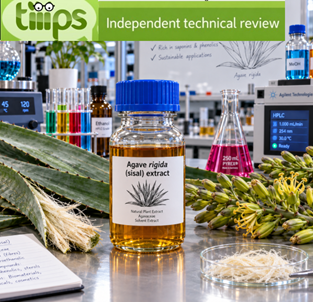
Agave Rigida Extract, commonly associated with sisal, is a botanical extract obtained from the leaves of agave plants used for sisal production. In European cosmetic nomenclature, the INCI name remains Agave Rigida Extract, while in modern botanical taxonomy commercial sisal is identified as Agave sisalana Perrine, family Asparagaceae.
It is a multicomponent botanical ingredient whose composition depends strongly on the raw material and extraction process. Sisal leaves may contain steroidal saponins, sapogenins, flavonoids, polyphenols, tannins, sugars, and other plant constituents.
Its documented cosmetic function is BULKING, meaning that it contributes to the volume and physical characteristics of a cosmetic formulation.
Description
The botanical nomenclature requires some clarification.
Historical cosmetic nomenclature has used Agave rigida in connection with sisal and has defined Agave Rigida Extract as an extract derived from sisal leaves. Modern botanical taxonomy, however, recognizes Agave sisalana Perrine as the accepted species for sisal.
The historical name Agave rigida var. sisalana is regarded as a synonym of Agave sisalana. The name Agave rigida used on its own has a different taxonomic history and should not automatically be interpreted as the current botanical name of commercial sisal.
For cosmetic assessment, it is therefore appropriate to retain:
INCI name: Agave Rigida Extract
while identifying the botanical source associated with sisal mainly as:
Agave sisalana Perrine – Asparagaceae.
Sisal leaves are highly fibrous and contain, in addition to the structural fiber, a substantial liquid and mucilaginous fraction rich in phytochemical substances.
During conventional industrial fiber production, only a relatively small proportion of the leaf biomass becomes commercial fiber, while a much larger fraction remains as plant residue that can potentially be valorized through extraction.
Manufacturing process
The manufacturing process depends on the type of commercial extract.
In general, it may include:
harvesting the leaves;
identification and selection of the botanical material;
washing;
crushing or decortication;
separation of the fibers;
recovery of residual plant material or juice;
optional drying;
extraction using water, ethanol, hydroalcoholic mixtures, glycerin, glycols, or other suitable solvents;
filtration;
concentration;
purification;
standardization;
microbiological control;
stabilization of the commercial grade.
Ultrasound-assisted extraction and other intensified extraction techniques have also been investigated to improve recovery of polyphenolic fractions.
The extraction method strongly influences the finished material. An aqueous extract enriched in saponins may be substantially different from a hydroalcoholic extract selected for polyphenols.
The INCI name alone therefore does not reveal:
extraction solvent;
leaf-to-extract ratio;
dry matter content;
saponin concentration;
polyphenol content;
sapogenin profile;
carrier ingredients present in the commercial grade.
Main compounds present
Several phytochemical classes have been identified in sisal leaves and their processing residues, including:
steroidal saponins;
steroidal sapogenins;
hecogenin and derivatives;
flavonoids;
kaempferol and derivatives;
polyphenols;
tannins;
glycosides;
sterols;
carbohydrates;
other plant-derived compounds.
Several steroidal saponins containing sapogenins such as hecogenin and tigogenin have been isolated from sisal.
These substances are phytochemically interesting, but their concentration varies considerably among different extracts.
Flavonoid and polyphenol levels also depend strongly on the extraction process. Extracts obtained from industrial Agave sisalana residues using aqueous-ethanolic systems can be particularly rich in phenolic compounds.
It is therefore not appropriate to assign a standard concentration of saponins, flavonoids, or other markers to every Agave Rigida Extract.
Identification data and specifications
| Characteristic | Value | Note |
|---|---|---|
| INCI name | Agave Rigida Extract | cosmetic ingredient name |
| Common name | Sisal Extract | botanical extract |
| Cosmetic definition | extract of sisal leaves | plant-derived ingredient |
| Modern botanical species relevant to sisal | Agave sisalana Perrine | currently accepted species |
| Current botanical family | Asparagaceae | modern classification |
| Plant part used | leaves | botanical raw material |
| Category | multicomponent botanical extract | complex mixture |
| Molecular formula | not applicable | not a single chemical substance |
| Molecular weight | not applicable | depends on individual constituents |
| CAS | 165800-55-5 | identifier associated with the extract |
| EC | 306-786-4 | European identifier |
| CosIng reference | 31390 | cosmetic ingredient reference |
| Official cosmetic function | Bulking | documented function |
| Current EU glossary | entry 1215 | AGAVE RIGIDA EXTRACT |
| Cosmetics Regulation provisions | no specific provision indicated | no specific Annex II–VI provision identified |
Indicative physicochemical properties
| Characteristic | Indicative value | Note |
|---|---|---|
| Commercial form | liquid, solution, concentrate, or dry extract | process-dependent |
| Color | yellow, green-brown, or brown | variable |
| Odor | characteristic botanical odor | depends on purification |
| Solubility | dependent on solvent and grade | aqueous and hydroalcoholic extracts may differ considerably |
| pH | variable | verify supplier specification |
| Dry matter content | variable | commercial-grade specification |
| Oxidative stability | requires control | polyphenols and other constituents may oxidize |
| Light stability | requires control | depends on phytochemical profile |
| Compositional variability | high | typical of botanical extracts |
| Microbiological sensitivity | relevant in aqueous grades | appropriate control required |
Cosmetics
The documented cosmetic function of Agave Rigida Extract is BULKING.
In a cosmetic formulation, it can therefore contribute to the overall physical properties and volume of the product matrix.
It may be used in:
creams;
lotions;
cleansers;
shampoos;
conditioners;
styling products;
leave-on hair products;
color cosmetics;
lip products;
formulations containing botanical complexes.
More recent research has also investigated Agave sisalana extracts specifically prepared to recover their polyphenolic fraction.
An extract obtained from sisal-industry residues by ultrasound-assisted extraction with an aqueous-ethanolic system showed antioxidant activity in vitro. When incorporated at 1% into specific experimental photoprotective emulsions, the extract was compatible with physically stable formulations and showed favorable dermatological tolerability under the study conditions.
Some photoprotection parameters were also increased in those specific formulations.
This result must be interpreted correctly:
Agave Rigida Extract is not an authorized UV filter.
An improvement observed in a particular experimental formulation does not convert the ingredient into a UV filter and does not demonstrate that every cosmetic containing it will increase SPF.
Pros
It is a plant-derived ingredient.
It may contribute to the valorization of residual biomass from the sisal industry.
Sisal leaves contain saponins, flavonoids, and other phytochemicals.
Specific extracts can be rich in polyphenols.
Antioxidant activity in vitro has been reported for selected extracts.
Certain experimental formulations containing 1% of a polyphenol-rich extract showed good stability and dermatological tolerability.
It can be incorporated into different cosmetic product categories.
Valorization of leaf residues may reduce waste generated during sisal-fiber production.
Cons
It is a highly variable botanical extract.
The INCI name does not identify the extraction solvent or phytochemical profile.
Saponin content may vary considerably among extracts.
Saponins are biologically active compounds and, at sufficiently high concentrations, may show surfactant and cytotoxic effects.
Antioxidant or anti-inflammatory effects observed with experimental extracts should not automatically be attributed to every cosmetic grade.
It should not be described as a UV filter on the basis of results obtained with specific experimental formulations.
Botanical extracts require control of pesticides, metals, and microbiological contamination.
Industrial residues must be adequately purified before cosmetic use.
Toxicological characteristics may vary substantially according to the extraction process.
Safety, regulation and environment
No specific SCCS or CIR assessment dedicated exclusively to Agave Rigida Extract has been identified that establishes a universal safe cosmetic concentration.
Safety should therefore be assessed according to:
origin of the raw material;
extraction method;
solvent;
concentration in the finished formulation;
saponin content;
polyphenol profile;
impurities;
irritation and sensitization data;
type and duration of exposure.
Experimental cosmetic data
Research on industrial Agave sisalana residues has developed polyphenol-rich extracts incorporated at 1% into experimental photoprotective emulsions.
The selected formulations were reported as:
physically stable;
dermatologically well tolerated under the tested conditions;
non-phototoxic;
non-photosensitizing in the tests performed.
These findings are favorable but apply to one specific extract, one defined concentration, and specific formulations.
They therefore do not establish universal safety for every Agave Rigida Extract at any concentration.
Saponins and sapogenins
Sisal leaves contain numerous steroidal saponins.
Saponins are of interest because of several biological activities, but they also interact strongly with biological membranes. At sufficiently high concentrations, some can produce hemolytic and cytotoxic effects.
A highly saponin-enriched extract should therefore not automatically be considered equivalent to a conventional diluted cosmetic extract.
Quantitative characterization of saponins is especially useful for concentrated raw materials.
Toxicological data from modified extracts
Toxicological studies on acid-hydrolyzed extracts obtained from Agave sisalana juice residues require careful interpretation.
Certain specifically modified extracts have shown findings relating to reproductive toxicity in animal studies after repeated oral exposure.
These findings should not be automatically attributed to cosmetic Agave Rigida Extract.
The experimental materials were:
obtained from juice-processing residues;
subjected to acid hydrolysis;
deliberately enriched in steroidal sapogenins;
administered orally to animals.
Their chemical profile and exposure scenario were therefore substantially different from those of an ordinary topical cosmetic extract.
These data nevertheless demonstrate why extraction method and the concentration of saponins/sapogenins should be known, and why not all sisal extracts should be regarded as interchangeable.
EU Cosmetics Regulation provisions
No specific “Cosmetics Regulation provisions / Cosmetic restrictions” are indicated for Agave Rigida Extract under Annexes II–VI of the EU Cosmetics Regulation.
Its documented cosmetic function is BULKING.
The absence of a specific Annex provision does not mean that every extract type or concentration is automatically safe. Safety must be established for the actual commercial grade and the finished cosmetic product.
Botanical identity and nomenclature
The nomenclature deserves particular attention.
The INCI name should remain:
AGAVE RIGIDA EXTRACT
when this is the ingredient name declared on the cosmetic label.
However, commercial sisal is now botanically identified as:
Agave sisalana Perrine
and classified in the family:
Asparagaceae.
The historical designation Agave rigida var. sisalana is treated as a synonym of Agave sisalana.
To avoid confusion, it is therefore preferable to distinguish between:
regulatory INCI name: Agave Rigida Extract
and
modern botanical identification of sisal: Agave sisalana.
Raw-material control
For professional evaluation, it is advisable to obtain:
an updated SDS;
a Certificate of Analysis (COA);
technical data sheet;
botanical identification;
confirmation of the actual species used;
plant part used;
geographical origin;
extraction method;
extraction solvent;
plant-to-extract ratio where available;
dry matter content;
saponin content where relevant;
steroidal sapogenins in concentrated grades;
total polyphenols where standardized;
phytochemical markers;
residual solvents;
pesticide analysis;
metal analysis;
microbiological specifications;
pH;
preservative system, if present;
stability data;
irritation and sensitization data for the commercial grade.
For extracts derived from agro-industrial residues, the sisal-fiber production process, treatment of the residue, and purification steps prior to cosmetic extraction should also be documented.
Environment
Sisal is cultivated mainly for production of strong plant fibers.
Processing of the leaves generates a large amount of residual biomass, because only a relatively small fraction of the total leaf mass is recovered as commercial fiber.
Using this material to produce cosmetic extracts may therefore represent an interesting form of agro-industrial by-product valorization.
The actual environmental benefit depends on:
cultivation practices;
water consumption;
fertilizer and pesticide use;
transport;
energy required for decortication;
drying;
extraction solvents;
solvent recovery;
wastewater treatment;
management of residual biomass after extraction.
Plant origin and use of an industrial residue are potentially favorable factors, but they do not automatically make every production process sustainable.
Conclusion
Agave Rigida (Sisal) Extract is an extract derived from sisal leaves. The official cosmetic INCI name remains Agave Rigida Extract, while the modern botanical species relevant to commercial sisal is Agave sisalana Perrine, family Asparagaceae.
Its documented cosmetic function is BULKING.
Sisal leaves may provide numerous phytochemical constituents, particularly steroidal saponins, sapogenins, flavonoids, and polyphenols. Specific extracts produced from sisal-industry residues have demonstrated antioxidant activity and favorable tolerability in experimental cosmetic formulations.
These findings should not be generalized because the composition changes substantially according to the extraction process.
No specific Cosmetics Regulation provisions are identified for this ingredient.
Agave Rigida Extract can be considered a cosmetically usable and potentially interesting botanical ingredient, including for the valorization of sisal-processing residues, but assessment should focus particularly on botanical identity, extraction method, saponin and sapogenin content, polyphenols, purity, pesticides, metals, microbiological quality, and tolerability data for the actual commercial grade.

