



Beta-Sitosterol: properties, uses, pros, cons, safety
Beta-Sitosterol (β-sitosterol) is one of the main phytosterols, plant-derived sterols structurally similar to cholesterol. It occurs naturally in numerous vegetable oils, seeds, nuts, cereals, legumes, fruits, and vegetables.
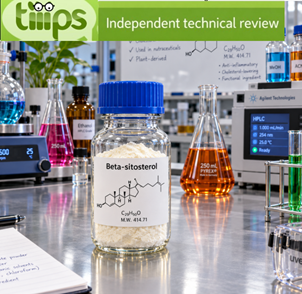
In cosmetics, it is used mainly for skin conditioning and formulation stabilization. Its strongly lipophilic sterol structure gives it affinity for lipid phases and membrane-like systems, while the hydroxyl group allows interaction with other formulation components.
The Cosmetic Ingredient Review (CIR) included Beta-Sitosterol in its assessment of phytosterols used in cosmetics and concluded that the group is safe under the practices and concentrations of use evaluated, while recommending good manufacturing practices to minimize impurities.
Description
Beta-Sitosterol belongs to the family of plant sterols and contains the typical polycyclic steroid nucleus.
Compared with cholesterol, it has a slightly different side chain, including an additional ethyl group.
It is one of the most widespread phytosterols in plants and is frequently found together with other sterols, especially:
campesterol;
stigmasterol;
sitostanol;
other minor plant sterols.
PubChem classifies it as a 3β-sterol, a stigmastane sterol, and a plant metabolite.
From a formulation standpoint, it is highly lipophilic, has very low compatibility with water, and is more readily incorporated into:
oils;
emulsions;
lipid systems;
suitable organic solvents;
delivery systems capable of dispersing sterols.
Its structural similarity to cholesterol makes phytosterols particularly interesting in formulations aimed at supporting the skin barrier. Experimental topical studies using soybean phytosterol mixtures have shown improved recovery of barrier function after disruption of the stratum corneum. These findings concern phytosterol mixtures and should not be quantitatively attributed to Beta-Sitosterol alone.
Manufacturing process
Industrial Beta-Sitosterol is generally isolated and purified from plant-derived raw materials rich in phytosterols, rather than necessarily being produced by total chemical synthesis.
Important industrial sources include:
deodorizer distillates from vegetable-oil refining;
soybean oil;
sunflower oil;
rapeseed/canola oil;
corn oil;
other sterol-rich vegetable fractions;
tall oil derived from wood processing.
Deodorizer distillates generated during vegetable-oil refining are especially rich in sterols, tocopherols, and other lipophilic components.
Industrial processing may include:
recovery of the sterol-containing fraction;
saponification to release esterified sterols;
separation of the unsaponifiable fraction;
solvent extraction;
distillation;
fractional precipitation;
crystallization;
crystal washing;
recrystallization;
drying;
chromatographic purification or other advanced separation techniques where necessary.
To obtain high-purity Beta-Sitosterol, additional separation from structurally similar phytosterols is generally required.
Main compounds present
In a highly purified Beta-Sitosterol grade, the principal component is β-sitosterol.
Plant-derived grades may nevertheless contain residual amounts of related sterols, including:
campesterol;
stigmasterol;
β-sitostanol;
other phytosterols;
residual sterol esters;
sterol hydrocarbons;
triterpenic alcohols;
sterol oxidation products.
Composition depends strongly on the source and purification process. In industrial phytosterol fractions, Beta-Sitosterol is often the predominant component but not necessarily the only one.
Oxidation requires attention because exposure to oxygen and severe thermal conditions can generate oxyphytosterols, including oxidation products of Beta-Sitosterol.
Identification data and specifications
| Characteristic | Value | Note |
|---|---|---|
| INCI name | Beta-Sitosterol | cosmetic ingredient name |
| Chemical name | Stigmast-5-en-3β-ol | sterol denomination |
| Synonyms | β-Sitosterol; Sitosterol; 22,23-Dihydrostigmasterol; 24-Ethylcholesterol | commonly used names |
| Chemical category | phytosterol / plant sterol | C₂₉ sterol |
| Molecular formula | C₂₉H₅₀O | defined molecular substance |
| Molecular weight | 414.71 g/mol | molecular value |
| CAS | 83-46-5 | substance identifier |
| EC | 201-480-6 | European identifier |
| PubChem CID | 222284 | PubChem identifier |
| CosIng reference | 74521 | European cosmetic ingredient reference |
| Cosmetic functions | Emulsion Stabilising; Masking; Skin Conditioning; Stabilising | documented functions |
| Cosmetics Regulation provisions | no specific provision indicated | no specific Annex II–VI provision identified |
Indicative physicochemical properties
| Characteristic | Indicative value | Note |
|---|---|---|
| Physical state | solid | at room temperature |
| Appearance | white or off-white powder/crystals | depends on purity |
| Melting point | approximately 136–140 °C | typical experimental range |
| Water affinity | very low | strongly lipophilic substance |
| Solubility in organic solvents | appreciable in several alcohols and organic solvents | solvent- and temperature-dependent |
| Volatility | very low | high-molecular-weight sterol |
| Formulation behavior | lipidic and structuring | useful in oil phases |
| Thermal stability | generally good under ordinary conditions | severe heating may promote oxidation |
| Oxidative stability | requires control during prolonged storage | oxidized phytosterols may form |
Cosmetics
In cosmetics, Beta-Sitosterol is used mainly in formulations intended for skin conditioning and stabilization of the lipid phase or emulsion system.
It may be present in:
facial creams;
body creams;
lipid serums;
emulsions;
barrier-support products;
balms;
lip products;
cosmetic oils;
products for dry skin;
soothing formulations;
hair-care products.
Its structural similarity to cholesterol makes phytosterols of particular interest in lipid systems of the stratum corneum.
Experimental research on topical phytosterol mixtures has shown favorable effects on recovery of skin barrier function after controlled disruption.
More recent studies are also investigating the cutaneous delivery of Beta-Sitosterol itself, showing that deposition in skin layers can vary markedly depending on the delivery system used.
Experimental anti-inflammatory effects have also been reported in animal models. These findings are relevant from a research standpoint but do not establish a therapeutic function for Beta-Sitosterol in ordinary cosmetic use.
Food use
Beta-Sitosterol is also a normal constituent of plant-based foods and is one of the main plant sterols used in phytosterol-enriched foods.
The nutritional mechanism of phytosterols is mainly based on reducing intestinal absorption of cholesterol.
In the European Union, an authorized health claim states that:
“Plant sterols contribute to the maintenance of normal blood cholesterol levels”
when consumers are informed that the beneficial effect is obtained with a daily intake of at least 0.8 g of plant sterols/stanols.
For certain phytosterol-enriched foods, a claim relating to the reduction of blood cholesterol is also authorized under defined conditions.
These effects apply to plant sterols as a category and under the authorized conditions of use. They should not automatically be converted into a health claim for any arbitrary amount of isolated Beta-Sitosterol.
Pros
It is one of the major naturally occurring phytosterols.
It has good compatibility with lipid phases.
It can contribute to skin conditioning.
It can support emulsion and formulation stability.
Its structural similarity to cholesterol makes phytosterols interesting for skin-barrier formulations.
Topical phytosterol studies have shown favorable results on experimental barrier recovery.
CIR considers phytosterols safe under the cosmetic practices and concentrations evaluated.
It is a chemically well-characterized substance.
It can be recovered from by-products of vegetable-oil refining, allowing valorization of industrial side streams.
Cons
It is strongly lipophilic and has poor direct compatibility with water.
Formulations may require appropriate solubilization or dispersion systems.
Less-purified plant-derived grades may contain other phytosterols and sterol-related impurities.
Botanical source and manufacturing process can significantly affect purity.
Under severe oxidative or thermal conditions, phytosterol oxidation products may form.
Anti-inflammatory or other biological effects observed experimentally should not automatically be presented as clinically proven cosmetic benefits.
In foods enriched with phytosterols, specific conditions of use and mandatory warnings apply; higher intake should not automatically be considered more beneficial.
Safety, regulation and environment
The Cosmetic Ingredient Review Expert Panel evaluated Beta-Sitosterol as part of the assessment of phytosterols and sterol esters used in cosmetics.
The conclusion was that the evaluated phytosterols are safe under the practices and concentrations of use described, with a recommendation to apply good manufacturing practices to minimize impurities.
Hormonal and reproductive considerations
Because phytosterols are structurally related to biologically active steroids, possible hormonal effects have historically been investigated.
Some older experimental studies raised questions regarding reproductive or hormonal activity of Beta-Sitosterol or poorly characterized sterol preparations.
However, studies on well-characterized phytosterols did not show estrogenic activity in receptor-binding assays, transcriptional systems, or uterotrophic testing, and reproductive studies with phytosterols or phytosterol esters did not show adverse fertility effects under the conditions examined.
The overall evidence therefore reduced earlier concerns regarding estrogenicity and reproductive toxicity of adequately characterized phytosterol materials.
EU Cosmetics Regulation provisions
No specific “Cosmetics Regulation provisions / Cosmetic restrictions” are indicated for Beta-Sitosterol under Annexes II–VI of the EU Cosmetics Regulation.
The absence of a specific Annex provision does not replace the normal safety assessment of the finished product or the quality control of the raw material.
Foods enriched with phytosterols
Foods to which plant sterols are added are subject in the EU to specific mandatory information.
Applicable requirements include statements indicating that:
the product is intended for people who wish to lower or control their blood cholesterol;
patients taking cholesterol-lowering medication should consume the product only under medical supervision;
the product may not be nutritionally appropriate for pregnant or breastfeeding women and children under 5 years of age;
the product should be consumed as part of a balanced and varied diet with adequate fruit and vegetable intake;
consumption of more than 3 g/day of added plant sterols/stanols should be avoided.
These warnings apply to foods enriched with added phytosterols, not to the ordinary amounts of Beta-Sitosterol naturally present in plant foods.
Raw-material control
For professional evaluation, it is advisable to obtain:
an updated SDS;
a Certificate of Analysis (COA);
technical data sheet;
Beta-Sitosterol assay;
plant source;
isolation process;
campesterol content;
stigmasterol content;
β-sitostanol content;
other phytosterols;
phytosterol oxidation products;
residual solvents;
pesticide data where relevant to the source;
metals and other impurities;
color;
melting point;
oxidative-stability data;
storage conditions.
For a grade marketed as purified Beta-Sitosterol, the actual assay and profile of related sterols are particularly important quality parameters.
Environment
Beta-Sitosterol is a naturally occurring substance widely present in plants.
Its environmental profile nevertheless also depends on the manufacturing process.
Isolation from vegetable-oil deodorizer distillates, which are by-products of refining, can contribute to the valorization of an industrial side stream.
The overall environmental assessment should consider:
source of the plant raw material;
use of industrial by-products;
extraction and purification solvents;
energy consumption;
solvent recovery;
residue management;
biodegradation;
quantities actually released into the environment.
Natural origin alone does not guarantee a low-impact production process.
Conclusion
Beta-Sitosterol is a plant sterol structurally similar to cholesterol and naturally widespread in vegetable oils and many plant-derived foods.
In cosmetics, it is used mainly for skin conditioning and formulation stabilization. The CIR assessment of phytosterols supports their safety under the evaluated cosmetic conditions, with particular emphasis on raw-material quality and impurity control.
No specific Cosmetics Regulation provisions are identified for this ingredient.
From a nutritional standpoint, Beta-Sitosterol belongs to the category of plant sterols, for which authorized EU health claims exist in relation to maintenance or reduction of blood cholesterol, together with specific conditions of use and warnings for phytosterol-enriched foods.
Beta-Sitosterol can be considered a favorable and well-characterized cosmetic ingredient, with particular attention to purity, sterol-profile composition, oxidation products, residual solvents, and raw-material stability. Experimental biological properties are scientifically interesting, but they should not automatically be converted into clinically proven therapeutic or anti-aging claims.

