



Isoamyl p-Methoxycinnamate: properties, uses, pros, cons, safety
Isoamyl p-Methoxycinnamate, also known as Amiloxate or Isopentyl p-Methoxycinnamate, is an oil-soluble organic UV filter belonging to the family of methoxycinnamic acid esters. It absorbs mainly UVB radiation, with an absorption maximum around 308 nm.
In the European Union, it is authorized as a UV filter under Annex VI, entry 14 of Regulation (EC) No 1223/2009, with a maximum concentration of 10% in the ready-for-use preparation.
Its documented cosmetic functions are Light Stabilizer, UV Absorber, and UV Filter. The regulatory reference VI/14 therefore represents a specific Cosmetics Regulation provision that must be highlighted, even though the substance is authorized under defined conditions of use.
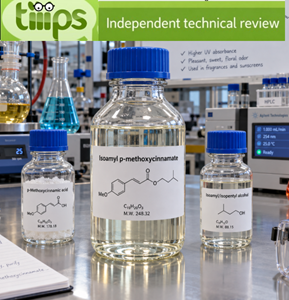
Description
Isoamyl p-Methoxycinnamate is the ester of p-methoxycinnamic acid with isoamyl/isopentyl alcohol.
Its structure contains:
an aromatic ring;
a methoxy group;
a conjugated cinnamate system;
an ester group;
a lipophilic isoamyl chain.
The conjugated aromatic system is responsible for ultraviolet absorption, while the isoamyl chain provides good compatibility with the oil phase of cosmetic formulations.
It is primarily regarded as a UVB filter, absorbing mainly in the approximate 280–320 nm region, with a maximum around 308 nm. It may extend to some extent toward the shorter-wavelength UVA region, but it should not be considered a broad-spectrum UVA filter on its own.
Its three cosmetic functions should be distinguished:
UV Filter: helps protect skin or hair from UV radiation;
UV Absorber: may help protect the formulation or its components from UV-induced degradation;
Light Stabilizer: helps reduce deterioration of the product caused by light.
Manufacturing process
Isoamyl p-Methoxycinnamate is normally produced by organic synthesis.
A conventional route involves esterification of p-methoxycinnamic acid with isoamyl alcohol, generally in the presence of a catalyst and with removal of the water generated during the reaction.
Alternative processes may include:
transesterification of other p-methoxycinnamate esters with isoamyl alcohol;
preparation of a cinnamate intermediate followed by transesterification;
enzymatic processes using lipases or esterases.
Biotechnological processes have also been described in which naturally derived ethyl p-methoxycinnamate is transesterified with natural isoamyl alcohol using enzymes.
After synthesis, processing may include:
neutralization;
removal of unreacted isoamyl alcohol;
removal of residual acids or esters;
filtration;
distillation or other purification;
chromatographic control;
purity verification;
UV-absorbance testing;
color and odor control;
stability testing.
Natural or synthetic origin does not alter the chemical identity of the final substance and does not automatically imply differences in safety.
Main compounds present
In a high-purity commercial grade, the main component is Isoamyl p-Methoxycinnamate.
Depending on the manufacturing process, small amounts of the following may also be present:
residual isoamyl alcohol;
residual p-methoxycinnamic acid;
other p-methoxycinnamate esters;
synthesis intermediates;
residual solvents;
traces of catalysts;
reaction by-products;
photochemical or oxidative degradation products.
Purity and impurity profile should be verified for the actual commercial grade used.
Identification data and specifications
| Characteristic | Value | Note |
|---|---|---|
| INCI name | Isoamyl p-Methoxycinnamate | cosmetic ingredient name |
| INN | Amiloxate | international denomination |
| Chemical name | 3-Methylbutyl 3-(4-methoxyphenyl)prop-2-enoate | p-methoxycinnamate ester |
| Chemical category | aromatic cinnamate ester | organic UV filter |
| Molecular formula | C₁₅H₂₀O₃ | defined molecular substance |
| Molecular weight | 248.32 g/mol | molecular value |
| CAS | 71617-10-2 | substance identifier |
| EC | 275-702-5 | European identifier |
| PubChem CID | 92386 | PubChem identifier |
| CosIng reference | 34598 | cosmetic ingredient reference |
| Cosmetic functions | Light Stabilizer; UV Absorber; UV Filter | documented functions |
| Cosmetics Regulation provisions | VI/14 | Annex VI, entry 14 |
| Maximum EU concentration | 10% | ready-for-use preparation |
Indicative physicochemical properties
| Characteristic | Indicative value | Note |
|---|---|---|
| Appearance | clear liquid | generally colorless to pale yellow |
| Polarity | relatively low | compatible with the lipid phase |
| Water solubility | very low | predominantly oil-soluble filter |
| Solubility in oils and organic solvents | good | useful in sunscreen formulations |
| Estimated log P | approximately 3.9 | indicates significant lipophilicity |
| UV absorption maximum | approximately 308 nm | UVB region |
| Main absorption range | approximately 280–320 nm | predominantly UVB |
| Volatility | low | consistent with its structure |
| Light stability | should be verified in the finished formulation | depends on the complete filter system |
| Formulation behavior | oil-soluble UV filter | mainly incorporated into the oil phase |
Cosmetics
Isoamyl p-Methoxycinnamate is used mainly in:
sunscreens;
SPF emulsions;
facial products with UV protection;
body products with SPF;
make-up with sun protection;
foundations;
lip balms with SPF;
hair products with UV protection;
formulations in which ingredients or color need protection from light.
Because it is oil-soluble, it is generally incorporated into the oil phase.
Its principal contribution is to UVB protection, helping increase SPF and reduce UVB-induced erythema. To obtain genuine broad-spectrum protection, it is normally combined with filters that provide adequate UVA coverage.
The performance of the isolated filter does not directly predict the SPF of the finished product. Protection also depends on:
concentration;
other filters used;
solubilization;
distribution within the formulation;
uniformity of the film on the skin;
overall photostability;
amount applied;
results of finished-product testing.
Pros
It is an effective UVB filter.
It has an absorption maximum close to 308 nm.
It is oil-soluble and readily incorporated into lipid phases.
It can make a significant contribution to SPF.
It can be combined with UVA filters to obtain broader protection.
It may also help protect ingredients, colors, or other formulation components from light-induced degradation.
It is authorized in the European Union up to 10%.
Earlier European scientific evaluation reported low acute toxicity, favorable irritation and sensitization findings, no evidence of mutagenicity or photomutagenicity, and an adequate margin of safety under the conditions assessed.
Cons
It provides mainly UVB protection and does not provide complete UVA protection on its own.
It is subject to the specific Cosmetics Regulation provision VI/14.
The maximum concentration in the EU is 10% in the ready-for-use preparation.
Photostability should be verified in the complete UV-filter system.
It has very low water solubility.
Its effectiveness depends strongly on formulation quality and film formation on the skin.
In the United States, Amiloxate is not currently an approved OTC sunscreen active under the monograph system; FDA has required additional data in the relevant review process.
It is currently subject to an ECHA assessment regarding potential endocrine-disrupting properties, which has not yet reached a final conclusion.
Available C&L notifications indicate an important aquatic environmental hazard, which should be considered in environmental assessment.
Safety, regulation and environment
European safety assessment
The former European Scientific Committee on Cosmetology evaluated Isopentyl-p-Methoxycinnamate.
The assessment reported:
low acute oral and dermal toxicity;
favorable irritation-test results;
no significant adverse findings in the human studies reviewed;
no evidence of embryotoxicity or teratogenicity at the tested doses;
no evidence of mutagenicity or photomutagenicity;
no significant evidence of sensitization or photoallergy in the available studies.
For a formulation containing 10%, the assessment calculated a Margin of Safety of approximately 150, using a maximum dermal absorption value of 4.4% and an oral NOAEL of 200 mg/kg body weight/day.
This remains an important historical safety reference, but it should be considered together with more recent regulatory and toxicological information.
EU Cosmetics Regulation provisions
Isoamyl p-Methoxycinnamate is subject to:
Cosmetics Regulation provisions: VI/14
The regulated substance is:
Isopentyl-4-methoxycinnamate / Amiloxate – Isoamyl p-Methoxycinnamate
and Annex VI, entry 14 establishes:
maximum concentration in the ready-for-use preparation: 10%.
No additional specific product-category conditions or mandatory warnings are indicated for this entry.
It is therefore an authorized UV filter subject to a precise regulatory condition, which should be explicitly reported as a Cosmetics Regulation provision.
Assessment of potential endocrine-disrupting properties
An important current issue concerns possible endocrine-disrupting properties.
ECHA includes Isopentyl p-methoxycinnamate among substances under assessment for endocrine disruption. The assessment remains ongoing under substance evaluation.
The substance entered the evaluation process because of concerns including:
potential endocrine disruption;
consumer use;
widespread dispersive use.
This status should be interpreted carefully:
an ongoing assessment does not mean that Isoamyl p-Methoxycinnamate has been concluded to be an endocrine disruptor.
At the same time, it is not appropriate to state that the issue has been definitively excluded, since the assessment is not yet complete.
This represents one of the main areas of current toxicological uncertainty.
United States
The regulatory situation in the United States differs from that in the European Union.
Amiloxate has been considered within the FDA sunscreen ingredient review framework, but additional data have been required to establish whether it meets the applicable GRASE standard.
It should therefore not be described as a generally authorized OTC sunscreen active in the United States simply because it is permitted as a UV filter in the EU.
Environment
Environmental impact deserves particular attention.
Available European C&L notifications frequently classify the substance as:
Aquatic Acute 1 – very toxic to aquatic life;
in many notifications also Aquatic Chronic 1 – very toxic to aquatic life with long-lasting effects.
These classifications derive from company C&L notifications and should not automatically be confused with a harmonized EU classification.
Nevertheless, they represent a relevant environmental warning, particularly for sunscreens and other cosmetics that may be released directly into aquatic environments.
A complete environmental assessment should consider:
biodegradability;
persistence;
bioaccumulation;
aquatic toxicity;
use concentration;
release from leave-on and sunscreen products;
fate in wastewater-treatment systems;
photochemical degradation.
Raw-material control
For professional evaluation, it is advisable to obtain:
an updated SDS;
a Certificate of Analysis (COA);
technical data sheet;
purity;
chromatographic profile;
UV absorbance;
identity/isomeric profile of the commercial grade;
residual isoamyl alcohol;
residual p-methoxycinnamic acid;
other residual esters;
solvents;
catalyst residues;
organic impurities;
color;
odor;
density;
refractive index;
photostability data;
oxidative-stability data;
documentation of compliance with Annex VI, entry 14;
available environmental data.
For sunscreen formulations, the finished product should also be evaluated for:
SPF;
UVA-PF;
critical wavelength where applicable;
photostability;
physical stability;
compatibility between UV filters;
film uniformity.
Conclusion
Isoamyl p-Methoxycinnamate (Amiloxate) is an oil-soluble organic UV filter that is primarily effective in the UVB region, with an absorption maximum close to 308 nm.
In the European Union, it is an authorized UV filter subject to the specific Cosmetics Regulation provision VI/14, which limits its concentration to 10% in the ready-for-use preparation.
Earlier European scientific evaluation showed an overall favorable toxicological profile under the conditions assessed. However, the current assessment requires additional caution because ECHA is still evaluating the substance for potential endocrine-disrupting properties, and no final conclusion has yet been reached.
Its environmental profile also requires attention because available C&L notifications indicate high toxicity to aquatic organisms.
Isoamyl p-Methoxycinnamate can be considered an effective UVB filter and is legally authorized in the EU within the specified limit, but it warrants a more cautious assessment than filters without unresolved toxicological evaluations. The main points to verify are compliance with VI/14, concentration, purity, formulation photostability, the ongoing ECHA endocrine-disruption assessment, aquatic impact, and finished-sunscreen performance testing.

