



Sargassum Filipendula Extract: properties, uses, pros, cons, safety
Sargassum Filipendula Extract is an extract obtained from the brown marine alga Sargassum filipendula C.Agardh, belonging to the family Sargassaceae. The species is classified among the brown algae, class Phaeophyceae, order Fucales.
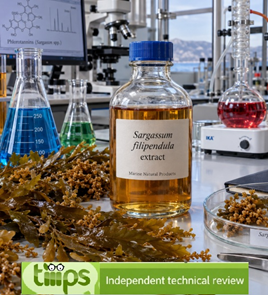
Its documented cosmetic function is Skin Protecting, meaning that it helps protect the skin from the effects of external factors.
It is a multicomponent marine botanical extract, not a single chemical substance. Depending on the extraction method, it may contain sulfated polysaccharides, particularly fucoidan-type compounds, brown-algae polyphenols such as phlorotannins, carotenoids, glycolipids, minerals, and other constituents naturally present in the alga.
Description
Sargassum filipendula is a brown marine macroalga. Its characteristic brown coloration results mainly from carotenoid pigments, particularly compounds of the fucoxanthin family, together with chlorophylls and other photosynthetic pigments.
From a cosmetic-research standpoint, two groups of constituents are particularly important:
sulfated polysaccharides, including fucoidans and related heterofucans;
brown-algae polyphenols, particularly phlorotannins.
Studies specifically conducted on S. filipendula have identified polysaccharide fractions containing sulfated fucose residues, together with glucose, mannose, and galactose. Polyphenolic fractions have also been reported to contain or be associated with compounds such as phloroglucinol, eckol-type structures, bifuhalol, and trifuhalol.
The actual composition of a commercial Sargassum Filipendula Extract may, however, differ greatly from a purified experimental fraction. Aqueous, hydroglycolic, hydroalcoholic, polysaccharide-enriched, and polyphenol-enriched extracts should not automatically be considered chemically equivalent.
Manufacturing process
Production begins with Sargassum filipendula biomass, which should be correctly identified and collected from a suitably controlled marine environment.
Processing may include:
collection and taxonomic identification of the biomass;
washing to remove sand, salts, epiphytes, and foreign matter;
drying;
grinding;
extraction with water or another suitable solvent;
separation of insoluble material;
filtration;
concentration;
optional fractionation;
purification;
standardization;
microbiological control;
stabilization of the commercial grade.
The solvent and processing conditions strongly determine which components are extracted.
Processes designed to recover fucoidans preferentially produce sulfated polysaccharide fractions, whereas other extraction conditions may enrich the polyphenolic/phlorotannin fraction.
Research on S. filipendula has separately obtained polysaccharide-rich and polyphenol-rich fractions, confirming that the same algal biomass can generate extracts with substantially different chemical and biological profiles.
Main compounds present
Depending on the extraction method, Sargassum Filipendula Extract may contain:
fucoidans and other sulfated polysaccharides;
fucose and sulfated sugar residues;
glucose;
galactose;
mannose;
phlorotannins;
phloroglucinol;
eckol-related compounds;
bifuhalol;
trifuhalol;
other phenolic compounds;
carotenoids;
glycolipids;
minerals and salts in variable amounts.
The concentration of individual constituents can vary according to:
collection site;
season;
environmental conditions;
age of the biomass;
drying method;
extraction solvent;
algae-to-solvent ratio;
temperature;
extraction time;
subsequent purification.
Results obtained with one experimental fraction should therefore not automatically be attributed to every commercial Sargassum Filipendula Extract.
Identification data and specifications
| Characteristic | Value | Note |
|---|---|---|
| INCI name | Sargassum Filipendula Extract | cosmetic ingredient name |
| Definition | extract of the brown alga Sargassum filipendula | marine-derived ingredient |
| Biological name | Sargassum filipendula C.Agardh | accepted species |
| Class | Phaeophyceae | brown algae |
| Order | Fucales | taxonomic classification |
| Family | Sargassaceae | taxonomic classification |
| Part used | alga / whole organism | biomass extract |
| Chemical category | multicomponent marine extract | complex mixture |
| Molecular formula | not applicable | not a single chemical substance |
| Molecular weight | not applicable | contains molecules and polymers of different sizes |
| CAS | 223751-78-8 | identifier associated with the extract |
| UNII | 55P66J5H7N | FDA GSRS identifier |
| Cosmetic function | Skin Protecting | documented cosmetic function |
| EU glossary | entry 25281 | SARGASSUM FILIPENDULA EXTRACT |
| Cosmetics Regulation provisions | no specific provision identified | no specific Annex II–VI entry identified |
Indicative physicochemical properties
| Characteristic | Indicative value | Note |
|---|---|---|
| Commercial form | solution, liquid extract, concentrate, or powder | process-dependent |
| Color | yellow-brown, green-brown, or dark brown | depends on concentration and extracted fraction |
| Odor | characteristic marine/algal odor | varies with purification |
| Solubility | dependent on extract type | polysaccharide-rich fractions are generally more compatible with aqueous systems |
| pH | variable | verify supplier specification |
| Oxidative stability | requires control | polyphenols and pigments may oxidize |
| Light stability | requires control | some components may be photosensitive |
| Mineral content | variable | influenced by marine environment and washing |
| Compositional variability | high | typical of macroalgal extracts |
| Microbiological sensitivity | relevant in aqueous grades | appropriate specifications required |
Cosmetics
The documented cosmetic function of Sargassum Filipendula Extract is Skin Protecting.
It may be used in:
facial creams;
body creams;
serums;
lotions;
moisturizing products;
anti-aging formulations;
masks;
cleansers;
after-sun products;
eye-area formulations;
hair-care products;
formulations containing marine-extract complexes.
The growing cosmetic interest in this species is related mainly to fractions rich in fucoidans and phlorotannins.
Specific S. filipendula extracts have demonstrated significant antioxidant activity in vitro and dose-dependent inhibition of collagenase and elastase in experimental systems.
Collagenase and elastase inhibition is of interest in anti-aging research because these enzymes contribute to degradation of extracellular-matrix proteins.
These findings must, however, be interpreted carefully: they relate to specifically prepared experimental fractions tested in vitro. They do not demonstrate that every cosmetic containing Sargassum Filipendula Extract automatically provides a clinically meaningful anti-aging effect.
Similarly, antioxidant activity or interaction with UV-related oxidative processes does not make the ingredient an authorized UV filter.
Pros
It is a brown-algae extract with a documented Skin Protecting function.
It may contain fucoidans and other sulfated polysaccharides.
It may contain phlorotannins, characteristic phenolic compounds of brown algae.
Specific fractions have demonstrated strong antioxidant activity in vitro.
Collagenase- and elastase-inhibitory activity has been reported for specific extracts.
It can be incorporated into a wide range of skin-care formulations.
Polysaccharide-rich fractions may provide useful film-forming and water-interaction properties.
It provides a source of marine bioactive compounds that is not of animal origin.
Scientific interest in the dermocosmetic potential of the species has increased in recent years.
Cons
It is a highly variable natural extract.
The INCI name does not specify solvent, concentration, or purification level.
Results obtained with purified fucoidans or phlorotannins cannot automatically be transferred to the commercial extract.
Marine macroalgae can accumulate metals and environmental contaminants.
Salt and mineral content can vary substantially.
Biomass collected from contaminated coastal areas may have an unfavorable impurity profile.
The raw material requires rigorous microbiological and environmental quality control.
Specific dermal-safety data on commercial INCI grades are more limited than for chemically defined substances.
Anti-aging activities observed in vitro do not constitute proof of clinical efficacy.
Safety, regulation and environment
No specific SCCS or CIR assessment dedicated exclusively to Sargassum Filipendula Extract has been identified that establishes a universal safe cosmetic concentration.
Scientific literature on the species includes numerous biochemical and preclinical studies, but a large proportion of the evidence remains preclinical and predominantly in vitro.
Metals and marine contaminants
This is one of the main points requiring control.
Species of the genus Sargassum can bioaccumulate substances from seawater. Relevant contaminants may include:
arsenic;
cadmium;
lead;
mercury.
Sargassum filipendula has also been investigated for its ability to accumulate lead and cadmium from aquatic environments, including in bioremediation research.
This property is environmentally interesting but creates a potential quality issue for cosmetic raw materials: the mineral and contaminant profile of the alga may partly reflect the environment in which it grew.
For a cosmetic extract, appropriate testing should therefore include at least:
total arsenic and, where relevant, arsenic speciation;
lead;
cadmium;
mercury;
other metals relevant to the harvesting area.
A raw material described as “natural” or “marine” should not automatically be assumed to be pure.
EU Cosmetics Regulation provisions
No specific “Cosmetics Regulation provisions / Cosmetic restrictions” have been identified for Sargassum Filipendula Extract under Annexes II–VI of Regulation (EC) No 1223/2009.
The ingredient is included in the current EU cosmetic ingredient glossary as SARGASSUM FILIPENDULA EXTRACT.
The absence of a specific Annex provision does not mean that every extract or concentration is automatically safe. Actual composition, contaminants, extraction solvent, use concentration, and expected exposure must be considered in the safety assessment of the finished product.
Variability of the extract
Safety cannot be assessed from the INCI name alone.
Different extracts may vary considerably in:
fucoidan content;
phlorotannin content;
salinity;
mineral residues;
extraction solvent;
carrier ingredients;
environmental contaminants;
molecular-weight distribution of polysaccharides.
A highly purified and standardized extract is not necessarily equivalent to a crude extract obtained directly from marine biomass.
Raw-material control
For professional evaluation, it is advisable to obtain:
an updated SDS;
a Certificate of Analysis (COA);
technical data sheet;
taxonomic identification of the species;
collection location and season;
traceability of the biomass;
washing and preparation method;
extraction solvent and process;
biomass-to-extract ratio where available;
dry matter content;
total polysaccharide content;
fucoidan content where standardized;
sulfate content;
polyphenol/phlorotannin content where standardized;
arsenic;
cadmium;
lead;
mercury;
other relevant metals;
residual solvents;
pesticides or other environmental contaminants where relevant;
microbiological specifications;
pH;
preservative system, if present;
stability data;
irritation and sensitization data for the commercial grade.
The origin of the marine biomass is a particularly important quality parameter because contaminant accumulation can differ considerably between harvesting sites.
Environment
Sargassum filipendula is a natural component of marine ecosystems, and species of Sargassum may form large accumulations of biomass.
Cosmetic use of this biomass may provide opportunities for valorization, but harvesting should be managed so that it does not damage marine habitats, associated organisms, or coastal ecosystems.
The overall environmental impact depends on:
biomass origin;
wild harvesting or cultivation;
transport;
washing;
water consumption;
drying;
extraction solvents;
energy use;
management of residual biomass;
treatment of saline and process wastewater.
Large coastal accumulations of decomposing Sargassum can also cause environmental problems, including release of ammonia and hydrogen sulfide. This phenomenon concerns large quantities of decomposing seaweed and is not representative of normal cosmetic use of the finished extract.
Conclusion
Sargassum Filipendula Extract is an extract of the brown macroalga Sargassum filipendula C.Agardh, family Sargassaceae, with the documented cosmetic function Skin Protecting.
The species is particularly interesting because it can provide sulfated polysaccharides such as fucoidans and polyphenolic compounds such as phlorotannins. Specific experimental fractions have shown antioxidant activity and inhibition of collagenase and elastase in vitro, suggesting potential interest in skin-protective and anti-aging-oriented formulations.
These activities should not automatically be attributed to every commercial extract because extraction method and standardization can substantially alter the chemical profile.
No specific Cosmetics Regulation provisions are identified for this ingredient.
The principal point of caution is the ability of marine algae to accumulate metals and environmental contaminants, making biomass traceability and control of arsenic, cadmium, lead, and mercury particularly important.
Sargassum Filipendula Extract can be considered an interesting and potentially favorable cosmetic ingredient when the commercial grade is well identified, purified, and standardized, with particular attention to fucoidan and phlorotannin markers where relevant, metals, marine contaminants, microbiological quality, residual solvents, stability, and skin-tolerability data.

