



Citrus Grandis Fruit Water: properties, uses, pros, cons, safety
Grapefruit Fruit Water, cosmetically identified as Citrus Grandis Fruit Water, is an aqueous solution of the steam distillate obtained from the fruit of grapefruit (Citrus grandis), family Rutaceae. It is therefore a botanical water or distillation water, substantially different from both grapefruit juice and concentrated essential oil.
Steam distillation transfers mainly a small fraction of volatile and water-dispersible aromatic compounds from the fruit into the aqueous phase. The finished material consists predominantly of water and contains much lower levels of aromatic substances than grapefruit essential oil.
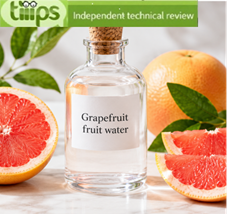
Its documented cosmetic functions include mainly Perfuming, Skin Conditioning, and Fragrance, with use primarily to provide a delicate citrus character and contribute to the sensory properties of the formulation.
Description
Citrus Grandis Fruit Water is obtained by steam distillation of the fruit.
During distillation, steam carries part of the volatile substances present in the botanical raw material. After condensation, an aromatic aqueous phase is obtained together with, where present in sufficient quantity, a separable oil phase.
The aqueous fraction therefore contains mainly:
water;
traces of volatile aromatic substances;
small amounts of terpenes and oxygenated compounds dispersed in water;
other volatile substances carried over during distillation.
It should not be confused with:
Citrus Grandis Juice, obtained by pressing the pulp;
Citrus Grandis Fruit Extract, obtained by extraction;
Citrus Grandis Peel Oil, a much more concentrated essential oil;
Citrus Grandis Fruit/Peel Water, which also includes material derived from the peel.
These raw materials can have different chemical profiles and different levels of furocoumarins.
Manufacturing process
Production may include:
selection and washing of the fruit;
preparation or crushing of the botanical material where appropriate;
introduction into the distillation system;
passage of steam through the plant material;
entrainment of volatile constituents;
condensation of the vapors;
separation of any oil phase;
collection of the aqueous fraction;
filtration;
microbiological control;
possible stabilization or preservation;
packaging.
The ingredient is defined as an aqueous solution of the steam distillate obtained from the fruit of Citrus grandis.
The actual composition depends on:
cultivar and geographical origin of the fruit;
proportion of pulp and other fruit tissues involved;
duration of distillation;
temperature and pressure;
water-to-botanical-material ratio;
efficiency of essential-oil separation;
storage conditions.
Main compounds present
Grapefruit Fruit Water is not a single chemical substance but a botanical aqueous mixture.
Water is quantitatively predominant. The aromatic fraction may contain, generally at very low and variable concentrations:
limonene;
linalool;
α-pinene;
β-pinene;
other monoterpenes;
aromatic alcohols and aldehydes;
traces of other characteristic grapefruit volatiles.
The actual presence and concentration of each compound should be verified for the specific commercial grade.
Analytical data on grapefruit fruit waters indicate that fragrance constituents may occur at much lower levels than in essential oils. This should nevertheless not be generalized to every commercial raw material without analytical confirmation.
Identification data and specifications
| Characteristic | Value | Note |
|---|---|---|
| INCI name | Citrus Grandis Fruit Water | cosmetic ingredient name |
| Common name | Grapefruit Fruit Water | botanical fruit water |
| Definition | aqueous solution of the steam distillate obtained from the fruit of Citrus grandis | botanical water |
| Botanical name | Citrus grandis | name used in the cosmetic definition |
| Botanical family | Rutaceae | citrus family |
| Plant part used | fruit | according to the INCI definition |
| Category | botanical water / steam distillate water | multicomponent mixture |
| Molecular formula | not applicable | not a single substance |
| Molecular weight | not applicable | depends on individual constituents |
| CAS | 90045-43-5 / 8016-20-4 | associated identifiers |
| EC | 289-904-6 / — | associated European identifier |
| CosIng reference | 55374 | ingredient reference |
| Cosmetic functions | Fragrance; Perfuming; Skin Conditioning | documented functions |
| Cosmetics Regulation provisions | II/358 | provision relating to furocoumarins |
The II/358 provision represents an important regulatory warning and should be specifically considered when assessing the raw material.
Indicative physicochemical properties
| Characteristic | Indicative value | Note |
|---|---|---|
| Appearance | clear or slightly opalescent aqueous liquid | depends on commercial grade |
| Color | colorless to slightly yellowish | process-dependent |
| Odor | delicate, citrus-like, characteristic of grapefruit | much less intense than essential oil |
| Water affinity | very high | water is the predominant phase |
| Aromatic content | low and variable | depends on distillation |
| Aromatic volatility | moderate for the odor fraction | bulk phase remains aqueous |
| pH | variable | verify TDS/COA |
| Microbiological stability | requires attention | typical of aqueous raw materials |
| Light and heat stability | requires control | aromatic constituents may degrade |
| Formulation behavior | readily incorporated into aqueous phases | suitable for aqueous formulations and emulsions |
Cosmetics
Grapefruit Fruit Water may be used in:
facial toners;
facial waters;
serums;
creams;
lotions;
cleansers;
shampoos;
conditioners;
scalp products;
cosmetic mists and sprays;
after-sun products;
formulations containing other botanical ingredients.
Its role is mainly sensory and formulation-related.
It can provide a delicate citrus note without introducing the same concentration of aromatic substances typically associated with grapefruit essential oil.
As a Skin Conditioning ingredient, it can contribute to the overall sensory characteristics of the formulation, but it should not automatically be considered:
a dermatological active ingredient;
a clinically effective antioxidant;
an antibacterial agent;
a skin-lightening agent;
a UV filter.
Any such properties would require specific evidence for the commercial grade and the finished formulation.
Pros
It is a predominantly aqueous botanical ingredient.
It provides a delicate grapefruit citrus note.
It generally contains much lower levels of aromatic substances than essential oil.
It can be readily incorporated into the aqueous phase.
It is suitable for a wide range of skin- and hair-care formulations.
It can contribute to sensory characterization without increasing the lipid phase.
Available cosmetic safety assessments of citrus fruit-derived ingredients are generally favorable under appropriate formulation conditions.
Cons
Composition may vary considerably between suppliers.
As an aqueous raw material, it requires adequate microbiological control.
Botanical origin does not automatically guarantee the absence of sensitizing substances.
It may contain traces of grapefruit aromatic constituents.
Grapefruit-derived materials require particular attention to furocoumarins and 5-methoxypsoralen (5-MOP).
The ingredient is subject to the specific Cosmetics Regulation provision II/358.
It should not be confused with essential oil or concentrated extract, which have different risk profiles.
Properties generically attributed to grapefruit cannot automatically be transferred to the distilled fruit water.
Safety, regulation and environment
Citrus fruit-derived cosmetic ingredients, including grapefruit fruit waters, have been evaluated with particular attention to irritation, sensitization, and phototoxic constituents.
The overall safety profile is favorable when formulations are designed to be non-irritating and non-sensitizing and when relevant furocoumarin exposure is adequately controlled.
EU Cosmetics Regulation provisions
Citrus Grandis Fruit Water is subject to:
Cosmetics Regulation provisions: II/358
Entry 358 of Annex II concerns:
Furocoumarins, including trioxysalen, 8-methoxypsoralen, and 5-methoxypsoralen, except for normal content in natural essences used.
For sun protection and tanning products, the total furocoumarin content must be:
< 1 mg/kg in the finished product.
This is an important Cosmetics Regulation provision.
Its inclusion under Annex II does not mean that Grapefruit Fruit Water is completely prohibited. The provision allows the normal content occurring in natural essences while imposing the specific limit applicable to sun protection and tanning products.
Furocoumarins and phototoxicity
Furocoumarins are naturally occurring compounds found in several citrus species. Some, including 5-MOP and 8-MOP, can interact with UVA radiation and cause phototoxic and photomutagenic effects.
This is the reason for specific regulatory control in products associated with sun exposure.
The actual risk from Grapefruit Fruit Water depends on its real composition. Furocoumarins are considerably less volatile than the principal terpenes of citrus essential oils, so steam distillation generally limits their transfer into the aqueous phase.
However, it is not appropriate to assume that every commercial grade is automatically free of furocoumarins.
Particularly in:
leave-on products;
products used on sun-exposed skin;
sunscreens;
tanning products;
analytical information on 5-MOP and total furocoumarins is advisable.
Irritation and sensitization
Citrus fruit-derived ingredients should be formulated to be non-irritating and non-sensitizing.
Distilled fruit water normally has a much lower aromatic load than essential oils, but any fragrance constituents present should still be considered according to their actual concentration.
Raw-material control
For professional evaluation, it is advisable to obtain:
an updated SDS;
a Certificate of Analysis (COA);
technical data sheet;
confirmation of botanical identity;
confirmation of the fruit material actually distilled;
distillation method;
pH;
density;
dry residue where specified;
aromatic-component profile;
5-MOP content;
total furocoumarin content, particularly for sun-care applications;
fragrance-allergen profile where relevant;
microbiological specifications;
preservative system, if present;
pesticide and metal data where relevant;
stability data;
declaration of compliance with Cosmetics Regulation provision II/358.
For this ingredient, furocoumarin control is particularly important when the raw material is intended for products associated with exposure to sunlight.
Environment
Grapefruit Fruit Water consists mainly of water with small amounts of botanical organic substances.
Its overall environmental impact depends mainly on:
grapefruit cultivation;
water consumption;
pesticide use where applicable;
energy required for steam distillation;
management of residual plant material;
transport;
preservatives added to the commercial grade.
Distillation may also allow the use of citrus-industry by-products, although this environmental advantage depends on the actual production chain and cannot automatically be attributed to every commercial material.
Conclusion
Grapefruit Fruit Water (Citrus Grandis Fruit Water) is a botanical water obtained by steam distillation of grapefruit fruit, used mainly for delicate perfuming and skin conditioning.
Compared with grapefruit essential oil, it generally contains much lower levels of aromatic substances and is more readily incorporated into aqueous formulations.
The main point of caution is regulatory: the ingredient is subject to Cosmetics Regulation provision II/358 concerning furocoumarins. In sun protection and tanning products, total furocoumarins must be below 1 mg/kg in the finished product.
Its safety profile is generally favorable when the finished formulation is non-irritating and non-sensitizing and when phototoxic constituents are adequately controlled.
Grapefruit Fruit Water can be considered a generally favorable cosmetic ingredient when the commercial grade is well characterized, with particular attention to furocoumarins, 5-MOP, microbiological quality, aromatic constituents, stability, and compliance with Cosmetics Regulation provision II/358.

