



Propylene Glycol Dicaprylate/Dicaprate: properties, uses, pros, cons, safety
Propylene Glycol Dicaprylate/Dicaprate is a mixture of diesters of propylene glycol with caprylic acid (octanoic acid, C₈) and capric acid (decanoic acid, C₁₀). It is a lipophilic ingredient used mainly in cosmetics as an emollient, improving spreadability, softness, and the sensory characteristics of formulations.
Its European chemical description is “Decanoic acid, mixed diesters with octanoic acid and propylene glycol.” Its documented cosmetic function is EMOLLIENT.
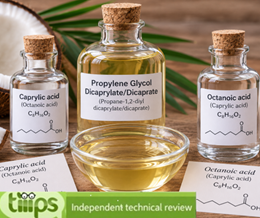
It should not be confused with free Propylene Glycol: in Propylene Glycol Dicaprylate/Dicaprate, the hydroxyl groups of propylene glycol are esterified with fatty acids, resulting in very different physicochemical properties, lipophilicity, and cosmetic behavior.
Description
Propylene Glycol Dicaprylate/Dicaprate belongs to the family of propylene glycol fatty acid esters.
The alcohol component is propane-1,2-diol, while the lipid component is derived from relatively short saturated fatty acids:
caprylic acid / octanoic acid, C₈;
capric acid / decanoic acid, C₁₀.
The commercial material does not necessarily consist of a single molecular species. It includes a distribution of diesters in which propylene glycol may be esterified with:
two caprylic acid residues;
two capric acid residues;
one caprylic and one capric acid residue.
It should therefore be considered a mixture of C₈–C₁₀ propylene glycol diesters.
The relatively compact C₈–C₁₀ chains generally provide a light, smooth, and relatively non-greasy sensory profile compared with many vegetable oils or longer-chain esters.
Manufacturing process
Propylene Glycol Dicaprylate/Dicaprate is produced by esterification of propylene glycol with caprylic and capric acids, or with fatty acid fractions rich in these two components.
The process may include:
preparation and purification of propylene glycol;
preparation of the C₈–C₁₀ fatty acid mixture;
esterification under controlled temperature;
removal of water generated during the reaction;
monitoring of esterification progress;
neutralization or removal of the catalyst;
removal of unreacted starting materials;
filtration;
purification;
optional deodorization;
oxidative-stability control.
Caprylic and capric acids may be derived from oleochemical raw materials, for example fractions of oils rich in medium-chain fatty acids, or from other industrial sources.
A vegetable origin should not be assumed solely from the INCI name and should instead be verified through supplier documentation.
Main compounds present
The commercial material consists mainly of a mixture of:
propylene glycol dicaprylate;
propylene glycol dicaprate;
mixed propylene glycol caprylate/caprate diesters.
Smaller amounts may include:
unreacted caprylic acid;
unreacted capric acid;
residual propylene glycol;
monoester intermediates;
water;
traces of catalyst;
other esterification by-products.
The proportion of the different species varies according to the composition of the starting fatty acids and the manufacturing conditions.
Identification data and specifications
| Characteristic | Value | Note |
|---|---|---|
| INCI name | Propylene Glycol Dicaprylate/Dicaprate | cosmetic ingredient name |
| Chemical name | Decanoic acid, mixed diesters with octanoic acid and propylene glycol | European chemical denomination |
| Chemical category | propylene glycol diesters of C₈–C₁₀ fatty acids | glycol esters |
| Molecular formula | not unique | mixture of different diesters |
| Molecular weight | approximately 328.49–384.59 g/mol | indicative range for the C₈–C₁₀ diester mixture |
| CAS | 68583-51-7; 58748-27-9; 68988-72-7 | identifiers associated with the ingredient |
| EC | 271-516-3 | principal European identifier |
| CosIng reference | 78795 | European cosmetic ingredient reference |
| Official cosmetic function | Emollient | documented function |
| Cosmetics Regulation provisions | no specific provision indicated | no specific Annex II–VI provision identified |
Indicative physicochemical properties
| Characteristic | Indicative value | Note |
|---|---|---|
| Appearance | clear liquid | typical of cosmetic grades |
| Color | colorless to slightly yellowish | depends on commercial grade |
| Odor | mild | generally has little impact on fragrance |
| Water solubility | very low | predominantly lipophilic material |
| Affinity for oils and esters | high | readily incorporated into the lipid phase |
| Viscosity | relatively low | contributes to a light sensory profile |
| Volatility | low | non-volatile ester under normal cosmetic conditions |
| Sensory profile | light, smooth, relatively non-greasy | useful in facial products and make-up |
| Stability | generally good | depends on purity, temperature, and storage conditions |
| Formulation behavior | emollient and lipophilic carrier | may facilitate dispersion of oil-soluble components |
Cosmetics
Its main cosmetic use is as an emollient.
It may be used in:
facial creams;
body creams;
lotions;
serums;
sunscreen products;
foundations;
concealers;
lip products;
color cosmetics;
hair-care products;
body oils;
oil cleansers;
anhydrous formulations.
Compared with heavier vegetable oils, it can provide a drier and less greasy feel, improving product distribution on the skin.
It may also be used as a carrier and dispersing medium for lipophilic substances, pigments, and other ingredients incorporated into the oil phase. These are formulation uses, while its official cosmetic function remains Emollient.
It is compatible with many systems containing anionic, non-ionic, or cationic surfactants and may contribute to adjusting the consistency of the lipid phase.
Pros
It is a light emollient.
It improves spreadability and distribution of cosmetic products.
It generally leaves a less greasy feel than many traditional oils.
It is useful in facial products and make-up.
It has good compatibility with many lipid phases.
It can contribute to dispersion of pigments and lipophilic components.
It can be used in both leave-on and rinse-off products.
It has low volatility.
It is chemically stable under normal formulation conditions.
Available cosmetic safety assessments support its use under the evaluated conditions when formulations are designed to be non-irritating.
Cons
It is practically insoluble in water and requires a lipid phase or an appropriate emulsification system.
It is not a humectant and does not perform the same function as free propylene glycol.
The INCI name identifies a mixture, so the exact profile may vary between manufacturers.
A high ester-phase content can significantly modify the consistency and sensory properties of a formulation.
Commercial grades should be controlled for free fatty acids, monoesters, and residual propylene glycol.
Although it generally has a favorable tolerability profile, the finished formulation should still be verified to be non-irritating.
Vegetable origin of the fatty acids is not guaranteed by the INCI name alone.
Safety, regulation and environment
The Cosmetic Ingredient Review Expert Panel evaluated Propylene Glycol Dicaprylate/Dicaprate together with other propylene glycol fatty acid esters.
The conclusion was that the ingredients in this group are safe under the cosmetic practices and concentrations evaluated when formulated to be non-irritating.
Specific available studies on Propylene Glycol Dicaprylate/Dicaprate showed minimal or no irritation in dermal testing and no significant comedogenic behavior under the investigated conditions.
Historically reported cosmetic use concentrations have included levels up to approximately 51.8% in certain product categories. This figure represents a reported use concentration and does not constitute a regulatory maximum limit of 51.8%.
EU Cosmetics Regulation provisions
No specific “Cosmetics Regulation provisions / Cosmetic restrictions” are indicated for Propylene Glycol Dicaprylate/Dicaprate.
There is therefore no specific provision comparable to III/60, III/62, or IV/119 identified for other ingredients.
The absence of a specific restriction does not mean that any concentration is automatically safe. The actual concentration, application area, leave-on or rinse-off use, and composition of the finished product must be considered in the cosmetic safety assessment.
Raw-material control
For professional evaluation, it is advisable to obtain:
an updated SDS;
a Certificate of Analysis (COA);
technical data sheet;
diester composition;
ratio of C₈ and C₁₀ fractions;
acid value;
hydroxyl value where specified;
residual propylene glycol;
free fatty acids;
monoesters;
water content;
color;
odor;
viscosity;
density;
refractive index;
oxidative-stability data;
possible catalyst residues;
origin of the fatty acids where relevant;
available irritation data.
Environment
Environmental assessment should consider the properties of the actual commercial grade used.
Relevant parameters include:
biodegradability;
actual quantity used;
release from rinse-off products;
adsorption to sludge;
fate in wastewater-treatment systems;
origin of the raw materials;
energy and processing requirements of manufacturing.
Available ecotoxicological data for this substance and structurally related glycol esters have generally not shown significant effects on aquatic organisms up to their water-solubility limits under the tested conditions.
This does not mean that the ingredient should automatically be considered environmentally impact-free.
Conclusion
Propylene Glycol Dicaprylate/Dicaprate is a mixture of propylene glycol diesters with caprylic and capric acids, used mainly as a light emollient and lipophilic carrier.
Its main formulation advantage is its ability to provide spreadability, softness, and a relatively dry, non-greasy sensory profile, making it particularly useful in facial products, make-up, sunscreens, and anhydrous formulations.
Its overall safety profile is favorable, and available cosmetic assessments support its use under the evaluated conditions when formulations are non-irritating.
No specific Cosmetics Regulation provisions are identified for this ingredient.
Propylene Glycol Dicaprylate/Dicaprate can be considered a favorable and technically versatile cosmetic ingredient, with particular attention to purity, composition of the ester mixture, residual fatty acids and propylene glycol, stability, and tolerability of the finished formulation.

