



Satureja Montana Extract: properties, uses, pros, cons, safety
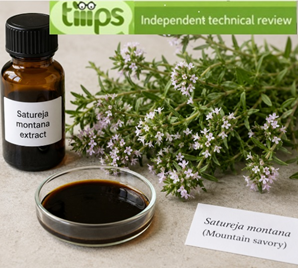
Satureja Montana Extract is a botanical extract obtained from the whole plant of Satureja montana L., commonly known as winter savory or mountain savory. Satureja montana is an accepted botanical species belonging to the family Lamiaceae, naturally distributed from central and southern Europe to the eastern Mediterranean.
The ingredient is a complex mixture of phytochemicals, not a single chemical substance. Its profile can vary substantially depending on the botanical material, geographical origin, cultivation conditions, drying process, extraction solvent, and extraction technology.
Its documented cosmetic function is Skin Conditioning.
Description
Satureja Montana Extract is derived from the aromatic plant Satureja montana, a perennial subshrub of the Lamiaceae family.
Depending on the extraction method, the material may contain different classes of natural compounds, including:
phenolic acids;
flavonoids;
luteolin derivatives;
rosmarinic acid;
other polyphenols;
terpenes and aromatic constituents in variable amounts;
carbohydrates and other water-soluble plant components.
The composition of the extract must be distinguished from that of Satureja Montana Oil.
The essential oil is enriched mainly in volatile constituents such as carvacrol, thymol, and terpenes, whereas an aqueous, glycolic, or hydroalcoholic extract may be considerably richer in polyphenols and phenolic acids while containing much lower levels of volatile compounds.
Recent studies on S. montana extracts have obtained fractions particularly rich in total phenols, phenolic acids including rosmarinic acid, flavonoids, and luteolin derivatives.
Manufacturing process
Production normally begins with Satureja montana plant material that has been botanically identified, cleaned, and, where appropriate, dried.
The process may include:
harvesting the plant;
botanical selection and identification;
drying;
grinding;
extraction using water, ethanol, hydroalcoholic mixtures, glycerin, glycols, or other cosmetically suitable solvents;
maceration, agitation, or assisted extraction;
filtration;
concentration;
partial removal of the extraction solvent where appropriate;
standardization;
microbiological control;
stabilization of the commercial grade.
More recent extraction technologies using glycerol and hydroxypropyl-β-cyclodextrin have also been investigated in order to enhance selective extraction of polyphenols, rosmarinic acid, flavonoids, and luteolin derivatives.
Other experimental processes have used hydroalcoholic extraction followed by drying to obtain concentrated extracts with rosmarinic acid as one of the predominant identified constituents.
These examples show that the INCI name alone does not define a unique phytochemical profile.
Main compounds present
The exact composition varies with the type of extract, but components may include:
rosmarinic acid;
luteolin derivatives;
other flavonoids;
phenolic acids;
polyphenols;
carvacrol in variable amounts;
terpenes;
aromatic constituents;
water-soluble plant substances.
Rosmarinic acid is one of the most consistently documented constituents in polar extracts of Satureja montana.
Other extraction systems can enrich different fractions, including:
total phenols;
phenolic acids;
flavonoids;
luteolin derivatives.
The concentrations reported for a specific experimental extract should not automatically be attributed to every commercial Satureja Montana Extract.
Identification data and specifications
| Characteristic | Value | Note |
|---|---|---|
| INCI name | Satureja Montana Extract | cosmetic ingredient name |
| Definition | extract of the whole plant of Satureja montana | botanical extract |
| Botanical name | Satureja montana L. | accepted species |
| Common name | Winter Savory / Mountain Savory | common English names |
| Botanical family | Lamiaceae | current botanical classification |
| Plant part used | whole plant | according to the ingredient definition |
| Chemical category | multicomponent botanical extract | phytochemical mixture |
| Molecular formula | not applicable | not a single chemical substance |
| Molecular weight | not applicable | depends on individual constituents |
| CAS | 90106-57-3 | identifier associated with Satureja montana extracts |
| EC | 290-280-2 | European identifier |
| CosIng reference | 90676 | cosmetic ingredient reference |
| Cosmetic function | Skin Conditioning | documented cosmetic function |
| Cosmetics Regulation provisions | no specific provision indicated | no specific Annex II–VI provision identified |
Indicative physicochemical properties
| Characteristic | Indicative value | Note |
|---|---|---|
| Commercial form | liquid, solution, viscous extract, or dry extract | depends on the process |
| Color | yellow, green-brown, or brown | variable |
| Odor | herbal, aromatic | intensity depends on volatile fraction |
| Solubility | vehicle-dependent | differs between aqueous, glycolic, hydroalcoholic, and lipophilic extracts |
| pH | variable | verify supplier specification |
| Oxidative stability | requires control | polyphenols and aromatic constituents may oxidize |
| Light stability | requires control | depends on phytochemical profile |
| Phytochemical variability | high | influenced by origin and extraction method |
| Microbiological sensitivity | relevant in aqueous grades | adequate microbiological control required |
| Formulation compatibility | solvent- and concentration-dependent | verify in the finished product |
Cosmetics
The documented cosmetic function of Satureja Montana Extract is Skin Conditioning.
It may be used in:
facial creams;
body creams;
serums;
lotions;
products for blemish-prone skin;
cleansers;
shampoos;
scalp products;
conditioners;
leave-on treatments;
formulations containing combinations of botanical extracts.
The ingredient is of particular cosmetic interest because some extracts contain significant amounts of polyphenols and flavonoids.
Specific experimental extracts have shown:
antioxidant activity;
anti-lipoxygenase activity;
anti-elastase activity;
anti-hyaluronidase activity;
anti-tyrosinase activity;
UV absorption in vitro.
These findings are scientifically interesting, but they apply to specific experimental extracts and do not demonstrate that every cosmetic containing Satureja Montana Extract provides clinically meaningful anti-aging, healing, brightening, or photoprotective effects.
In particular, in vitro UV absorption does not make Satureja Montana Extract an authorized UV filter.
Pros
It is a botanical ingredient with a documented Skin Conditioning function.
It can be used in both skin-care and hair-care products.
Polar extracts can be rich in rosmarinic acid and other polyphenols.
Specific extracts have shown strong antioxidant activity in vitro.
Anti-elastase and anti-hyaluronidase activity has been reported for appropriately prepared extracts.
Certain experimental extracts have shown good cellular compatibility.
The phytochemical profile can be modulated through solvent choice and extraction technology.
The species and extract identifiers are well established in European chemical databases.
Cons
It is a complex and variable botanical extract.
The INCI name does not indicate the concentration of individual constituents.
Extracts produced with different solvents may have very different properties.
In vitro results do not automatically translate into clinical efficacy in the finished cosmetic product.
It should not be confused with Satureja Montana Oil, which is much richer in volatile aromatic compounds.
Carvacrol, thymol, and related aromatic constituents may vary greatly depending on the process.
Botanical extracts require control for pesticides, metals, and microbiological contamination.
Highly aromatic grades may require additional attention to irritation and sensitization potential.
Safety, regulation and environment
No specific SCCS or CIR assessment dedicated exclusively to Satureja Montana Extract was identified that establishes a universal safe cosmetic concentration.
Safety should therefore be evaluated according to:
actual composition of the commercial grade;
extraction solvent;
concentration in the finished formulation;
purity;
profile of key constituents;
irritation and sensitization data;
application type;
expected exposure.
Available experimental data
Experimental studies on specific Satureja montana extracts have reported generally favorable toxicological or biocompatibility findings under the conditions tested.
These data are useful, but they should not be interpreted as a universal safety assessment because:
the tested extract may differ from commercial cosmetic grades;
extraction methods may alter the phytochemical composition substantially;
experimental exposure conditions may differ from topical cosmetic use.
Extract versus essential oil
It is important to distinguish the safety profile of Satureja Montana Extract from that of Satureja Montana Oil.
The essential oil can be particularly rich in phenolic aromatic substances such as carvacrol and thymol, which may require specific precautions because of irritation potential.
These characteristics should not automatically be transferred to the botanical extract, which may have a completely different composition.
Conversely, an extract intentionally enriched in volatile or aromatic fractions should be assessed according to its actual composition.
EU Cosmetics Regulation provisions
No specific “Cosmetics Regulation provisions / Cosmetic restrictions” are identified for Satureja Montana Extract under Annexes II–VI of the EU Cosmetics Regulation.
The absence of a specific Annex provision does not mean that every concentration or commercial extract is automatically safe. The finished cosmetic product and the specific raw material used still require an appropriate safety assessment.
Raw-material control
For professional evaluation, it is advisable to obtain:
an updated SDS;
a Certificate of Analysis (COA);
technical data sheet;
botanical identification;
confirmation of the plant part used;
geographical origin and traceability;
extraction solvent;
plant-to-extract ratio where available;
dry matter content;
phytochemical markers;
rosmarinic acid content where standardized;
flavonoid profile where relevant;
carvacrol and thymol content if present in significant amounts;
residual solvents;
pesticide analysis;
heavy-metal analysis;
microbiological specifications;
mycotoxin data where relevant;
pH;
preservative system of the commercial grade;
stability data;
available irritation and sensitization data.
For a botanical extract, phytochemical standardization is especially useful because it helps distinguish raw materials that share the same INCI name but have substantially different compositions and activities.
Environment
Satureja Montana Extract is derived from botanical material, but its environmental impact depends on the entire supply chain.
Relevant factors include:
cultivation or harvesting practices;
geographical origin;
water consumption;
fertilizer and pesticide use;
drying method;
extraction solvents;
energy consumption;
process-water treatment;
management of residual plant biomass;
biodegradability of the commercial carrier system.
Botanical origin does not automatically guarantee a low environmental impact.
Conclusion
Satureja Montana Extract is an extract of the whole plant of Satureja montana L., family Lamiaceae, used in cosmetics primarily for Skin Conditioning.
Its most important characteristic is its phytochemical variability: aqueous, glycolic, hydroalcoholic, or selectively prepared extracts may contain very different levels of rosmarinic acid, flavonoids, luteolin derivatives, and aromatic constituents.
Recent studies on specific extracts show an interesting antioxidant and cosmetic-research profile in vitro together with good cellular compatibility, but these findings should not automatically be extended to every raw material sold under the same INCI name.
No specific Cosmetics Regulation provisions are identified for this ingredient.
Satureja Montana Extract can be considered a cosmetically interesting botanical ingredient, particularly when the commercial grade is well identified and standardized. The main points to verify are extraction method, phytochemical profile, rosmarinic acid and aromatic constituents where relevant, pesticides, metals, microbiological quality, residual solvents, stability, and skin-tolerability data.

