



BAPDMA (Behenamidopropyl Dimethylamine ): properties, uses, pros, cons, safety
Behenamidopropyl Dimethylamine, commonly abbreviated BAPDMA, is a long-chain amidoamine obtained by reacting behenic acid with 3-dimethylaminopropylamine (DMAPA). Its long hydrophobic C₂₂ chain and terminal amine group give it properties that are particularly useful in hair-care formulations.
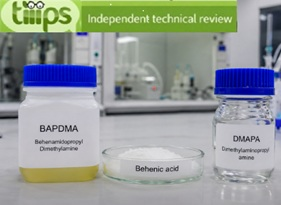
Its documented cosmetic functions are Antistatic and Surfactant – Emulsifying. Under acidic conditions, the tertiary amine becomes protonated and the compound acquires cationic behavior, a property extensively exploited in conditioners and other hair-conditioning treatments.
Description
Behenamidopropyl Dimethylamine belongs to the family of fatty acid amidopropyl dimethylamines, commonly referred to as amidoamines.
Its structure contains:
a long lipophilic behenyl chain;
an amide group;
a propyl chain;
a terminal tertiary dimethylamine group.
In its non-neutralized form, the compound is not a quaternary ammonium salt. When neutralized with an organic or mineral acid, the amine group becomes protonated and the molecule develops cationic character, increasing its affinity for the hair surface, which normally carries negative charges, particularly when damaged.
This behavior can improve:
wet and dry combability;
softness;
slip;
reduction of static electricity;
tactile properties;
deposition of conditioning material on the hair fiber.
Studies specifically performed on BAPDMA have shown that its protonated form can provide effective conditioning performance while also showing favorable biodegradability compared with some traditional cationic surfactants.
Manufacturing process
Behenamidopropyl Dimethylamine is produced by amidation of behenic acid with DMAPA.
In general, the manufacturing process includes:
preparation of behenic acid;
controlled addition of DMAPA;
heating of the reaction mixture;
formation of the amide bond;
removal of water or other condensation by-products;
removal of unreacted DMAPA;
purification;
solidification;
conversion into pellets, flakes, or another commercial form;
amine-value determination;
residual-acidity control;
impurity analysis.
The production reaction therefore combines the long-chain fatty acid portion with the aminopropyl dimethylamine portion to form the characteristic amidoamine structure.
One of the most important quality parameters is residual DMAPA, because this substance has recognized sensitizing potential and should therefore be minimized in cosmetic-grade raw material.
Main compounds present
In a high-purity raw material, the principal component is Behenamidopropyl Dimethylamine.
Depending on the manufacturing process, smaller amounts may include:
residual DMAPA;
unreacted behenic acid;
related amidoamines;
amidation by-products;
water;
traces of catalysts or other process residues.
Commercial specifications have reported residual DMAPA levels in the low ppm range for certain grades. Such values are supplier-specific and should not be regarded as universal specifications.
The important principle is that the concentration of sensitizing DMAPA should be kept as low as technically achievable.
Identification data and specifications
| Characteristic | Value | Note |
|---|---|---|
| INCI name | Behenamidopropyl Dimethylamine | cosmetic ingredient name |
| Abbreviation | BAPDMA | technical abbreviation |
| Chemical name | N-[3-(Dimethylamino)propyl]docosanamide | chemical denomination |
| Chemical category | fatty acid amidopropyl dimethylamine / amidoamine | behenic-acid derivative |
| Molecular formula | C₂₇H₅₆N₂O | defined molecular substance |
| Molecular weight | approximately 424.7 g/mol | theoretical molecular value |
| CAS | 60270-33-9 | substance identifier |
| EC | 262-134-8 | European identifier |
| PubChem CID | 108912 | PubChem identifier |
| CosIng reference | 32098 | European cosmetic ingredient reference |
| Official cosmetic functions | Antistatic; Surfactant – Emulsifying | documented cosmetic functions |
| Cosmetics Regulation provisions | no specific provision identified | no specific Annex II–VI entry associated with the ingredient |
Indicative physicochemical properties
| Characteristic | Indicative value | Note |
|---|---|---|
| Appearance | pellets or white to yellowish solid | typical concentrated commercial grade |
| Melting point | approximately 80 °C | representative commercial value |
| Volatility | extremely low | consistent with the long C₂₂ chain |
| Water affinity as free base | limited | strongly lipophilic component |
| Compatibility after acid neutralization | substantially improved | formation of the protonated salt |
| Ionic behavior | weakly basic as free base; cationic after protonation | essential for hair conditioning |
| Hygroscopicity | low in certain solid commercial grades | grade-dependent |
| Melt viscosity | relatively low | commercial-grade dependent |
| Stability | generally good under suitable formulation conditions | influenced by pH and counterion |
| Biodegradability | favorable for specific evaluated grades/salts | should not automatically be generalized to all grades |
Cosmetics
The main field of application for Behenamidopropyl Dimethylamine is hair care.
It may be used in:
hair conditioners;
hair masks;
detangling products;
2-in-1 shampoos;
leave-on treatments;
products for damaged hair;
hair-coloring creams;
protective treatments for the hair fiber.
In conditioners, it is normally neutralized with an acid, converting it into its active cationic form.
Different acids and counterions can be used, including those derived from:
lactic acid;
succinic acid;
malic acid;
acetic acid;
citric acid;
glutamic acid;
hydrochloric acid;
phosphoric acid.
The choice of acid can influence viscosity, stability, deposition, and conditioning performance. Lactic, succinic, and malic acid salts have shown particularly favorable formulation characteristics in comparative studies.
The long behenyl chain promotes deposition on the hair surface, while the positive charge produced after protonation interacts with negatively charged areas of the hair fiber.
The resulting effects may include:
reduced combing force;
less static electricity;
improved softness;
increased slip;
better manageability;
a smoother and silkier sensory profile.
These hair-conditioning effects are well documented from a formulation standpoint, although the official cosmetic functions assigned to the ingredient are Antistatic and Surfactant – Emulsifying.
Pros
It is particularly effective in hair-conditioning formulations.
It helps reduce static electricity.
It improves wet and dry combability.
It can reduce friction between hair fibers.
It improves softness and slip.
It can serve as a formulation alternative to certain traditional quaternary ammonium compounds.
Its degree of protonation can be controlled through acid selection and formulation pH.
It can contribute to stabilization of emulsified systems.
Specific commercial systems have shown favorable biodegradability.
Products containing up to approximately 3% BAPDMA have shown good dermal tolerability in available use studies.
Human repeated-insult patch tests on shampoo formulations containing lower concentrations did not demonstrate sensitization under the tested conditions.
Cons
It belongs to a family of amidoamines with sensitization potential, so the finished formulation should be designed to be non-sensitizing.
Residual DMAPA is a critical impurity and should be minimized.
Poorly purified raw material may present a higher sensitization risk than a tightly controlled cosmetic-grade material.
The free base has limited water compatibility and normally requires acidification for use in conditioners.
Performance and formulation stability depend strongly on pH and the acid used for neutralization.
It should not be used with nitrosating agents, because amine-containing structures and secondary amine impurities may contribute to the formation of N-nitroso compounds.
Increasing the concentration does not automatically increase conditioning performance and may increase irritation or sensitization risk.
Safety and performance data obtained for one specific protonated salt or commercial grade should not automatically be transferred to every BAPDMA raw material.
Safety, regulation and environment
The Cosmetic Ingredient Review Expert Panel evaluated Behenamidopropyl Dimethylamine together with other fatty acid amidopropyl dimethylamines.
The assessment concluded that these ingredients are safe in cosmetics when formulated to be non-sensitizing, with the appropriate concentration potentially established through a Quantitative Risk Assessment (QRA).
Sensitization
Sensitization is the principal point of caution.
Two factors must be considered separately:
the sensitization potential of the amidoamine itself;
the contribution of residual DMAPA.
For long-chain fatty acid amidopropyl dimethylamines, including BAPDMA, the non-sensitizing concentration should be established using appropriate sensitization data and risk-assessment methodology.
The level of residual DMAPA should also be maintained as low as technically feasible.
Specific available product-use data are generally favorable. Examples include:
a conditioner containing approximately 3% used daily for two weeks without significant dermal irritation or adverse effects in the test population;
a shampoo containing approximately 0.3% with favorable tolerability;
HRIPTs performed on shampoo formulations containing approximately 0.3% without evidence of sensitization under the tested conditions.
These concentrations relate to specific tested formulations and should not be interpreted as universal regulatory limits.
Nitrosamines
A second relevant safety consideration is the potential formation of N-nitroso compounds.
Fatty acid amidopropyl dimethylamines contain amine and amide structures and may also contain secondary amine impurities arising from production.
Under suitable conditions, such components may participate in N-nitrosation reactions.
For this reason, formulations containing BAPDMA should not be combined with nitrosating agents.
Appropriate quality control should therefore consider:
residual DMAPA;
secondary amines;
nitrites where relevant;
nitrosamines where appropriate;
nitrosating substances present in the finished formulation.
EU Cosmetics Regulation provisions
No specific “Cosmetics Regulation provisions / Cosmetic restrictions” are identified for Behenamidopropyl Dimethylamine under Annexes II–VI of the EU Cosmetics Regulation.
The absence of a specific Annex provision does not remove the need to manage the recognized issues of sensitization, residual DMAPA, secondary amines, and nitrosation.
Environment
Specific BAPDMA-based conditioning systems have shown an interesting environmental profile compared with certain conventional cationic surfactants.
Reported properties for evaluated systems include:
high aerobic biodegradation;
substantial anaerobic biodegradation;
lower aquatic toxicity than some conventional quaternary ammonium conditioning agents.
These results should not be interpreted as evidence that every commercial BAPDMA grade has the same environmental profile.
Environmental assessment should consider:
free-base or protonated form;
counterion;
use concentration;
biodegradability of the specific grade;
aquatic toxicity;
release from rinse-off products;
behavior in wastewater-treatment systems.
For professional evaluation of the raw material, it is advisable to obtain:
an updated SDS;
a Certificate of Analysis (COA);
technical data sheet;
purity data;
residual DMAPA specification;
residual behenic acid;
secondary amine content;
amine value;
acid value;
nitrosamine data where relevant;
nitrite control where relevant;
melting point;
color and odor specifications;
biodegradability data;
ecotoxicological information;
recommended pH and neutralization conditions;
supplier-recommended use concentration;
sensitization-safety documentation.
Conclusion
Behenamidopropyl Dimethylamine (BAPDMA) is a long-chain amidoamine particularly useful in hair-care products. After acid neutralization, it acquires cationic behavior and can improve combability, softness, slip, manageability, and control of static electricity.
The available cosmetic safety assessment is generally favorable, but with an important condition: the ingredient must be formulated so that the finished product is non-sensitizing.
The two most important quality and safety issues are residual DMAPA, which should be minimized, and the potential for N-nitrosation, which is why combinations with nitrosating agents should be avoided.
No specific Cosmetics Regulation provisions are identified for this ingredient.

