



Carbonated water: properties, uses, advantages, disadvantages, safety
Carbonated water is water intended for food use into which food-grade carbon dioxide is dissolved under pressure. The dissolved gas produces the characteristic effervescence, bubbles, slightly sharp mouthfeel and mild acidification.
When “carbonated water” appears in the ingredient list of a beverage, it normally means that the water used in the formulation has been artificially carbonated. It does not necessarily mean naturally carbonated mineral water.
Carbon dioxide used in foods is identified in the European Union as E 290 and internationally by Codex Alimentarius as INS 290. Under current EU food-additive legislation, E 290 is authorised at quantum satis, meaning that it may be used at the level necessary to achieve the intended technological effect in accordance with good manufacturing practice.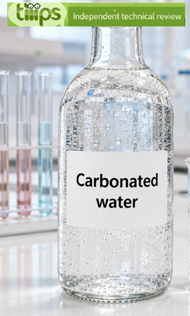
Description
Water constitutes virtually the entire liquid phase of carbonated water. Carbon dioxide is introduced and maintained in solution by pressure.
The amount of gas that remains dissolved depends mainly on:
pressure;
temperature;
composition of the beverage;
carbonation process;
packaging;
storage temperature.
At lower temperatures and higher pressures, more carbon dioxide can remain dissolved in the water.
When a bottle or can is opened, the pressure above the liquid decreases and part of the dissolved carbon dioxide progressively escapes as gas, producing the characteristic bubbles and effervescence.
A small proportion of dissolved carbon dioxide reacts reversibly with water to form carbonic acid (H₂CO₃). This equilibrium contributes to the mildly acidic character and characteristic sharp sensation of carbonated beverages.
In drinks that also contain citric acid, malic acid, phosphoric acid or other acidifying agents, however, the overall acidity of the finished product should not be attributed to carbonation alone.
Production process
Production of carbonated water for use in beverages generally includes:
sourcing water suitable for food use;
filtration or other water treatment where required;
cooling the water;
supplying food-grade carbon dioxide;
injecting or dissolving CO₂ under controlled pressure;
maintaining pressure during blending and filling;
packaging in bottles, cans or other pressure-resistant containers.
Food-grade carbon dioxide is normally supplied commercially as a liquefied gas under pressure and introduced into beverages through controlled carbonation equipment.
EU specifications for E 290 require carbon dioxide to have an assay of at least 99% v/v on the gaseous basis and establish purity criteria for unwanted substances such as carbon monoxide and oil residues.
The UK Food Standards Agency similarly lists carbon dioxide as E 290, with the same basic identity and a minimum assay of 99% v/v for food-additive use.
Main substances contained
Carbonated water is a very simple mixture.
The principal components are:
Water: the overwhelmingly predominant component.
Dissolved carbon dioxide: responsible for carbonation and effervescence.
Carbonic acid: formed in small amounts through the reversible equilibrium between water and dissolved carbon dioxide; it should not normally be regarded as a separately added ingredient.
Naturally occurring minerals and ions in the source water: depending on the water used, these may include calcium, magnesium, sodium, bicarbonates, chlorides, sulphates and other dissolved substances.
Carbonated water itself contains no meaningful amounts of sugars, fats, proteins or dietary fibre.
When carbonated water is incorporated into a complex beverage, ingredients such as sugar, fruit juice, caffeine, taurine, acids, flavours, preservatives or sweeteners belong to the overall beverage formulation, not to carbonated water itself.
Identification data and specifications
| Characteristic | Value | Note |
|---|---|---|
| Name | Carbonated water | water containing dissolved CO₂ |
| Main component | Water | liquid phase |
| Added gas | Carbon dioxide | carbonation agent |
| Water formula | H₂O | predominant substance |
| Carbon dioxide formula | CO₂ | dissolved gas |
| Carbonic acid formula | H₂CO₃ | formed in small amounts in solution |
| EU additive number | E 290 | carbon dioxide |
| Codex INS number | 290 | carbon dioxide |
| CAS | 124-38-9 | carbon dioxide |
| Molecular weight of CO₂ | 44.01 g/mol | food-additive specification |
| Food-grade CO₂ assay | ≥ 99% v/v | gaseous basis |
| EU use level | quantum satis | subject to authorised conditions |
| Main technological function | Carbonating agent | produces effervescence |
| Allergens | none intrinsic | water and CO₂ are not regulated food allergens |
Indicative nutritional values
| Nutrient | Indicative amount | Note |
|---|---|---|
| Energy | 0 kcal / 0 kJ | water and CO₂ provide no nutritional energy |
| Fat | 0 g | absent |
| Saturated fat | 0 g | absent |
| Carbohydrates | 0 g | absent |
| Sugars | 0 g | absent |
| Protein | 0 g | absent |
| Dietary fibre | 0 g | absent |
| Salt | generally negligible | depends on the mineral composition of the water |
| Cholesterol | 0 mg | absent |
Carbonation does not add calories or sugars. A carbonated beverage becomes caloric only when other energy-containing ingredients such as sugar, juice, carbohydrates or alcohol are included.
Physical and technological properties
Carbon dioxide gives water several important technological and sensory properties.
Effervescence
The most obvious characteristic is the production of bubbles when pressure is reduced.
Sharp mouthfeel
Dissolved carbon dioxide produces the characteristic tingling, sharp and refreshing sensation associated with carbonated drinks.
Mild acidification
Formation of a small amount of carbonic acid lowers the pH compared with the same water without carbonation.
Contribution to microbiological stability
Carbon dioxide and the associated reduction in pH can make the environment less favourable to the growth of some microorganisms.
This does not mean that carbonation sterilises a beverage or replaces appropriate hygiene, processing and preservation controls.
Sensory stability
In packaged beverages, dissolved CO₂ and carbon dioxide in the headspace can influence the internal atmosphere and help maintain certain sensory characteristics. The actual effect depends on the formulation, package and processing system.
Food uses
Carbonated water is used extensively in:
sparkling waters;
soft drinks;
colas;
lemonades;
orange drinks;
energy drinks;
sports drinks;
non-alcoholic aperitifs;
mixers;
tonic waters;
flavoured waters;
beer and other fermented beverages, where part of the CO₂ may also originate from fermentation;
other carbonated beverage systems.
Codex Alimentarius classifies carbon dioxide, depending on application, within functional classes including carbonating agent, foaming agent, packaging gas, preservative and propellant.
In carbonated water, its principal role is clearly that of a carbonating agent.
Advantages
Provides no calories.
Contains no sugars.
Contains no fat.
Contains no cholesterol.
Contains no dietary fibre.
Is intrinsically gluten-free.
Contains no intrinsic regulated food allergens.
Provides effervescence without requiring the addition of sugar.
Produces a refreshing and distinctive sensory effect.
Can increase beverage palatability without directly increasing energy content.
Produces mild acidification.
Can contribute to the microbiological stability of certain beverage systems.
E 290 is a well-characterised and widely used food additive.
In the EU it is authorised at quantum satis under the conditions laid down for food additives.
JECFA established an ADI “not specified” for carbon dioxide, meaning that a numerical acceptable daily intake was not considered necessary for its authorised food uses.
Disadvantages
Carbonation makes water more acidic than the equivalent still water.
Some individuals may experience temporary bloating, belching or gastric fullness after consuming carbonated drinks.
Effervescence progressively decreases after the container is opened.
The amount of dissolved CO₂ is highly dependent on temperature and pressure.
Poor closure or inappropriate storage results in loss of carbonation.
Carbonation does not sterilise the beverage.
When a product also contains citric, malic, phosphoric or other food acids, the overall acidity may be considerably greater than that produced by carbon dioxide alone.
Carbonated water cannot be used to infer the nutritional characteristics of the finished beverage: a carbonated soft drink may also contain substantial quantities of sugars, acids, caffeine or other ingredients.
Safety and regulatory status
Food-grade carbon dioxide is considered suitable for food use when it complies with the applicable purity specifications and conditions of use.
European Union
Carbon dioxide is authorised as E 290 under Regulation (EC) No 1333/2008. The current Union list specifies a maximum level of quantum satis.
EU purity specifications identify carbon dioxide as CO₂ with:
molecular weight 44.01;
assay not less than 99% v/v on the gaseous basis;
carbon monoxide not more than 10 µl/l;
oil content not more than 5 mg/kg;
additional requirements concerning acidity and reducing substances.
United Kingdom
The UK Food Standards Agency lists E 290 Carbon dioxide within its regulated food-additives data and specifies the same chemical identity, minimum 99% v/v assay and purity requirements for food-grade carbon dioxide.
United States
In the United States, the FDA lists carbon dioxide under 21 CFR §184.1240 in its food-substance inventory. FDA records identify CAS 124-38-9 and recognise multiple technical effects, including antimicrobial action, pH control, formulation aid, cooling, processing aid and propellant functions.
FDA's GRAS database also identifies carbon dioxide as a substance covered by 21 CFR 184.1240.
Consumer safety
At the concentrations normally present in carbonated beverages, ingested carbon dioxide should not be confused with the hazards associated with inhaling high concentrations of CO₂ gas.
Much of the carbon dioxide swallowed with a beverage is released by belching, while some is absorbed and eliminated through normal physiological processes.
The principal practical effects for consumers are therefore usually sensory or gastrointestinal rather than toxicological.
Industrial safety
A very different issue applies to concentrated carbon dioxide used in beverage plants.
Because CO₂ can displace oxygen from the atmosphere, a leak in a confined or poorly ventilated area can create a serious occupational asphyxiation hazard.
Industrial handling therefore requires appropriate:
ventilation;
gas monitoring;
pressure-control systems;
equipment maintenance;
worker procedures and training.
This occupational hazard relates to concentrated gas handling and not to normal consumption of carbonated water.
Acidity and teeth
Simple carbonated water is mildly acidic because part of the dissolved carbon dioxide forms carbonic acid.
It is useful to distinguish between:
Water + CO₂
→ relatively mild acidity.
Beverage + CO₂ + citric/malic/phosphoric acid
→ potentially much greater acidity.
Acidic beverage + fermentable sugars
→ combines acidity with an additional dental-caries risk associated with sugars.
The erosive potential of a finished beverage therefore depends much more on its complete formulation and pH than on the simple fact that it contains carbon dioxide.
Storage
Carbonated water must be stored in containers designed to withstand the internal pressure generated by dissolved carbon dioxide.
To retain carbonation it is advisable to:
keep the container tightly closed;
avoid excessive heat;
minimise the duration and frequency of opening;
reseal bottles immediately after use;
follow the manufacturer's storage instructions;
refrigerate where appropriate.
Lower temperature favours retention of dissolved carbon dioxide. A warm carbonated beverage therefore generally loses its effervescence more rapidly than a cold one.
Environment
The environmental impact of carbonated water depends on several factors, including:
source and treatment of the water;
source of the carbon dioxide;
energy required for purification and compression of CO₂;
beverage processing;
refrigeration;
transport;
packaging production and disposal.
Food-grade carbon dioxide may originate from industrial streams in which CO₂ is recovered, purified and brought to food-grade specifications, rather than necessarily being generated specifically for beverage production.
The actual origin of the gas depends on the supplier and production chain and cannot be determined merely from the ingredient declaration “carbon dioxide”.
Conclusion
Carbonated water consists essentially of food-grade water containing carbon dioxide dissolved under pressure.
Its main function in beverages is carbonation, producing bubbles, effervescence, a sharp sensory effect and mild acidification.
From a nutritional standpoint it is essentially neutral: it provides 0 kcal and no sugars, fats, proteins or dietary fibre. Carbonation itself should therefore not be confused with the addition of sugar or other energy-yielding ingredients.
Food-grade carbon dioxide is identified as E 290 / INS 290. In the European Union it is authorised at quantum satis, and EU specifications require a minimum assay of 99% v/v, together with defined purity criteria. The UK Food Standards Agency likewise recognises E 290 and applies corresponding food-grade specifications.
JECFA has assigned carbon dioxide an ADI “not specified”, while in the United States the FDA lists it under 21 CFR §184.1240 within its GRAS framework for food use.
The key distinction is between plain carbonated water and a complete formulated beverage. When a drink also contains sugar, citric acid, malic acid, caffeine, taurine, flavours, sweeteners, preservatives or other ingredients, its nutritional profile, acidity and safety considerations must be assessed on the basis of the complete formulation, rather than attributed to the carbonated water alone.

