



Humulus Lupulus (Hops) Extract: properties, uses, pros, cons, safety
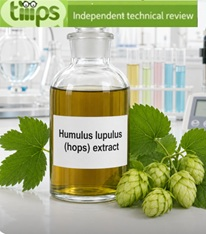
Humulus Lupulus (Hops) Extract is a botanical extract obtained from the female inflorescence, cone or strobile of Humulus lupulus L., a perennial climbing plant belonging to the botanical family Cannabaceae. The current INCI definition specifically refers to the extract obtained from the inflorescence rather than generically from the entire plant.
It is a complex botanical ingredient rather than a single chemical substance. It can contain numerous classes of compounds, including bitter acids, polyphenols, flavonoids, prenylated flavonoids, tannins, and aromatic constituents. Its composition may vary substantially according to cultivar, geographical origin, raw-material quality, extraction solvent, and manufacturing process.
Its documented cosmetic functions include mainly Antimicrobial, Hair Conditioning, Skin Conditioning, and Skin Protecting; fragrance-related uses have also been associated with hop-derived materials.
Description
Humulus lupulus is a dioecious plant. The female inflorescences form the characteristic cones or strobiles, whose bracts contain glands rich in lupulin.
Lupulin is a yellowish resinous material containing bitter acids, volatile aromatic constituents, and prenylated flavonoids. These compounds account for many of the chemical and biological characteristics of hop extracts.
The correct botanical family is Cannabaceae.
Cosmetic extracts can be produced using different solvents and extraction technologies. Consequently, two commercial raw materials carrying the same INCI name may have substantially different chemical profiles.
For example, a hydroglycolic extract is not chemically equivalent to an ethanolic or lipophilic extract. The solvent determines which fractions of the plant are preferentially extracted.
This variability is particularly relevant because some constituents of hops, including 8-prenylnaringenin (8-PN), β-myrcene, and quercetin, require specific consideration in the safety assessment.
Manufacturing process
Cosmetic production generally begins with the dried female strobiles of Humulus lupulus. After harvesting and drying, the botanical material is subjected to extraction using a suitable solvent.
Documented extraction systems include:
water and propylene glycol;
approximately 50% aqueous ethanol;
approximately 50% butylene glycol solutions;
caprylic/capric triglyceride for lipophilic extracts.
In hydroglycolic processes, the plant material may be extracted, pressed, clarified, filtered, and microbiologically treated.
Ethanolic or butylene glycol extraction processes may involve:
maceration or controlled extraction;
filtration;
concentration;
sedimentation;
standardization;
adjustment of the final extract;
packaging under controlled conditions.
The extraction method directly influences the final composition. Certain volatile or lipophilic constituents may be absent or present only in very low amounts in hydroglycolic extracts while being more concentrated in lipophilic preparations.
After extraction, important quality-control operations include:
filtration;
concentration;
standardization;
microbiological control;
residual-solvent analysis;
pesticide control;
heavy-metal testing;
analysis of relevant phytochemical markers;
control of potentially critical constituents;
stability testing of the commercial grade.
Main compounds present
Hop extract has a highly complex phytochemical composition.
Important groups and individual constituents may include:
α-acids, including humulone, cohumulone, and adhumulone;
β-acids, including compounds of the lupulone family;
xanthohumol;
isoxanthohumol;
8-prenylnaringenin (8-PN);
6-prenylnaringenin;
desmethylxanthohumol;
quercetin and its glycosides;
kaempferol and its glycosides;
tannins;
amino acids in some extracts;
volatile terpenic components, depending strongly on the extraction method.
Flavonoids represent a significant phytochemical fraction of hop strobiles, and xanthohumol is generally one of the most abundant prenylated flavonoids in fresh or properly stored hop cones.
The presence and concentration of individual compounds should not be assumed to be constant in every commercial extract.
Identification data and specifications
| Characteristic | Value | Note |
|---|---|---|
| INCI name | Humulus Lupulus (Hops) Extract | cosmetic ingredient name |
| Definition | extract obtained from the inflorescence (hop cone) of Humulus lupulus | botanical extract |
| Botanical name | Humulus lupulus L. | accepted species |
| Botanical family | Cannabaceae | botanical classification |
| Plant part used | female inflorescence / cone / strobile | botanical raw material |
| Chemical category | complex botanical extract | multicomponent mixture |
| Molecular formula | not applicable | not a single molecular substance |
| Molecular weight | not applicable | depends on the individual constituents |
| CAS | 8016-25-9; 8060-28-4 | identifiers associated with hop extract |
| EC | 232-504-3 | European identifier associated with the extract |
| CosIng reference | 83442 | European cosmetic ingredient reference |
| Documented cosmetic functions | Antimicrobial; Hair Conditioning; Skin Conditioning; Skin Protecting; Fragrance | functions associated with the ingredient |
| Cosmetics Regulation provisions | no specific provision indicated | no specific Annex II–VI provision identified |
Indicative physicochemical properties
| Characteristic | Indicative value | Note |
|---|---|---|
| Commercial form | liquid, viscous extract, or solution | depends on solvent and concentration |
| Color | yellow-green to brown | highly grade-dependent |
| Odor | characteristic, herbal, aromatic, bitter | depends on extracted fraction |
| Solubility | dependent on extraction solvent | hydroglycolic and lipophilic grades behave differently |
| pH | variable | verify supplier specification |
| Density | variable | depends on solvent and concentration |
| Air stability | susceptible to oxidation | some constituents degrade during storage |
| Light stability | requires control | polyphenols and aromatic constituents may degrade |
| Phytochemical profile | highly variable | influenced by cultivar, origin, and extraction |
| Microbiological sensitivity | relevant in aqueous grades | adequate microbiological control is required |
Hop cones and extracts can undergo chemical changes during ageing and atmospheric exposure. Bitter acids, lupulones, humulones, and prenylated flavonoids may therefore be useful markers for monitoring raw-material quality and stability.
Cosmetics
Humulus Lupulus (Hops) Extract is used in cosmetics mainly as a skin- and hair-conditioning ingredient, with additional antimicrobial and skin-protecting properties associated with the botanical extract.
It may be used in:
facial creams;
serums;
anti-aging products;
lotions;
products for oily or blemish-prone skin;
shampoos;
conditioners;
scalp products;
leave-on hair products;
deodorant-type cosmetic formulations;
formulations containing combinations of botanical extracts.
The presence of flavonoids and polyphenols can also make the extract of interest in formulations designed to help manage oxidative processes.
However, actual antioxidant performance depends on the specific phytochemical profile of the commercial grade and should not be assumed solely from the INCI name.
Likewise, biological effects demonstrated for isolated xanthohumol, 8-PN, or other purified compounds cannot automatically be attributed to every cosmetic hop extract.
Pros
It is a botanical extract containing polyphenols and flavonoids.
It has a documented Skin Conditioning function.
It has a documented Hair Conditioning function.
It may contribute to the antimicrobial properties of a formulation.
It may be useful in scalp and hair-care products.
It contains phytochemically interesting constituents such as xanthohumol and prenylated flavonoids.
Available dermal testing of certain commercial extracts and formulations has generally indicated good tolerability at the concentrations tested.
Human repeated-insult patch testing of certain hop-extract preparations did not demonstrate sensitization under the tested conditions.
Cosmetic safety assessment supports use of the ingredient under the evaluated conditions when formulations are designed to be non-sensitizing.
Cons
It is a complex and highly variable botanical extract: different materials with the same INCI name may have different chemical profiles.
Concentrations of individual constituents depend strongly on cultivar, geographical origin, storage, and extraction solvent.
It may contain 8-prenylnaringenin, a prenylated flavonoid with estrogenic activity.
It may contain β-myrcene, which requires consideration in relation to irritation and exposure.
Quercetin and related flavonoids should be considered when assessing the overall phytochemical and toxicological profile.
Naturally occurring aromatic constituents may contribute to skin sensitization in susceptible individuals.
Occupational allergy and dermatitis have been reported in individuals heavily exposed to hop plants or hop dust; such exposure is much higher than ordinary cosmetic exposure.
Botanical extracts require control of pesticides, metals, microbiological contamination, and foreign plant material.
An extraction process substantially different from those previously evaluated may produce a different phytochemical profile and may require a specific safety assessment.
Safety, regulation and environment
The Expert Panel for Cosmetic Ingredient Safety has specifically evaluated Humulus Lupulus (Hops) Extract together with other hop-derived cosmetic ingredients.
The assessment supports its use under the evaluated cosmetic practices and concentrations when formulated to be non-sensitizing.
Particular attention was given to several constituents of toxicological interest:
8-prenylnaringenin (8-PN), because of its estrogenic activity;
β-myrcene, because of concerns associated with irritation and exposure;
quercetin, because of considerations relating to genotoxicity data.
At the cosmetic exposure levels evaluated, these constituents were considered present at levels substantially below those associated with concern. Nevertheless, formulators should consider the combined exposure when several botanical extracts containing similar constituents are used in the same formulation.
Estrogenic constituents
8-Prenylnaringenin is recognized as one of the principal constituents responsible for the estrogenic activity associated with hops.
This is therefore an important characteristic of the botanical profile and should not be ignored.
However, cosmetic exposure depends on:
the actual concentration of hop extract;
the concentration of 8-PN in the specific extract;
the extraction process;
the amount of product applied;
application area;
leave-on or rinse-off use.
The presence of 8-PN in the plant does not mean that every cosmetic containing hop extract produces a clinically significant estrogenic effect.
Skin sensitization
Several tests performed on hop extracts or formulations containing them have produced negative sensitization results.
Nevertheless, cases of:
contact dermatitis;
urticaria;
rhinoconjunctivitis;
occupational sensitization
have been reported in workers exposed directly to large quantities of hops or hop dust.
These occupational scenarios are not equivalent to normal cosmetic exposure, but they demonstrate that hop-derived materials are capable of producing allergic responses in susceptible individuals under sufficient exposure.
EU Cosmetics Regulation provisions
For Humulus Lupulus (Hops) Extract, no specific “Cosmetics Regulation provisions / Cosmetic restrictions” entry is indicated under Annexes II–VI of the EU Cosmetics Regulation.
No specific regulatory provision comparable to III/62 or IV/119 is therefore identified for this ingredient.
The absence of a specific provision does not eliminate the need for a rigorous safety assessment of the commercial grade, particularly because botanical extracts can differ substantially in composition.
Raw-material quality
Safety depends significantly on the extraction process and phytochemical profile.
A safety conclusion based on one type of extract should not automatically be transferred to a materially different extract that concentrates specific constituents to a much higher degree.
Particular attention should be paid to:
botanical identity;
foreign plant species;
pesticides;
heavy metals;
fungi;
bacteria;
residual extraction solvents;
phytochemical variability.
Appropriate Good Manufacturing Practices (GMP) should therefore be applied to minimize contaminants and unwanted constituents.
For professional evaluation of the raw material, it is advisable to obtain:
an updated SDS;
a Certificate of Analysis (COA);
technical data sheet;
botanical identification of the raw material;
plant part used;
geographical origin and traceability;
extraction solvent and manufacturing method;
drug-to-extract ratio, where available;
8-PN content or specification;
β-myrcene content or specification;
xanthohumol and prenylated-flavonoid profile;
quercetin control where relevant;
residual-solvent data;
pesticide analysis;
heavy-metal analysis;
microbiological specifications;
stability data;
preservative system of the commercial grade, where applicable.
From an environmental standpoint, assessment should consider:
origin and cultivation of the botanical biomass;
agricultural inputs;
water consumption;
extraction solvents;
management of botanical waste;
wastewater generation;
environmental fate of extracted constituents.
The fact that the ingredient is botanical does not automatically mean that it has a low environmental impact.
Conclusion
Humulus Lupulus (Hops) Extract is an extract of the female inflorescence of Humulus lupulus L., family Cannabaceae, characterized by a complex composition that may include bitter acids, tannins, polyphenols, flavonoids, and prenylated flavonoids.
From a cosmetic standpoint, it is useful mainly for skin conditioning, hair conditioning, skin protection, and antimicrobial activity, with performance strongly dependent on the specific extract used.
Available cosmetic safety assessment supports its use under the evaluated conditions when formulated to be non-sensitizing.
No specific Cosmetics Regulation provisions are identified for this ingredient.
The principal points of caution are instead the phytochemical variability of the extract and the possible presence of biologically active constituents such as 8-PN, β-myrcene, and quercetin. Control of these compounds, together with pesticides, heavy metals, microbiological contamination, and residual solvents, is therefore important.
For Tiiips, Humulus Lupulus (Hops) Extract can be regarded as a generally favorable cosmetic ingredient when the raw material is correctly identified, standardized, and controlled, with specific caution regarding the estrogenic activity of certain prenylated flavonoids and the sensitizing potential of some hop constituents.

