



TEA-Sulfate: properties, uses, pros, cons, safety
TEA-Sulfate is the sulfate salt of triethanolamine (TEA). ECHA identifies the substance as Bis[tris(hydroxyethyl)ammonium] sulphate, while the Cosmetic Ingredient Review defines it simply as the triethanolamine salt of sulfuric acid.
In cosmetics, its official function is BUFFERING, meaning that it contributes to controlling and stabilizing the pH of a formulation. The European Commission's CosIng entry also explicitly links TEA-Sulfate to the regulatory group “Trialkylamines, trialkanolamines and their salts” and reports “Cosmetics Regulation provisions: III/62”.
For Tiiips, this reference represents an important Cosmetics Regulation provision / cosmetic restriction that must be highlighted. It does not mean that the ingredient is prohibited, but it imposes specific conditions concerning concentration, purity, secondary amines, nitrosamines, and the prevention of nitrosamine formation.
Description
TEA-Sulfate belongs to the family of trialkanolamine salts. Triethanolamine contains three hydroxyethyl groups attached to a tertiary nitrogen atom; in the presence of sulfuric acid, it can form protonated salts with sulfate or hydrogen sulfate.
The presence of both hydroxyl groups and ionic components gives the material a strong affinity for water. The CIR lists TEA-Sulfate among the inorganic salts of triethanolamine and describes it as miscible with water.
It is important not to confuse TEA-Sulfate with ingredients such as TEA-Lauryl Sulfate, TEA-Laureth Sulfate, or TEA-Coco-Sulfate. These are salts of organic sulfate surfactants and have different structures and functions. TEA-Sulfate, by contrast, is the salt formed between triethanolamine and sulfuric acid, and CosIng classifies it as a buffering agent.
Manufacturing process
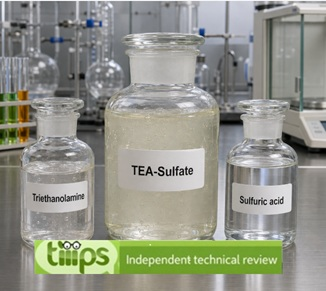
TEA-Sulfate can be produced by controlled neutralization of triethanolamine with sulfuric acid, generally in the presence of water.
The acid-base reaction results in protonation of triethanolamine and formation of the corresponding sulfate salt. Patent literature describes preparations in which triethanolamine is first dispersed or dissolved in water and sulfuric acid is then added under controlled conditions.
The industrial process must be carefully controlled to avoid excessive acidity and, in particular, to ensure:
the correct ratio between triethanolamine and sulfuric acid;
purity of the starting materials;
free triethanolamine content;
presence of secondary amines, especially diethanolamine;
absence of nitrite contamination;
nitrosamine content;
water content;
pH;
color and appearance;
storage stability.
These controls are particularly important because Annex III of the EU Cosmetics Regulation imposes specific requirements concerning purity, secondary amines, nitrosamines, and nitrites.
Main compounds present
In a properly specified raw material, the characteristic component is TEA-Sulfate, the salt formed from triethanolamine and sulfuric acid.
Depending on stoichiometry, manufacturing process, and commercial grade, small amounts of the following may also be present:
free triethanolamine;
water;
traces of diethanolamine and other secondary amines;
residual acidic species;
related sulfate/hydrogen sulfate species;
impurities originating from the starting materials.
Control of free diethanolamine is particularly important because secondary amines can form nitrosamines in the presence of nitrosating systems. CIR has specifically addressed this issue for TEA and TEA-containing ingredients.
Identification data and specifications
| Characteristic | Value | Note |
|---|---|---|
| INCI name | TEA-Sulfate | cosmetic ingredient name |
| ECHA chemical name | Bis[tris(hydroxyethyl)ammonium] sulphate | European inventory name |
| Definition | triethanolamine salt of sulfuric acid | CIR definition |
| Chemical category | inorganic trialkanolamine salt | triethanolamine derivative |
| Formula | C12H32N2O10S for the 2:1 salt; ECHA represents the composition generically as C6H15NO3·xH2SO4 | salt stoichiometry should be verified for the actual raw material |
| Molecular weight | approximately 396.46 g/mol for the 2:1 form | other stoichiometric representations have different values |
| CAS | 7376-31-0 | substance identifier |
| EC | 230-934-6 | European identifier |
| CosIng reference | 38535 | European Commission reference |
| Cosmetic function | Buffering | pH control/stabilization |
| Identified regulatory substance/group | Trialkylamines, trialkanolamines and their salts | Annex III group |
| Cosmetics Regulation provisions | III/62 | Annex III, entry 62 of Regulation (EC) No 1223/2009 |
Indicative physicochemical properties
| Characteristic | Indicative value | Note |
|---|---|---|
| Physical state | liquid | reported for certain registered salt forms |
| Water solubility | miscible | high affinity for the aqueous phase |
| Ionic nature | ionic salt | formed from protonated triethanolamine and sulfate species |
| Formulation affinity | predominantly aqueous | consistent with its highly polar structure |
| Volatility | low | expected for an ionic salt |
| Commercial form | depends on water content and concentration | verify supplier TDS and COA |
| Raw-material pH | dependent on stoichiometry and concentration | no universal value should be assigned |
| Stability | dependent on purity and contaminants | particular attention to nitrites and nitrosating systems |
Cosmetics
The documented cosmetic function of TEA-Sulfate is BUFFERING. Its principal role is therefore to help maintain the formulation pH within the range established by the formulator.
pH control is important because it can influence:
chemical stability of ingredients;
viscosity;
surfactant behavior;
emulsion stability;
effectiveness of certain preservative systems;
compatibility with skin and hair;
product stability during storage.
TEA-Sulfate may be particularly useful in aqueous or water-rich systems.
It should not automatically be classified as a cleansing surfactant simply because other ingredients containing the designation TEA-... Sulfate, such as TEA-Lauryl Sulfate, are surfactants. The specific CosIng function of TEA-Sulfate is buffering.
Pros
It is useful for pH control and stabilization.
It has high compatibility with aqueous systems.
It is a chemically well-identified ingredient.
It can contribute to formulation stability when used correctly.
Its official cosmetic function is clearly defined by CosIng.
A specific CIR assessment includes TEA-Sulfate among triethanolamine-containing ingredients.
CIR concluded favorably on the safety of the group under the evaluated conditions, provided formulations are non-irritating and the issue of nitrosamine formation is properly controlled.
Cons
It is subject to Cosmetics Regulation provisions III/62 in the European Union.
In leave-on products, the maximum concentration established by entry III/62 is 2.5%.
It must not be used together with nitrosating systems.
The raw material must meet a minimum purity of 99%.
The level of secondary amines in the raw material is restricted.
A very low limit applies to nitrosamines.
It must be stored in nitrite-free containers.
An improperly designed formulation may favor the formation of N-nitroso compounds.
The presence of TEA-Sulfate does not automatically guarantee an appropriate pH: the finished product must be measured and validated.
Salt stoichiometry and the characteristics of the commercial grade must be verified from supplier documentation.
Safety, regulation and environment
The Cosmetic Ingredient Review Expert Panel included TEA-Sulfate in its assessment of triethanolamine and related TEA-containing ingredients. The published conclusion considers these ingredients safe under the practices of use and concentrations evaluated when formulated to be non-irritating, with particular attention to free diethanolamine and prevention of N-nitroso compound formation.
EU Cosmetics Regulation provisions
For Tiiips, this is the key regulatory point.
CosIng explicitly reports:
Cosmetics Regulation provisions: III/62
and links TEA-Sulfate to the group:
Trialkylamines, trialkanolamines and their salts.
The consolidated version of Regulation (EC) No 1223/2009 confirms the following conditions for Annex III, entry 62:
leave-on products: maximum concentration 2.5%;
rinse-off products: the entry does not establish a specific maximum concentration, but the conditions below still apply;
do not use with nitrosating systems;
minimum purity: 99%;
maximum secondary amine content: 0.5% in the raw material;
maximum nitrosamine content: 50 μg/kg;
keep in nitrite-free containers.
This is therefore an important Cosmetics Regulation provision, not merely an informational note. The substance may be used, but only when the conditions established under III/62 are respected.
The most technically important issue is the possible formation of nitrosamines. Tertiary amines such as triethanolamine can, under certain conditions, contribute indirectly to the formation of N-nitroso compounds through reactions involving secondary amines such as diethanolamine. For this reason, impurity control and exclusion of nitrosating systems are essential.
For professional evaluation of the raw material, it is advisable to obtain:
an updated SDS;
a Certificate of Analysis (COA);
technical data sheet;
purity ≥99% where required by regulation;
free triethanolamine content;
diethanolamine and other secondary amine content;
certification of nitrosamine content;
absence or control of nitrites;
TEA/sulfuric acid ratio;
water content;
pH;
stability data;
storage conditions;
declaration of compliance with Annex III, entry 62.
From an environmental perspective, its high water solubility makes release into wastewater particularly relevant for rinse-off products. Environmental safety should not, however, be inferred from solubility alone: specific data are required on biodegradation, transformation, aquatic toxicity, and the actual concentration released.
Conclusion
TEA-Sulfate is a triethanolamine salt used in cosmetics primarily as a buffering agent, helping control and stabilize formulation pH.
The most important aspect of its evaluation for Tiiips is regulatory: CosIng explicitly reports “Cosmetics Regulation provisions: III/62”, linking the substance to Trialkylamines, trialkanolamines and their salts.
Entry III/62 establishes a maximum of 2.5% in leave-on products and imposes strict conditions for both leave-on and rinse-off products regarding nitrosating systems, purity, secondary amines, nitrosamines, and nitrite contamination.
The available CIR assessment is favorable under the evaluated conditions, but it also confirms the importance of preventing circumstances in which N-nitroso compounds may form.
For Tiiips, TEA-Sulfate can therefore be regarded as a technically useful ingredient subject to an important regulatory warning, with particular attention to III/62, the leave-on concentration limit, purity ≥99%, secondary amines ≤0.5%, nitrosamines ≤50 μg/kg, absence of nitrosating systems, and nitrite-free containers.

