



Benzaldehyde: properties, uses, pros, cons, safety
Benzaldehyde is an aromatic aldehyde characterized by a distinctive bitter almond odor, with sweet, fruity, and cherry-like nuances. It also occurs naturally in several plant materials, although commercial grades may be obtained through industrial synthesis. NIST identifies it as a chemically defined aromatic aldehyde and lists synonyms including Benzenecarboxaldehyde, Benzoic aldehyde, and Phenylmethanal.
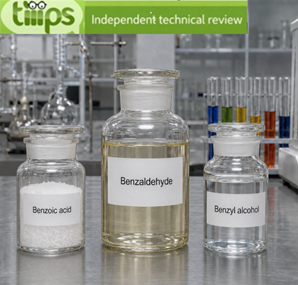
In cosmetics, Benzaldehyde is mainly used in fragrance compositions and to modify or mask the organoleptic characteristics of a formulation. The current CosIng entry associates it with the cosmetic functions Denaturant, Flavouring, Masking, and Perfuming.
Description
Benzaldehyde is one of the simplest aromatic aldehydes. Its structure consists of a benzene ring directly bonded to an aldehyde group, which is responsible for both its chemical reactivity and its characteristic odor.
Its olfactory profile is strongly associated with bitter almond, cherry, sweet, and fruity notes, making it particularly useful in almond, cherry, gourmand, floral, and balsamic fragrance accords.
Benzaldehyde can gradually oxidize when exposed to air, forming benzoic acid. This transformation is relevant to raw-material stability and should be considered when establishing specifications and storage conditions.
Manufacturing process
Benzaldehyde can be obtained from natural raw materials or through chemical synthesis.
One historically important natural source is bitter almond-derived material. Industrial Benzaldehyde, however, can be manufactured through several synthetic routes, including:
controlled oxidation of toluene;
controlled oxidation of benzyl alcohol;
hydrolysis of suitable aromatic intermediates;
catalytic processes designed to minimize over-oxidation;
final separation and purification by distillation.
After production, typical quality-control parameters include:
purity;
color;
odor;
water content;
residual benzyl alcohol;
benzoic acid content;
residual solvents or reagents;
oxidative stability;
chromatographic profile.
Because Benzaldehyde can oxidize during storage, the impurity profile may change over time if the material is exposed unnecessarily to air, heat, or unsuitable storage conditions.
Main compounds present
In a high-purity raw material, the principal component is Benzaldehyde.
Depending on the manufacturing process, purity, and storage conditions, smaller amounts may include:
benzyl alcohol;
benzoic acid;
residual aromatic starting materials;
reaction intermediates;
residual solvents;
water;
oxidation products.
The presence of benzoic acid is particularly relevant because oxidation of Benzaldehyde can occur during storage.
Identification data and specifications
| Characteristic | Value | Note |
|---|---|---|
| INCI name | Benzaldehyde | cosmetic ingredient name |
| Chemical name | Benzaldehyde | aromatic aldehyde |
| Main synonyms | Benzenecarboxaldehyde; Benzoic aldehyde; Phenylmethanal | chemical synonyms |
| Chemical category | aromatic aldehyde | volatile aromatic compound |
| Molecular formula | C7H6O | defined molecular substance |
| Molecular weight | 106.12 g/mol | molecular value |
| CAS | 100-52-7 | substance identifier |
| EC | 202-860-4 | European identifier |
| CosIng reference | 74599 | European Commission cosmetic ingredient database |
| Cosmetic functions | Denaturant; Flavouring; Masking; Perfuming | functions reported in CosIng |
| Cosmetics Regulation provisions | no specific provision indicated in the current CosIng entry | no specific Annex reference is displayed |
Indicative physicochemical properties
| Characteristic | Indicative value | Note |
|---|---|---|
| Appearance | clear liquid | may become yellowish during storage |
| Odor | strong, bitter almond, cherry-like | characteristic |
| Boiling point | approximately 179 °C | experimental value |
| Melting point | approximately −57 °C | experimental value |
| Water solubility | limited | greater compatibility with organic media |
| Volatility | significant | relevant to fragrance use and inhalation exposure |
| Air stability | susceptible to oxidation | benzoic acid may form progressively |
| Formulation behavior | aromatic and relatively lipophilic | mainly used in fragrance systems |
| Ageing behavior | color and impurity profile may change | particularly under oxidative conditions |
Cosmetics
In cosmetics, Benzaldehyde is used predominantly as a component of fragrance compositions.
It can contribute notes described as:
almond-like;
cherry-like;
fruity;
sweet;
gourmand;
balsamic;
floral.
It may occur in:
perfumes;
eau de parfum and eau de toilette;
fragranced creams and lotions;
bath products;
cleansing products;
hair-care products;
deodorants;
shaving products;
lip products;
other cosmetics in which odor, taste, or masking of an undesirable raw-material odor is relevant.
The CosIng function Flavouring should be understood here as a cosmetic function applicable to products in which taste or organoleptic perception is relevant; it does not imply that this Tiiips assessment concerns a food use. CosIng also explicitly lists Masking and Perfuming among its cosmetic functions.
Pros
It has a highly recognizable and characteristic odor profile.
It is particularly useful in almond, cherry, fruity, and gourmand accords.
Relatively small amounts can significantly modify a fragrance composition.
It is a chemically well-characterized substance.
It can be obtained from natural sources or through controlled industrial synthesis.
It is suitable for many categories of fragranced cosmetics.
It can also help mask undesirable odors from other formulation components.
The Cosmetic Ingredient Review has maintained a favorable safety conclusion for its cosmetic uses under the conditions evaluated.
Cons
It has a documented skin-sensitization potential.
The SCCS includes Benzaldehyde among established contact allergens in humans, although it is placed in the lowest evidence category, indicated as “+”.
Its use as a fragrance ingredient is subject to a specific IFRA Restriction Standard.
Its volatility makes inhalation exposure relevant in certain spray or aerosol applications.
It may irritate eyes or respiratory tissues at sufficiently high exposure.
It can oxidize during storage, increasing the amount of benzoic acid and potentially changing odor and color.
The appropriate concentration depends strongly on the product category and exposure scenario.
A favorable safety evaluation under defined conditions does not mean that every concentration or every type of finished product is automatically appropriate.
Safety, regulation and environment
The Cosmetic Ingredient Review Expert Panel originally concluded that Benzaldehyde is safe as used in cosmetic products. In its 2023 re-review, the Panel considered updated use and safety information and reaffirmed the existing conclusion rather than reopening the assessment. The review also noted Benzaldehyde's sensitization potential and compared reported cosmetic use concentrations with the applicable IFRA limits.
EU Cosmetics Regulation provisions
The current CosIng entry does not display a specific “Cosmetics Regulation provisions / Cosmetic restrictions” reference for Benzaldehyde. Therefore, unlike ingredients for which CosIng explicitly reports a provision such as IV/119, no corresponding Annex provision is identified in the current Benzaldehyde entry.
This absence of a specific CosIng provision does not remove the need for caution. The SCCS fragrance-allergen assessment lists Benzaldehyde among established human contact allergens and records positive patch-test reactions, although at relatively low frequencies in the clinical datasets reviewed.
IFRA restriction
The current IFRA Standards Library identifies Benzaldehyde as subject to an “R – Restriction” standard. The published Benzaldehyde Standard states that the risk-management drivers are dermal sensitization and systemic toxicity.
The maximum acceptable concentrations in the finished product specified by that IFRA Standard vary according to product category:
Category 1: 0.045%;
Category 2: 0.014%;
Category 3: 0.27%;
Category 4: 0.25%;
Category 5A: 0.064%;
Category 5B: 0.064%;
Category 5C: 0.064%;
Category 5D: 0.021%;
Category 6: 0.15%;
Category 7A: 0.52%;
Category 7B: 0.52%;
Category 8: 0.021%;
Category 9: 0.49%;
Category 10A: 0.49%;
Category 10B: 1.8%;
Category 11A: 0.021%;
Category 11B: 0.021%;
Category 12: no IFRA restriction.
These are IFRA risk-management limits for fragrance applications, not general maximum concentrations established by the EU Cosmetics Regulation.
For professional evaluation of the raw material, it is advisable to obtain:
an updated SDS;
a Certificate of Analysis (COA);
purity data;
benzoic acid content;
benzyl alcohol content;
residual solvent information;
impurity profile;
oxidative-stability data;
recommended storage conditions;
applicable CLP classification;
available toxicological documentation;
an applicable IFRA certificate or conformity assessment for the intended product category;
the actual concentration present in the finished formulation.
From an environmental standpoint, appropriate assessment should consider:
biodegradability;
volatility and atmospheric degradation;
aquatic toxicity;
actual release concentration;
environmental exposure;
fate in wastewater-treatment systems.
The environmental profile should not be inferred simply from the fact that Benzaldehyde may also occur naturally. Environmental risk depends on substance properties, concentration, release, and exposure.
Conclusion
Benzaldehyde is an aromatic aldehyde valued in cosmetics primarily for its characteristic bitter-almond, cherry-like, sweet, and fruity odor profile, as well as for its masking properties. CosIng identifies its cosmetic functions as Denaturant, Flavouring, Masking, and Perfuming.
Available CIR evaluation supports its cosmetic use under the assessed conditions, but an important caution remains: the SCCS identifies Benzaldehyde as an established human contact allergen, albeit in the lowest evidence category used in that assessment.
In addition, IFRA applies a specific restriction based on dermal sensitization and systemic toxicity, with maximum acceptable concentrations that vary substantially according to the product category.
The current CosIng entry does not indicate a specific “Cosmetics Regulation provisions / Cosmetic restrictions” reference for Benzaldehyde.
For Tiiips, Benzaldehyde can therefore be regarded as functionally useful but with relevant elements of caution, particularly regarding skin sensitization, IFRA compliance, inhalation exposure, oxidative stability, concentration in the finished product, and raw-material quality.

