



Dilauryl Thiodipropionate: properties, uses, pros, cons, safety
Dilauryl Thiodipropionate, also abbreviated DLTDP or DLTP, is an organosulfur compound belonging to the family of thiodipropionic acid esters. Structurally, it consists of two lauryl chains linked through ester groups to a sulfur-containing central portion. It is also known as Didodecyl 3,3'-thiodipropionate and Thiodipropionic Acid Dilauryl Ester.
The two long alkyl chains make the compound strongly lipophilic and highly compatible with oily phases, waxes, lipids, and other low-polarity organic materials. The thiodipropionate portion is responsible for its use in protecting formulations against oxidation.
Description
Dilauryl Thiodipropionate is the diester of 3,3'-thiodipropionic acid and lauryl alcohol. Its structure therefore contains two lipophilic dodecyl groups and a central sulfur-containing bridge, giving the substance a marked affinity for lipid phases.
In cosmetics, it is mainly used when improved oxidative stability of a formulation is required. It can help reduce oxidation of oils, lipids, fragrance components, and other oxygen-sensitive substances, thereby helping preserve the color, odor, and physical characteristics of the product during storage.
Its documented cosmetic function is antioxidant.
Its role should be distinguished from that of an antioxidant active ingredient necessarily intended to produce a biological effect on the skin. In formulation practice, its main value is the protection of the formula against oxidation.
Manufacturing process
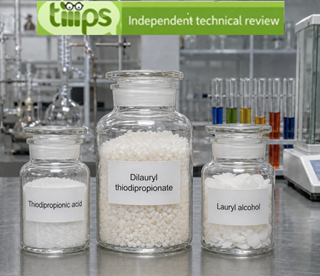
Dilauryl Thiodipropionate is generally manufactured by esterification of thiodipropionic acid with lauryl alcohol, or 1-dodecanol.
The reaction may be carried out under acid catalysis with removal of the water generated during esterification. Enzymatic solvent-free processes have also been described, in which a lipase catalyzes the direct esterification of thiodipropionic acid with 1-dodecanol.
After the reaction, industrial processing may include:
- removal of unreacted lauryl alcohol;
- removal of water;
- neutralization or catalyst removal;
- purification;
- crystallization;
- filtration;
- purity control;
- melting-point determination;
- impurity analysis;
- oxidative-stability testing.
The quality of the commercial grade therefore depends on the purity of the starting materials and on the effectiveness of the purification process.
Main compounds present
In a high-purity grade, the main component is Dilauryl Thiodipropionate.
Depending on the manufacturing process, small amounts of the following may also be present:
- unreacted lauryl alcohol;
- residual thiodipropionic acid;
- monoester intermediates;
- esterification by-products;
- catalyst residues;
- water;
- oxidation or degradation products formed during unsuitable storage.
High-purity commercial grades may reach assay values above 97–99%, but the actual specification must always be verified on the supplier's Certificate of Analysis.
Identification data and specifications
| Characteristic | Value | Note |
|---|---|---|
| INCI name | Dilauryl Thiodipropionate | cosmetic ingredient name |
| Chemical name | Didodecyl 3,3'-thiodipropionate | chemical denomination |
| Main synonyms | DLTDP; DLTP; Thiodipropionic Acid Dilauryl Ester | technical names |
| Chemical category | thiodipropionic acid diester | lipophilic organosulfur compound |
| Molecular formula | C30H58O4S | defined molecular substance |
| Molecular weight | approximately 514.8 g/mol | molecular value |
| CAS | 123-28-4 | substance identifier |
| EC/EINECS | 204-614-1 | European identifier |
| CosIng reference | 75573 | cosmetic ingredient database reference |
| Cosmetic function | Antioxidant | protects the formulation against oxidation |
| Cosmetics Regulation provisions | no specific provision identified | no specific Annex II–VI entry was found in the verified CosIng information |
Indicative physicochemical properties
| Characteristic | Indicative value | Note |
|---|---|---|
| Appearance | crystalline solid / flakes | depends on commercial grade |
| Color | white to yellowish-white | typical of purified grades |
| Odor | weak, characteristic | may depend on grade |
| Melting point | approximately 40–42 °C | typical value for purified material |
| Water solubility | extremely low / practically insoluble | strongly lipophilic behavior |
| Solubility in organic media | good in several organic solvents and lipid systems | consistent with the long alkyl chains |
| Formulation affinity | predominantly oil phase | suitable for lipid systems |
| Volatility | very low | high molecular size and long alkyl chains |
| Stability | dependent on storage and oxidative conditions | verify supplier specifications |
| Environmental partitioning | tendency to associate with solids and sediments | dependent on environmental conditions |
Cosmetics
In cosmetics, Dilauryl Thiodipropionate is used primarily as a formulation antioxidant.
It may be useful in formulations containing:
- vegetable oils;
- emollient esters;
- waxes;
- lipid components;
- oxidation-sensitive fragrance materials;
- oil-soluble ingredients;
- emulsions containing an oil phase;
- lipid-containing hair-care products;
- anhydrous products.
Oxidation of lipid components can cause changes in odor, color, and the overall characteristics of the formula. A formulation antioxidant can help slow these processes, but actual effectiveness depends on concentration, the presence of other antioxidants, oxygen availability, light, temperature, packaging, and the overall composition of the product.
The substance is technically regarded as a secondary antioxidant and can be particularly useful in combination with other antioxidant systems.
Pros
- It is a lipophilic antioxidant useful for protecting oil phases.
- It can help slow rancidity and oxidative degradation.
- It is compatible with many oils, waxes, and emollients.
- It can help preserve the odor, color, and characteristics of a formulation.
- It has very low volatility.
- It is a chemically well-defined substance.
- It can be combined with other antioxidants to obtain more effective stabilization systems.
- Its long lipophilic chains favor its presence in the oil phase.
- Cosmetic safety assessments are available for thiodipropionate ingredients.
Cons
- It is practically insoluble in water and therefore requires an oil phase or an appropriate formulation system.
- It is not a humectant and does not directly moisturize the skin.
- The presence of an antioxidant does not automatically make a formulation stable: stability testing is still necessary.
- Increasing the concentration does not necessarily produce proportionally greater oxidative protection.
- The raw material should be controlled for residual lauryl alcohol, intermediates, and degradation products.
- Cosmetic safety evaluations emphasize that the finished formulation should be non-irritating.
- Its strongly lipophilic behavior also requires consideration in environmental assessment.
- Safety of the ingredient should not be interpreted as automatic safety at any concentration or in every finished product.
Safety, regulation and environment
The Cosmetic Ingredient Review (CIR) evaluated Dilauryl Thiodipropionate together with thiodipropionic acid and related esters. The conclusion was that these ingredients are safe in cosmetic formulations when formulated to be non-irritating.
This is a cosmetic safety assessment, not a general quantitative limit imposed by EU legislation. The safety of the finished product must still be evaluated according to the actual concentration, cosmetic category, exposure, and other ingredients present.
EU Cosmetics Regulation provisions
In the verified CosIng and related regulatory information, no specific “Cosmetics Regulation provisions” entry was identified for Dilauryl Thiodipropionate.
The official cosmetic inventory identifies the substance with its antioxidant function, but no specific provision comparable, for example, to IV/119 for Kaolin was identified.
This does not mean that every possible use or concentration is automatically acceptable. Under the EU cosmetic framework, the finished cosmetic product must still undergo an appropriate safety assessment.
For professional evaluation of the raw material, it is advisable to obtain:
- an updated SDS;
- a Certificate of Analysis (COA);
- purity data;
- residual lauryl alcohol content;
- residual thiodipropionic acid;
- intermediate and by-product profile;
- possible catalyst residues;
- melting point;
- color and odor specifications;
- stability data;
- storage conditions;
- applicable CLP classification of the commercial grade;
- available toxicological data;
- supplier-recommended use concentration;
- compatibility and stability tests on the finished product.
From an environmental perspective, the substance's strongly lipophilic nature and low water solubility make specific environmental data important. Relevant parameters include:
- biodegradability;
- persistence;
- adsorption to sludge and sediment;
- aquatic toxicity;
- bioaccumulation potential;
- degradation products;
- actual release from rinse-off products;
- behavior in wastewater-treatment systems.
Conclusion
Dilauryl Thiodipropionate is a lipophilic ester of thiodipropionic acid used in cosmetics primarily to improve the oxidative stability of formulations containing lipid components. Its two long lauryl chains provide strong affinity for oils and waxes, making it particularly suitable for protecting oil phases.
Available cosmetic safety assessments consider the ingredient safe when the formulation is designed to be non-irritating.
No specific CosIng “Cosmetics Regulation provisions” entry was identified for this ingredient in the verified information.
In a properly designed formulation, it can therefore be a useful ingredient for oxidation protection, stabilization of lipid phases, and preservation of the organoleptic properties of the product.
The main parameters to verify are SDS, COA, purity, residual reactants, by-products, stability, use concentration, irritation potential of the finished formulation, and environmental behavior.

