



Caprylyl Ether: properties, uses, pros, cons, safety
Caprylyl Ether or Dicaprylyl Ether is a lipophilic aliphatic ether consisting of two linear eight-carbon chains linked through an oxygen atom. It is also known as Dioctyl Ether, Di-n-octyl Ether, Octyl Ether, and 1-octoxyoctane.
In cosmetics, it is used mainly as a fast-spreading emollient, skin-conditioning ingredient, and lipophilic carrier. Commercial grades such as BASF Cetiol® OE are characterized by rapid spreading, a relatively dry skin feel, and high hydrolytic stability.
Description
Dicaprylyl Ether belongs to the family of fatty ethers. Its structure essentially consists of two n-octyl groups linked to the same oxygen atom, resulting in a strongly lipophilic molecule with low polarity.
From a formulation standpoint, it behaves similarly to a very light cosmetic oil, but generally provides a drier sensory profile than many triglycerides and vegetable oils. It is therefore particularly useful where rapid spreading and reduced greasiness are desired.
The ether structure is also relatively resistant to hydrolysis. This makes the material useful in formulations where more readily hydrolysable esters may be less stable, including certain deodorant, antiperspirant, and depilatory formulations.
Manufacturing process
Dicaprylyl Ether can be produced through the reaction of two molecules of 1-octanol with elimination of water, using a catalytic etherification/dehydration process.
Different industrial catalytic systems are available. Processes described in the technical and patent literature include dehydration of n-octanol at elevated temperatures followed by purification of the resulting ether.
The 1-octanol used as a starting material may originate from petrochemical routes or from oleochemical feedstocks. Consequently, commercial Dicaprylyl Ether may be produced through different supply chains, including processes based partly on vegetable-derived raw materials, depending on the manufacturer.
After synthesis, processing may include:
separation of reaction water;
recovery of unreacted octanol;
catalyst removal;
distillation;
purification;
purity control;
color and odor assessment;
peroxide-value determination where relevant;
stability testing;
verification of the physical characteristics of the commercial grade.
Main compounds present
In a high-purity grade, the principal component is Dicaprylyl Ether.
Depending on the production technology and degree of purification, small amounts of the following may also be present:
residual 1-octanol;
residual water;
condensation by-products;
related ethers or hydrocarbons;
traces of catalysts or processing residues;
oxidation products if the material has not been adequately protected during production and storage.
Unlike oligomeric ingredients, Dicaprylyl Ether is a chemically defined substance with a discrete molecular structure.
Identification data and specifications
| Characteristic | Value | Note |
|---|---|---|
| INCI name | Dicaprylyl Ether | cosmetic ingredient name |
| Chemical / IUPAC name | 1-octoxyoctane | linear dialkyl ether |
| Main synonyms | Dioctyl Ether; Di-n-octyl Ether; Octyl Ether; Caprylic Ether | chemical synonyms |
| Chemical category | aliphatic ether / fatty ether | lipophilic compound |
| Molecular formula | C16H34O | defined molecular structure |
| Molecular weight | approximately 242.44 g/mol | molecular value |
| CAS | 629-82-3 | substance identifier |
| EC/EINECS | 211-112-6 | European identifier |
| CosIng reference | 75672 | European cosmetic ingredient database reference |
| Cosmetic functions | Skin Conditioning; Skin Conditioning – Emollient; Solvent | cosmetic functions associated with the ingredient |
Indicative physicochemical properties
| Characteristic | Indicative value | Note |
|---|---|---|
| Physical state | liquid | at room temperature |
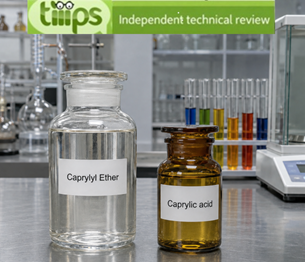
| Appearance | clear and generally colorless | typical of purified grades |
| Polarity | low | strongly lipophilic material |
| Affinity for water | very low | predominantly compatible with the oil phase |
| Viscosity at 20 °C | approximately 2–5 mPa·s | indicative commercial-grade specification |
| Boiling point | approximately 300 °C | indicative value |
| Flash point | approximately 139 °C | representative commercial-grade value |
| Spreading on skin | very fast | characteristic formulation property |
| Sensory profile | light and relatively dry | typical cosmetic use |
| Hydrolytic stability | high | consequence of the ether structure |
Cosmetics
In cosmetics, Dicaprylyl Ether is used mainly as a light emollient and skin-conditioning agent. Its fast-spreading behavior helps improve product distribution over the skin while reducing the excessively greasy sensation associated with some heavier oils.
It may be present in:
face and body creams;
light emulsions;
sunscreen products;
dry oils;
deodorants and antiperspirants;
depilatory products;
foundations and color cosmetics;
hair-care products;
conditioners and leave-on treatments;
anhydrous formulations;
products in which improved spreading of the lipid phase is required.
Its high resistance to hydrolysis can be particularly useful in formulations exposed to different pH conditions.
As a lipophilic solvent, it may also assist in dissolving or dispersing components that have poor compatibility with water. Its actual solvent performance depends on the nature of the substance being incorporated and on the other components of the oil phase.
Pros
It is a very light emollient.
It spreads rapidly over the skin.
It provides a relatively dry and non-greasy sensory profile.
It can improve the slip and distribution of creams, oils, and anhydrous products.
It can reduce the heavy feel of some lipid phases.
It has high hydrolytic stability, which can be useful in formulations exposed to different pH conditions.
It can act as a carrier for lipophilic components.
It is suitable for skin care, hair care, and many color-cosmetic applications.
Its well-defined chemical identity facilitates analytical quality control.
Available cosmetic safety assessments support its use under the evaluated conditions.
Cons
It is strongly lipophilic and therefore cannot be incorporated directly into an aqueous phase without an appropriate formulation system.
It is not a humectant and does not directly bind water in the same way as glycerin or polyglycerols.
Its emollient effect should not be confused with a biological or therapeutic action on the skin.
High concentrations can significantly modify fluidity, viscosity, and the behavior of the oil phase.
In spray products, the specific inhalation exposure scenario should be considered.
Raw-material quality depends on control of residual octanol, by-products, purity, and oxidative stability.
As with other lipophilic organic substances, environmental behavior cannot be inferred simply from good cosmetic tolerability.
Safety, regulation and environment
Dicaprylyl Ether has been specifically evaluated by the Expert Panel for Cosmetic Ingredient Safety as part of its assessment of fatty ethers used in cosmetics. The assessment includes Dicaprylyl Ether among the evaluated ingredients and supports their safety under the cosmetic practices of use and concentrations considered.
Use data considered in the assessment included substantially different concentrations depending on the cosmetic category. High reported use concentrations represent observed formulation practices and should not be interpreted as universal regulatory maximum limits.
The safety evaluation also considered product categories that may generate incidental inhalation exposure, such as cosmetic sprays. Exposure from ordinary cosmetic spray systems should nevertheless be distinguished from unusual or intensive respiratory exposure scenarios.
Within the European Union, the ingredient is included in the CosIng cosmetic ingredient database. The legally binding status of cosmetic ingredients derives from Regulation (EC) No 1223/2009 and its applicable Annexes.
For professional evaluation of the raw material, it is advisable to obtain:
an updated SDS;
a Certificate of Analysis (COA);
purity data;
residual 1-octanol content;
impurity profile;
information on process residues;
peroxide value where included in the specification;
color and odor specifications;
viscosity;
density;
oxidative-stability data;
recommended storage conditions;
available toxicological documentation;
supplier-recommended use concentration for the specific application.
The substance is also covered by European chemical registration documentation, providing additional physicochemical, toxicological, and environmental information.
From an environmental perspective, assessment should be kept separate from dermal safety. Relevant parameters for a lipophilic material such as Dicaprylyl Ether include:
biodegradability;
persistence;
bioaccumulation potential;
aquatic toxicity;
fate in wastewater-treatment systems;
actual release from rinse-off cosmetic products;
origin and sustainability of oleochemical raw materials, where applicable.
A favorable or unfavorable environmental profile should therefore not be assigned solely on the basis of the INCI name; substance-specific and commercial-grade environmental data are required.
Conclusion
Dicaprylyl Ether is a lipophilic fatty ether used mainly as a light emollient, skin-conditioning agent, and lipophilic carrier/solvent. Its main formulation advantage is its ability to spread rapidly while leaving a drier and less greasy feel than many conventional cosmetic oils.
Its ether structure also provides good hydrolytic stability, making it useful in a broad range of cosmetic formulations.
Available cosmetic safety assessments support the ingredient under the evaluated conditions of use. In a properly designed formulation, it can therefore be considered a favorable ingredient particularly for sensory performance, emollience, spreading, stability, and compatibility with lipid phases.
The main points to verify are SDS, COA, purity, residual octanol, process impurities, oxidative stability, physical characteristics of the commercial grade, use concentration, application method, and compatibility with the finished product.

