



Kaolin: properties, uses, pros, cons, safety
Kaolin is a natural mineral clay composed mainly of kaolinite, a hydrated aluminium silicate. It generally occurs as a fine white or yellowish-white powder and is used in cosmetics mainly for its absorbent, opacifying and texture-modifying properties. The Cosmetic Ingredient Review describes Kaolin as a naturally occurring hydrated aluminium silicate derived from mineral clay.
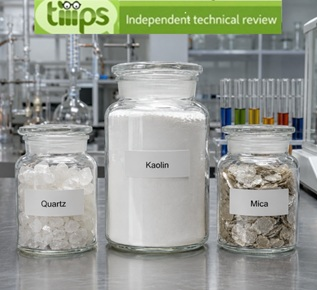
The characteristics of the raw material may vary depending on the geological deposit, purification process, particle-size distribution and presence of secondary minerals. This variability makes quality control of the cosmetic grade particularly important.
Description
Kaolinite has a layered mineral structure in which tetrahedral silicon-containing units are associated with aluminium-containing octahedral layers. Naturally sourced clays may also contain varying amounts of other minerals and geological impurities.
Its pale color, fine particle size, very low volatility and surface properties make Kaolin particularly suitable for powder cosmetics, masks, mattifying products and formulations intended to control surface oiliness.
When used as a mineral colorant, it is associated with Colour Index CI 77004 and with the specific EU Cosmetics Regulation provision identified in CosIng as IV/119.
Manufacturing process
Kaolin is obtained through mining followed by physical refining, rather than conventional chemical synthesis.
Processing may include:
extraction from the mineral deposit;
dispersion and washing with water;
separation of sand and coarse particles;
removal of part of the mica and other undesirable minerals;
particle-size classification;
filtration;
drying;
grinding;
micronization or final classification.
Cosmetic-grade quality therefore depends not only on the presence of kaolinite but also on the effectiveness of purification and the control of particle size and impurities.
Main compounds present
The predominant mineral component is normally kaolinite. Depending on geological origin and purification, smaller amounts may include:
quartz;
mica;
feldspars;
iron oxides and hydroxides;
calcium-, magnesium- or iron-containing carbonates;
titanium-containing minerals;
other naturally occurring mineral components;
structural water and residual moisture.
The possible presence of crystalline silica, particularly quartz, is one of the parameters that should be controlled in the actual commercial grade. CIR also highlights the importance of mineral and metal impurity control in naturally sourced clays.
Identification data and specifications
| Characteristic | Value | Note |
|---|---|---|
| INCI name | Kaolin | cosmetic ingredient name |
| Common name | Kaolin / China clay | natural mineral clay |
| Main mineral | Kaolinite | predominant component |
| Chemical category | hydrated aluminium silicate | clay mineral |
| Regulatory substance / ideal composition | Natural hydrated aluminium silicate, Al2O3·2SiO2·2H2O, containing calcium, magnesium or iron carbonates, ferric hydroxide, quartz-sand, mica, etc. as impurities | EU regulatory description |
| Theoretical formula weight | approximately 258.2 g/mol | referring to the ideal kaolinite unit |
| CAS | 1332-58-7 | substance identifier |
| EC | 310-194-1 | European identifier |
| Documented cosmetic functions | Abrasive; Absorbent; Anticaking; Bulking; Colorant; Opacifying | cosmetic functions |
| Colour Index | CI 77004 | white mineral colorant |
| Cosmetics Regulation provisions | IV/119 | Annex IV, entry 119 of Regulation (EC) No 1223/2009 |
CosIng specifically flags IV/119, while Annex IV of the EU Cosmetics Regulation identifies entry 119 as Natural hydrated aluminium silicate, CI 77004, white.
Indicative physicochemical properties
| Characteristic | Indicative value | Note |
|---|---|---|
| Appearance | fine powder | depends on commercial grade |
| Color | white to yellowish-white | mineral impurities may alter it |
| Odor | generally odorless | typical of purified grades |
| Water solubility | insoluble | forms dispersions rather than solutions |
| Morphology | layered mineral particles | characteristic of kaolinite |
| Particle size | variable | key commercial specification |
| Volatility | negligible | non-volatile mineral material |
| Formulation behavior | absorbent and opacifying | particularly useful in powder systems |
| Surface behavior | able to retain finely dispersed material | depends on surface area and particle size |
| Stability | generally high | relatively inert mineral material |
Cosmetics
The documented cosmetic functions of Kaolin include abrasive, absorbent, anticaking, bulking, colorant and opacifying. COSMILE Europe reports these functions and identifies the ingredient as being of mineral origin.
It may be used in:
clay face masks;
face powders;
foundations;
eye shadows;
mattifying products;
cleansers and scrubs;
products intended for oily skin;
powdered cosmetics;
hair and scalp products;
formulations requiring increased body, coverage or opacity.
Its ability to retain oily material at the surface can temporarily reduce visible skin shine. Actual performance depends on concentration, particle size, specific surface characteristics and the other ingredients in the formulation.
When used as a colorant, it falls within Annex IV of the EU Cosmetics Regulation, which is the positive list of substances authorised for cosmetic colouring purposes.
Pros
It is a versatile mineral ingredient.
It has good surface oil-absorbing properties.
It can contribute to a more matte and uniform appearance.
It is particularly suitable for powder formulations.
It can increase body and consistency.
It can contribute to coverage and opacity.
It may provide mild abrasive action when particle size and formulation are appropriate.
It is non-volatile and generally stable.
It can be used as CI 77004 in accordance with the applicable regulatory provision.
CIR concludes that Kaolin is safe under the cosmetic practices of use and concentrations assessed.
Cons
Strong absorbency may increase dryness in some skin types.
High concentrations may produce a dry or powdery sensory profile.
Composition may vary between geological deposits and suppliers.
Particle size must be carefully controlled.
Quartz or other crystalline silica may occur as a natural impurity.
Trace metals and other minerals may be present.
Industrial handling of dry powder requires attention to respiratory exposure.
Airbrush systems represent a special exposure scenario for which CIR considers the available data insufficient to establish general safety.
Safety, regulation and environment
The Expert Panel for Cosmetic Ingredient Safety concluded that Kaolin is safe in cosmetics under the practices of use and concentrations described in its assessment. Available inhalation studies also mitigated concern for incidental inhalation under the relevant cosmetic exposure conditions considered.
EU Cosmetics Regulation provisions
CosIng specifically identifies “Cosmetics Regulation provisions: IV/119” for Kaolin. The associated regulated substance is:
Natural hydrated aluminium silicate, containing calcium, magnesium or iron carbonates, ferric hydroxide, quartz-sand, mica, etc. as impurities.
Annex IV, entry 119 identifies this substance as CI 77004, an authorised white cosmetic colorant.
This provision should be interpreted correctly: IV/119 does not mean that Kaolin is generally prohibited or subject to a universal maximum concentration. Rather, when the substance is considered in its regulatory role as the colorant CI 77004, it belongs to the positive list in Annex IV and must comply with the applicable provisions. The European Commission also stresses that CosIng itself is an informative database and that legally binding status derives from Regulation (EC) No 1223/2009 and its Annexes.
The framework was further updated in 2026. Regulation (EU) 2026/909, when introducing new provisions for certain aluminium-containing ingredients, expressly excludes substances already covered by specific Annex IV entries, including entry 119. This confirms that IV/119 remains the specific relevant provision for this material when used as a colorant.
From a raw-material quality perspective, CIR highlights particular concern regarding heavy metals and mineral impurities, recommending appropriate current good manufacturing practices to limit such contaminants.
For professional evaluation, it is advisable to obtain:
an updated SDS;
a Certificate of Analysis (COA);
technical data sheet;
mineralogical purity;
particle-size distribution;
moisture content;
quartz and other crystalline silica content;
profile of metals and other mineral impurities;
microbiological control where relevant;
information on respirable particles;
documentation confirming cosmetic-grade quality;
evidence of compliance with IV/119 when used as CI 77004.
From an environmental standpoint, Kaolin is an inorganic mineral material and should not be evaluated using the same biodegradation criteria applied to organic substances. More relevant considerations include mining impacts, water use during refining, mineral dust generation, solid residues and release of suspended mineral particles.
Conclusion
Kaolin is a natural mineral clay with valuable absorbent, opacifying, anticaking, abrasive and bulking properties, as well as a possible regulatory role as a mineral colorant.
An essential regulatory point is the Cosmetics Regulation provisions: IV/119 designation. This reference concerns Natural hydrated aluminium silicate, identified as the white colorant CI 77004 in Annex IV of the EU Cosmetics Regulation.
CIR considers Kaolin safe under the cosmetic practices evaluated, but the mineral nature of the raw material makes control of particle size, crystalline silica, metals, other impurities and respirable dust particularly important.
For reliable professional use, the key parameters are therefore SDS, COA, mineralogical purity, particle-size distribution, impurities, cosmetic-grade quality, application method and compliance with IV/119 where applicable.

