



Polyglycerin-10: properties, uses, pros, cons, safety
Polyglycerin-10, also known as Decaglycerol or Decaglycerin, is a polyglycerol consisting on average of 10 glycerin units linked together. It belongs to the polyol family and contains numerous hydroxyl groups, a characteristic that gives it a strong affinity for water.
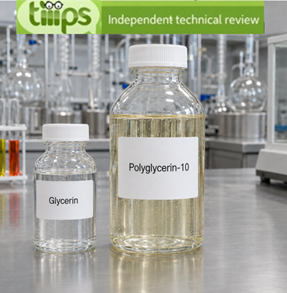
It is important to distinguish it from the many ingredients named Polyglyceryl-10 ..., such as Polyglyceryl-10 Laurate, Oleate, or Stearate. These are esters of Polyglycerin-10 with fatty acids and have different formulation properties.
Description
Polyglycerin-10 is a hydrophilic glycerin oligomer. Considering the relatively limited number of repeating units, the term oligomer may be more appropriate than polymer in the strict sense. It is also a polyol because it contains numerous hydroxyl groups distributed throughout its structure.
The large number of –OH groups results in strong interaction with water and a considerable ability to retain moisture. In cosmetic formulations, this property can help maintain hydration and improve skin feel, particularly in aqueous products and emulsions.
The actual structure of commercial polyglycerols should not necessarily be considered a single, perfectly uniform linear chain. They may contain linear, branched, cyclic, and differently sized oligomeric structures, in proportions that depend on the manufacturing process.
Manufacturing process
Polyglycerols can be produced through different controlled polymerization or condensation processes.
General manufacturing routes include ring-opening polymerization of glycidol derivatives and acid- or base-catalyzed condensation polymerization. Depending on the process conditions, the resulting structures may be linear, cyclic, branched, or hyperbranched.
Some industrial processes use glycidol as the starting material and are designed to obtain highly branched polyglycerols with a controlled molecular distribution and relatively low levels of cyclic components.
After synthesis, the material may undergo:
- removal of residual glycerin;
- removal of excess water;
- purification;
- adjustment of the average degree of polymerization;
- control of oligomer distribution;
- color control;
- water-content determination;
- hydroxyl-value determination;
- viscosity measurement;
- control of impurities and process residues.
The exact composition therefore depends on the manufacturing technology and the specifications of the commercial grade.
Main compounds present
The characteristic component consists of glycerin oligomers with an average degree of polymerization close to 10.
A commercial raw material may also contain, in varying proportions:
- oligomers containing slightly fewer or more glycerin units;
- linear structures;
- branched or hyperbranched structures;
- small amounts of cyclic components;
- residual glycerin;
- water;
- traces of substances originating from the manufacturing process.
Commercial polyglycerols should therefore be considered distributions of related oligomeric structures rather than a single perfectly uniform molecular species.
Identification data and specifications
| Characteristic | Value | Note |
|---|---|---|
| INCI name | Polyglycerin-10 | cosmetic ingredient name |
| Synonyms | Decaglycerol; Decaglycerin | recognized names |
| Chemical category | polyglycerol / oligomeric polyol | glycerin-derived oligomer |
| Average structure | 10 glycerin units | nominal degree of polymerization |
| Molecular formula | C30H62O21 | theoretical linear structure containing 10 condensed units |
| Molecular weight | approximately 758.8 g/mol | theoretical value |
| CAS | 9041-07-0 | substance identifier |
| EC | 232-921-0 | European identifier |
| UNII | P9060O936A | FDA identifier |
| Cosmetic functions | Humectant; Skin Conditioning | functions reported for cosmetic use |
Indicative physicochemical properties
| Characteristic | Indicative value | Note |
|---|---|---|
| Appearance | viscous liquid in common commercial grades | may contain a proportion of water |
| Color | colorless and transparent in purified grades | depends on manufacturing process |
| Affinity for water | very high | due to the numerous hydroxyl groups |
| Water solubility | complete in highly purified grades | typical of hydrophilic polyglycerols |
| Estimated log Kow | approximately −8.6 | indicates a very strong preference for the aqueous phase |
| Indicative viscosity at 40 °C | approximately 16,800 mPa·s | representative value for a commercial decaglycerol grade |
| Indicative hydroxyl value | approximately 822 mg KOH/g | representative commercial-grade value |
| Formulation behavior | strongly hydrophilic and hygroscopic | useful in aqueous systems |
| Structural distribution | linear, branched, or hyperbranched depending on process | commercial material is not necessarily a single species |
| Physical stability | generally good in suitable aqueous systems | should be verified in the finished formulation |
Cosmetics
Humectant and Skin conditioning
In cosmetics, Polyglycerin-10 is particularly useful because of its ability to bind and retain water. It can help reduce the sensation of dryness and improve perceived skin softness and suppleness.
It may be incorporated into:
- face and body creams;
- lotions;
- serums;
- gels;
- cleansing products;
- moisturizing products;
- hair-care products;
- shampoos and conditioners;
- masks;
- aqueous formulations containing high levels of humectants.
Its behavior may resemble glycerin in certain respects, but its larger molecular size and greater number of hydroxyl groups modify viscosity, distribution on the skin, water-binding capacity, and sensory characteristics.
It should not be confused with Polyglyceryl-10 esters. Polyglycerin-10 does not automatically possess emulsifying or cleansing properties simply because its esterified derivatives are widely used for these purposes. Its numerous hydroxyl groups do, however, provide chemically modifiable sites, making it a useful starting structure for more complex polyglyceryl derivatives.
Pros
- It has a strong ability to retain water.
- It can help reduce the sensation of skin dryness.
- It is highly hydrophilic.
- It is compatible with many aqueous cosmetic systems.
- It can improve softness and the sensory profile of formulations.
- It has extremely low volatility.
- Its relatively large molecular size is associated with limited potential for significant skin penetration compared with much smaller molecules.
- It is chemically versatile because of its numerous hydroxyl groups.
- It can serve as a starting material for the preparation of many polyglyceryl derivatives.
Cons
- It is an oligomeric mixture, not necessarily a single perfectly uniform molecular species.
- Structural distribution may vary between manufacturers and production processes.
- High concentrations can significantly increase viscosity or alter the sensory characteristics of a formulation.
- Excessive levels of polyol humectants may produce a sticky feel if the formulation is not properly balanced.
- Properties of the pure material cannot automatically be applied to all commercial grades, some of which contain water.
- It should not be confused with Polyglyceryl-10 Laurate, Oleate, Stearate, or other esters, which have different structures and functions.
- It should not automatically be regarded as an emulsifier or cleanser on the basis of the properties of its esterified derivatives.
- Purity, water content, oligomer distribution, and cyclic components should be evaluated in the actual commercial material.
Safety, regulation and environment
The Expert Panel for Cosmetic Ingredient Safety has evaluated Polyglycerin-10 together with related polyglycerols and concluded that these ingredients are safe in cosmetics under the practices of use and concentrations considered in the assessment.
The scientific evaluation considered the overall toxicological profile to be favorable and noted that the molecular size of polyglycerols makes substantial dermal absorption unlikely. Data from glycerin have also been considered useful as read-across information for certain endpoints where direct data were limited.
For applications that may cause incidental inhalation, the exposure scenario should be assessed separately. In particular, specialized aerosolization systems such as airbrush applications require additional respiratory-safety consideration. This does not represent a general prohibition on Polyglycerin-10 in sprays, but indicates that specific inhalation exposure conditions require dedicated evaluation.
For professional assessment of the raw material, it is advisable to obtain:
- an updated SDS;
- a Certificate of Analysis (COA);
- technical data sheet;
- average degree of polymerization;
- molecular distribution data;
- water content;
- hydroxyl value;
- viscosity;
- purity;
- residual glycerin;
- information on cyclic components and lower oligomers, where available;
- process-residue data;
- microbiological data where relevant;
- stability data;
- supplier-recommended use concentration.
From an environmental standpoint, the strong hydrophilic character of Polyglycerin-10 suggests behavior very different from strongly lipophilic substances. Its very low estimated partition coefficient is consistent with little tendency to accumulate in lipid phases.
A complete environmental assessment should nevertheless consider:
- biodegradability;
- fate in wastewater-treatment systems;
- actual use concentration;
- environmental release;
- aquatic toxicity;
- degradation products.
Conclusion
Polyglycerin-10 is a strongly hydrophilic polyglycerol consisting on average of ten glycerin units. Its numerous hydroxyl groups make it particularly useful in cosmetic formulations where water retention, moisturization, and skin conditioning are desired.
An important characteristic is that the commercial material should not be regarded as a single perfectly uniform molecule. It may contain a distribution of oligomers with different degrees of branching and chain lengths. Manufacturing quality can therefore influence color, viscosity, molecular distribution, water content, and the proportion of cyclic components.
Available cosmetic safety assessments support its use under the evaluated conditions. For appropriate formulation and quality control, the principal parameters to verify are SDS, COA, purity, oligomer distribution, average degree of polymerization, water content, viscosity, process residues, use concentration, and compatibility with the finished formulation.

