



Dimethyl Phenethyl Acetate: properties, uses, pros, cons, safety
Dimethyl Phenethyl Acetate is a synthetic aromatic ester used mainly as a fragrance ingredient in cosmetics and perfumery. It is also known by several technical synonyms, including Dimethylbenzyl Carbinyl Acetate (DMBCA), α,α-Dimethylphenethyl Acetate, and 2-Methyl-1-phenyl-2-propyl Acetate.
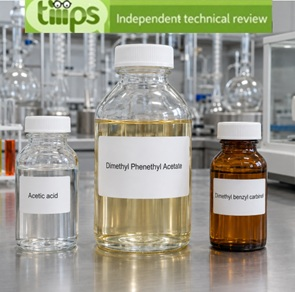
From an olfactory standpoint, it belongs to the raw materials used to impart fruity, floral, and sweet nuances to fragrance compositions. Its characteristic profile is commonly described with fruity, plum, and jasmine-like notes.
Description
Dimethyl Phenethyl Acetate is the acetic ester of dimethyl benzyl carbinol, an aromatic alcohol also used in the fragrance industry. Esterification modifies the olfactory profile of the parent alcohol and produces a substance particularly suitable for fragrance compositions.
The molecule contains an aromatic phenyl portion, a branched carbon structure, and an acetate group. This combination provides good affinity with many oily systems and other fragrance materials, while its solubility in water is very limited.
Its role is essentially olfactory and formulation-related: it is incorporated into fragrance compositions to build or modify the aromatic profile of the finished product.
Manufacturing process
Dimethyl Phenethyl Acetate is produced by chemical synthesis. One of the conceptually simplest routes involves esterification of the corresponding alcohol, dimethyl benzyl carbinol, with acetic acid or another acetylating agent.
Industrial processes may also involve intermediate esters that can subsequently be converted through transesterification into the desired acetate.
After synthesis, the raw material is normally subjected to:
- removal of residual reactants;
- neutralization, where necessary;
- distillation or other purification procedures;
- purity control;
- chromatographic profile verification;
- color and odor assessment;
- determination of residual solvents;
- storage-stability testing.
For a fragrance ingredient, the olfactory profile and batch-to-batch consistency are particularly important parameters in addition to chemical purity.
Main compounds present
In a high-purity commercial grade, the main component is Dimethyl Phenethyl Acetate.
Depending on the industrial process and supplier specification, small amounts of the following may also be present:
- unreacted dimethyl benzyl carbinol;
- esterification intermediates;
- residual acetic acid or acetylating derivatives;
- synthesis by-products;
- residual solvents;
- other related aromatic compounds.
When the substance is supplied as part of a fragrance mixture, numerous other fragrance materials, solvents, and co-formulants may naturally be present. In that case, the composition must be assessed from the documentation of the complete mixture rather than from the name of the individual ingredient alone.
Identification data and specifications
| Characteristic | Value | Note |
|---|---|---|
| INCI name | Dimethyl Phenethyl Acetate | cosmetic ingredient name |
| Chemical name | 2-Methyl-1-phenyl-2-propyl acetate | chemical denomination |
| Main synonym | Dimethylbenzyl Carbinyl Acetate (DMBCA) | widely used in perfumery |
| Other synonym | α,α-Dimethylphenethyl Acetate | chemical synonym |
| Chemical category | aromatic acetic ester | derivative of an aromatic alcohol |
| Molecular formula | C12H16O2 | molecular identification |
| Molecular weight | 192.25 g/mol | theoretical value |
| CAS | 151-05-3 | substance identifier |
| EC | 205-781-3 | European identifier |
| Cosmetic function | Perfuming | fragrance ingredient |
| CosIng reference | 100220 | European cosmetic ingredient database |
| EU regulatory status | Annex III, entry 334 | fragrance allergen subject to individual declaration above specified thresholds |
Indicative physicochemical properties
| Characteristic | Indicative value | Note |
|---|---|---|
| Physical state | liquid | typical fragrance grade |
| Olfactory profile | fruity, plum, jasmine-like | characteristic fragrance profile |
| Water solubility | practically insoluble | strongly lipophilic behavior |
| Oil-phase solubility | good | compatible with oils and many fragrance systems |
| Boiling point | approximately 250 °C | indicative value |
| Vapor pressure at 25 °C | approximately 0.0223 mmHg | calculated indicative value |
| Formulation behavior | lipophilic | generally incorporated into the fragrance or oil phase |
| Stability | formulation- and storage-dependent | verify for the specific commercial grade |
| Olfactory volatility | moderate | contributes to persistence in fragrance compositions |
Cosmetics and perfumery
In cosmetics, Dimethyl Phenethyl Acetate is used primarily in fragrance compositions.
It may occur directly or as a component of parfum in:
- perfumes and eau de parfum;
- eau de toilette;
- deodorants;
- hair-care products;
- shampoos and conditioners;
- body creams and lotions;
- body cleansers;
- bath products;
- skin-care products;
- fragranced color cosmetics.
Its fruity-plum profile with a floral jasmine-like component allows it to be used both to reinforce floral accords and to introduce fruity and sweet nuances.
The consumer does not necessarily perceive the odor of Dimethyl Phenethyl Acetate as an isolated note. In commercial formulations, it is normally used as part of a complex fragrance accord, where it interacts with many other fragrance substances.
Pros
- It is a fragrance raw material with a well-defined fruity and floral profile.
- It can contribute plum and jasmine-like notes.
- It is useful in the construction of floral, fruity, and sweet accords.
- It has good compatibility with many lipophilic perfumery raw materials.
- It can be used in many categories of fragranced cosmetic products.
- Its olfactory persistence allows it to support more complex fragrance compositions.
- It is a chemically well-characterized substance with established use in the fragrance industry.
Cons
- It is a recognized fragrance allergen and may cause reactions in sensitized individuals.
- Its presence requires particular attention in the safety assessment of leave-on products that remain on the skin for prolonged periods.
- It has very low water solubility and therefore requires an appropriate formulation system in predominantly aqueous products.
- It does not provide a specific moisturizing, skin-treatment, or protective function: its main role is perfuming.
- In individuals specifically sensitized to fragrance substances, even relatively low concentrations may be relevant.
- Since 2026, it has been subject in the EU to specific individual labeling requirements above defined concentrations.
Safety, regulation and environment
Dimethyl Phenethyl Acetate is relevant from the standpoint of skin sensitization. The Scientific Committee on Consumer Safety has included DMBCA among fragrance substances for which evidence of contact allergy in humans is available.
The European regulatory framework was updated by Commission Regulation (EU) 2023/1545, which included Dimethyl Phenethyl Acetate in Annex III, entry 334 of the EU Cosmetics Regulation.
The substance must be individually declared in the ingredient list when its concentration exceeds:
- 0.001% in leave-on products, intended to remain on the skin, hair, or mucous membranes;
- 0.01% in rinse-off products, intended to be rinsed away.
These are labeling thresholds, not general maximum permitted use concentrations.
The transitional provisions allow products that did not comply with the new labeling requirements, but that were placed on the EU market by 31 July 2026, to continue being made available until 31 July 2028. Consequently, new products placed on the EU market from 1 August 2026 must comply with the new provisions.
The substance has also been the subject of toxicological and dermatological assessment in relation to its use as a fragrance ingredient.
For a professional evaluation, it is advisable to obtain from the supplier:
- an updated SDS;
- a Certificate of Analysis (COA);
- purity data;
- chromatographic profile;
- information on relevant impurities;
- residual solvent data;
- CLP classification of the raw material;
- applicable IFRA certificate;
- recommended maximum concentrations by product category, where applicable;
- fragrance-allergen declaration;
- stability data;
- storage conditions;
- available toxicological documentation.
IFRA standards should be checked using the current certificate applicable to the specific raw material or fragrance composition used.
From an environmental standpoint, an appropriate assessment should not be based solely on its classification as an aromatic ester. Specific data are needed on:
- biodegradability;
- persistence;
- aquatic toxicity;
- potential for bioaccumulation;
- actual concentration in the finished product;
- release from rinse-off products;
- fate during wastewater treatment.
These aspects should be evaluated using the SDS, relevant regulatory documentation, and environmental data supplied by the manufacturer.
Conclusion
Dimethyl Phenethyl Acetate is a synthetic fragrance ingredient used mainly to provide cosmetic and perfumery compositions with fruity, floral, plum, and jasmine-like notes.
From a technical standpoint, it is a useful and versatile material for building fragrance accords, but its evaluation should not be limited to its olfactory characteristics. It is recognized as a contact fragrance allergen, and European legislation requires its individual declaration on the ingredient list when the applicable thresholds are exceeded.
Correct use therefore requires verification of concentration in the finished product, cosmetic category, exposure, IFRA compliance where relevant, SDS, COA, purity, fragrance-allergen status, and correct INCI labeling.
Overall, it can be considered a functionally useful fragrance ingredient, but with a specific caution related to skin sensitization and the associated regulatory labeling requirements.

