



Tocopheryl Glucoside: properties, uses, pros, cons, safety
Tocopheryl Glucoside is a glucoside derivative of tocopherol, in which a vitamin E-derived component is linked to a glucose unit. This chemical modification changes some of the physicochemical properties of tocopherol, particularly by increasing the hydrophilic character of the molecule and making it more suitable for certain cosmetic systems than unmodified tocopherol.
Its documented cosmetic functions are mainly skin conditioning and skin conditioning – emollient: it therefore helps maintain the skin in good condition and contributes to making it softer and smoother.
Description
Tocopheryl Glucoside can be regarded as a glycosylated derivative of tocopherol. The tocopherol-derived portion retains the characteristic structure of the vitamin E family, while the introduction of the glucoside residue modifies the balance between the lipophilic and hydrophilic properties of the molecule.
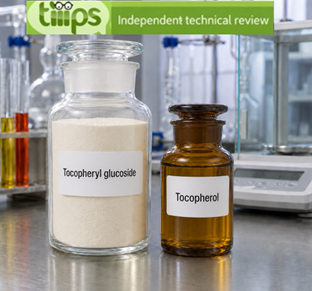
From a cosmetic formulation standpoint, this modification is of interest because free tocopherol is strongly lipophilic, whereas glycosylation produces a derivative with different formulation characteristics.
Tocopheryl Glucoside is therefore mainly used in products intended for skin care and skin conditioning. Its origin may be synthetic and/or plant-derived depending on the source of the tocopherol and the manufacturing process used.
Specific forms, such as δ-tocopheryl glucoside, have also been investigated for their ability to be biologically converted into tocopherol and thereby contribute to antioxidant activity in the skin. This property should, however, be distinguished from the official cosmetic functions attributed to the generic INCI ingredient Tocopheryl Glucoside.
Manufacturing process
Tocopheryl Glucoside is produced through glycosylation of tocopherol, meaning that a bond is formed between the hydroxyl group of tocopherol and a carbohydrate-derived glucose unit.
In general terms, glucosides are compounds formed by linking glucose to molecules containing suitable hydroxyl groups. In Tocopheryl Glucoside, tocopherol provides the alcohol-derived portion of the molecule.
The synthesis can be performed using different technological approaches. Methods described for tocopheryl glucosides include chemical glycosylation, involving controlled reaction steps and subsequent purification, as well as enzymatic or biocatalytic processes capable of transferring glucoside groups to tocopherols.
After synthesis, the material is generally subjected to:
- purification;
- removal of residual reagents;
- determination of Tocopheryl Glucoside content;
- control of free tocopherol;
- determination of residual sugars or intermediates;
- water-content control;
- color and appearance assessment;
- microbiological control where applicable;
- storage-stability testing.
The exact profile depends on the production method and the specifications of the commercial grade.
Main compounds present
In a high-purity raw material, the principal component is Tocopheryl Glucoside. Depending on the manufacturing process and commercial grade, the material may also contain:
- small amounts of unreacted tocopherol;
- residual glucose or other carbohydrates;
- traces of glycosylation intermediates;
- possible residual solvents or processing reagents;
- water;
- stabilizers or carrier components if supplied as a solution or dispersion.
It is also important to distinguish the generic INCI name from individual structural forms investigated or commercialized, such as α-tocopheryl glucoside and δ-tocopheryl glucoside.
Identification data and specifications
| Characteristic | Value | Note |
|---|---|---|
| INCI name | Tocopheryl Glucoside | cosmetic ingredient name |
| Chemical category | tocopherol glucoside | glycosylated vitamin E derivative |
| Main structural components | tocopherol linked to glucose | general structure |
| CAS | 104832-72-6 | reported for α-tocopherol glucoside |
| Molecular formula | C35H60O7 | reported for a discrete tocopheryl glucoside structure |
| Molecular weight | approximately 592.9 g/mol | theoretical value for C35H60O7 |
| Cosmetic function | Skin conditioning | helps maintain the skin in good condition |
| Cosmetic function | Skin conditioning – Emollient | helps soften and smooth the skin |
| Origin | synthetic/plant-derived | depends on raw materials and manufacturing process |
| Functional family | skin-care ingredient | tocopherol derivative |
| CosIng reference | 59776 | European cosmetic ingredient database reference |
Indicative physicochemical properties
| Characteristic | Indicative value | Note |
|---|---|---|
| Chemical nature | tocopherol glucoside | vitamin E derivative |
| Molecular weight | approximately 592.9 g/mol | theoretical value |
| Lipophilic component | tocopherol structure | provides affinity for lipid phases |
| Hydrophilic component | glucoside residue | increases polarity compared with free tocopherol |
| Formulation behavior | more hydrophilic than free tocopherol | depends on the specific form and commercial grade |
| Primary function | skin conditioning | documented cosmetic function |
| Secondary function | emollient | contributes to softness and smoothness |
| Stability | dependent on formulation, pH, temperature and light | verify for the specific commercial grade |
| Physical specifications | supplier-dependent | verify TDS, SDS and COA |
Cosmetics
The cosmetic functions attributed to Tocopheryl Glucoside are SKIN CONDITIONING and SKIN CONDITIONING – EMOLLIENT. It is therefore used to help maintain the skin in good condition and to improve softness and smoothness.
It may be incorporated into formulations such as:
- facial creams;
- moisturizing emulsions;
- serums;
- eye-area products;
- anti-aging products;
- after-sun products;
- emulsions for dry or stressed skin;
- cosmetic products intended to support skin condition and barrier quality.
Some forms of tocopheryl glucoside have also been investigated as tocopherol precursors. In particular, studies on δ-tocopheryl glucoside indicate that this form can be metabolized to δ-tocopherol in the skin, potentially contributing to prolonged antioxidant activity.
This is a relevant property, but it does not mean that Tocopheryl Glucoside should be classified as a UV filter. Antioxidant activity against oxidative stress caused by solar radiation is conceptually different from the direct absorption of UV radiation required for an authorized sunscreen filter.
Pros
- It is a cosmetic derivative of tocopherol.
- It has a documented skin-conditioning function.
- It has a documented emollient function.
- It helps maintain the skin soft and smooth.
- The glucoside group modifies some formulation characteristics compared with strongly lipophilic free tocopherol.
- It can be useful in formulations designed to maintain skin quality.
- Specific forms, such as δ-tocopheryl glucoside, have been investigated as skin precursors of tocopherol with prolonged antioxidant activity.
- It may be of interest in anti-aging formulations and products designed to address oxidative stress.
- It provides formulators with an alternative way of incorporating a tocopherol derivative compared with free tocopherol.
Cons
- It should not be confused with free tocopherol: its properties, bioavailability and formulation behavior are not identical.
- The generic INCI name does not necessarily identify the exact tocopherol isomer used.
- Experimental results obtained with a specific form, such as δ-tocopheryl glucoside, cannot automatically be attributed to every raw material marketed simply as Tocopheryl Glucoside.
- Biological antioxidant activity should not be confused with the regulatory function of a UV filter.
- Performance depends on concentration, vehicle and the complete formulation.
- Purity and the amount of free tocopherol or other residual substances should be controlled in the commercial grade.
- Toxicological and stability data should be assessed for the specific raw material used.
- Depending on supplier and purity, its formulation cost may be higher than that of more common vitamin E derivatives.
Safety, regulation and environment
Tocopheryl Glucoside is listed in the European cosmetic ingredient database with the functions skin conditioning and skin conditioning – emollient.
Its inclusion in a cosmetic ingredient inventory should not, however, be interpreted as a general authorization for every possible use. Under the EU Cosmetics Regulation (EC) No 1223/2009, safety must be assessed in relation to the actual concentration, product category, expected exposure, rinse-off or leave-on use, application area and the complete finished formulation.
In the United Kingdom, cosmetic products are likewise subject to product safety assessment and responsible-person requirements under the applicable UK cosmetics framework.
In the United States, cosmetic manufacturers are responsible for ensuring that ingredients and finished products are safe under their intended or customary conditions of use, subject to the applicable requirements of the Federal Food, Drug, and Cosmetic Act and the Modernization of Cosmetics Regulation Act (MoCRA).
For professional evaluation of the raw material, it is advisable to obtain:
- an updated SDS;
- a Certificate of Analysis (COA);
- a technical data sheet;
- assay and purity information;
- identification of the tocopherol form used;
- Tocopheryl Glucoside content;
- free tocopherol content;
- residual glucose where relevant;
- residual solvents and processing reagents;
- impurity profile;
- stability data;
- microbiological data where applicable;
- storage conditions;
- available toxicological data;
- supplier-recommended use concentration;
- compatibility data for the finished formulation.
Safety should be evaluated considering concentration, application site, exposure, leave-on or rinse-off use, target population and the complete formulation.
From an environmental perspective, Tocopheryl Glucoside should not automatically be regarded as environmentally favorable simply because its structure contains glucose and a tocopherol-derived component. A proper assessment requires specific data concerning:
- biodegradability;
- persistence;
- aquatic toxicity;
- mobility;
- degradation products;
- actual use concentration;
- quantity released into wastewater.
Where specific environmental data for the commercial grade are unavailable, the assessment should rely on supplier documentation and applicable regulatory data.
Conclusion
Tocopheryl Glucoside is a glycosylated tocopherol derivative used primarily for skin conditioning and emollient purposes. The glucoside residue modifies the characteristics of the molecule compared with free tocopherol and can make it particularly useful in certain skin-care formulations.
Specific forms of Tocopheryl Glucoside have also been investigated for their ability to behave as tocopherol precursors in the skin and to provide progressive antioxidant activity. These effects may be particularly relevant in anti-aging formulations and products designed to address oxidative stress, but they should be attributed precisely to the chemical form actually used and to the supporting experimental evidence.
It should not be presented as a sunscreen filter simply because it may contribute to antioxidant protection of the skin: antioxidant protection and UV radiation filtration are distinct functions.
In a properly designed formulation, Tocopheryl Glucoside can be a useful ingredient for skin conditioning, emollience and antioxidant support. The main points to verify are chemical identity, purity, free tocopherol content, process residues, SDS, COA, stability, use concentration, compatibility and finished-product safety assessment.

