



PPG-1-PEG-9 Lauryl Glycol Ether: properties, uses, pros, cons, safety
PPG-1-PEG-9 Lauryl Glycol Ether is a chemical ingredient belonging to the family of alkoxylated lauryl glycol ethers. It consists of a lipophilic portion associated with the lauryl chain and a hydrophilic polyoxyalkylene portion, a structural combination that gives the ingredient surfactant properties and enables it to interact with both aqueous phases and lipophilic substances.
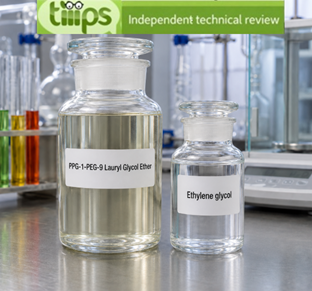
Its descriptive chemical name is 2-(2-Hydroxydodecyloxy)ethanol, ethoxylated, propoxylated, with an average molar ratio of approximately 9 moles of ethylene oxide (EO) and 1 mole of propylene oxide (PO). The use of average values is important: the ingredient is not necessarily a single, completely uniform molecule, but rather an alkoxylated material characterized by a distribution of species with different polyoxyethylene/polyoxypropylene chain lengths.
Description
PPG-1-PEG-9 Lauryl Glycol Ether is a non-ionic alkoxylated surfactant. Its long lauryl hydrocarbon portion has affinity for oils and other lipophilic substances, while the chain containing ethylene oxide and propylene oxide units increases affinity for the aqueous phase.
This amphiphilic structure allows the ingredient to facilitate the incorporation and distribution of substances with low water solubility, contribute to the formation and stabilization of dispersed systems, and participate in cleansing processes.
The BASF commercial grade Eumulgin® L is described as an alkoxylated fatty alcohol derivative used primarily as a solubilizer for aqueous and hydroalcoholic cosmetic preparations.
From a formulation standpoint, it is therefore mainly a technical-functional ingredient. It is generally not used as an active ingredient intended to produce a specific biological effect on the skin, but rather to modify the behavior of the different phases of a formulation and support uniformity, cleansing, emulsification or solubilization.
Manufacturing process
PPG-1-PEG-9 Lauryl Glycol Ether is produced through chemical synthesis and controlled alkoxylation. The material can be obtained from a glycol ether structure derived from the reaction of a lauryl-containing precursor with ethylene glycol, followed by the controlled introduction of oxyethylene and oxypropylene units.
The INCI name indicates an average composition corresponding to approximately 9 EO units and 1 PO unit. Because alkoxylation is a statistical process, the industrial product normally contains a distribution of homologues around the stated average degree of alkoxylation rather than one chemically identical molecule.
After the reaction, depending on the process and commercial specification, manufacturing may include neutralization, purification and quality-control stages. Particularly relevant parameters include:
- distribution of the degree of alkoxylation;
- active matter content;
- unreacted raw materials;
- process residues;
- water content, where applicable;
- color and odor;
- surfactant characteristics;
- purity of the commercial grade;
- storage stability.
Main compounds present
The name PPG-1-PEG-9 Lauryl Glycol Ether identifies an alkoxylated material with a distributed composition. The raw material may therefore mainly contain:
- lauryl glycol ethers containing polyoxyethylene chains;
- species containing an average of approximately 9 ethylene oxide units;
- species containing an average of approximately 1 propylene oxide unit;
- homologues with slightly higher or lower numbers of EO and PO units than the stated average;
- possible residual amounts of precursors or process by-products, depending on the manufacturer and purification process.
This characteristic explains why it is not appropriate to assign the material a single molecular formula and one exact molecular weight in the same way as a chemically pure, discrete substance.
Identification data and specifications
| Characteristic | Value | Note |
|---|---|---|
| INCI name | PPG-1-PEG-9 Lauryl Glycol Ether | cosmetic ingredient name |
| Chemical description | 2-(2-Hydroxydodecyloxy)ethanol, ethoxylated, propoxylated | descriptive chemical name |
| Average alkoxylation | 9 mol EO / 1 mol PO | average molar ratio |
| Chemical category | alkoxylated lauryl glycol ether | non-ionic surfactant |
| CAS | 154248-98-3 | associated with commercial grades such as Eumulgin® L |
| EC | not consistently specified in public cosmetic ingredient records | verify on the supplier SDS |
| Molecular formula | not unique | material consists of a distribution of alkoxylated homologues |
| Molecular weight | not unique | depends on EO/PO distribution |
| Cosmetic functions | Surfactant – Emulsifying; Surfactant – Cleansing | functions reported in CosIng |
| Documented technical use | solubilizer | particularly in aqueous and hydroalcoholic systems |
| Known trade name | Eumulgin® L | BASF |
| Ionic nature | non-ionic | typical of EO/PO alkoxylates |
Indicative physicochemical properties
| Characteristic | Indicative value | Note |
|---|---|---|
| Appearance | clear to slightly cloudy liquid | may depend on commercial grade |
| Color | pale yellow | may vary slightly between grades and batches |
| Odor | characteristic | supplier-dependent |
| Chemical nature | alkoxylated fatty-chain glycol ether | EO/PO structure |
| Ionic nature | non-ionic | no permanent ionic charge |
| Formulation affinity | hydrophilic/lipophilic | consequence of its amphiphilic structure |
| Typical systems | aqueous and hydroalcoholic formulations | particularly suitable for solubilization |
| Formulation behavior | surfactant, emulsifying and solubilizing | depends on the overall formulation |
| Molecular formula/weight | distribution of values | should not be treated as a single molecular species |
| Batch-specific parameters | refer to TDS/COA | viscosity, density, water and related parameters depend on the commercial grade |
Cosmetics
In cosmetics, PPG-1-PEG-9 Lauryl Glycol Ether is mainly used because of its ability to act at the interface between water and lipophilic substances.
As an emulsifying surfactant, it facilitates the formation of systems in which one phase is dispersed in another. As a cleansing surfactant, it can contribute to the removal and dispersion of oily substances and impurities through normal surfactant mechanisms.
These are the two cosmetic functions officially associated with the ingredient in the European Commission's CosIng database: SURFACTANT – EMULSIFYING and SURFACTANT – CLEANSING.
The ingredient can also be particularly useful as a solubilizer, meaning that it can facilitate the incorporation of small amounts of poorly water-soluble substances into an aqueous phase. This use is documented for commercial grades such as BASF Eumulgin® L, particularly in aqueous and water/alcohol personal-care formulations.
It may be useful, for example, when an aqueous formulation needs to incorporate:
- lipophilic components;
- fragrance materials;
- certain oils;
- poorly water-soluble functional ingredients;
- mixtures that would otherwise cause cloudiness or phase separation.
Actual performance must nevertheless be confirmed in the finished formulation because it depends on factors such as the water/oil ratio, other surfactants, electrolytes, solvents, temperature, pH and the nature of the substances being solubilized.
Pros
- It is a versatile non-ionic surfactant.
- Its amphiphilic structure makes it suitable for systems containing both aqueous and lipophilic components.
- It has a recognized cosmetic function as an emulsifying surfactant.
- It has a recognized cosmetic function as a cleansing surfactant.
- It can act effectively as a solubilizer in aqueous and hydroalcoholic preparations.
- It can facilitate the incorporation of lipophilic substances into predominantly aqueous formulations.
- It can be used in a wide range of personal-care products.
- Its non-ionic nature may be formulation-friendly when the addition of a permanently charged surfactant is undesirable.
- It can contribute to the stability and uniformity of complex systems when used at an appropriate concentration and in a suitable surfactant system.
Cons
- It is not a perfectly uniform molecular substance: the degree of alkoxylation is expressed as an average value.
- Its properties may vary to some extent according to the homologue distribution and supplier specification.
- Its effectiveness as a solubilizer or emulsifier cannot be established from the INCI name alone and must be verified in the actual formulation.
- Excessive surfactant concentrations may alter sensory properties, cleansing strength, foaming, viscosity and skin compatibility of the finished product.
- A formulation that appears clear immediately after preparation may still require stability testing to exclude later cloudiness or phase separation.
- Because it is produced by alkoxylation, raw-material quality and the control of process-related impurities are important.
- The hazard characteristics of the concentrated raw material must be assessed from the supplier-specific SDS, rather than inferred solely from the INCI name.
- Purity, EO/PO distribution and technical specifications may differ between commercial grades.
Safety, regulation and environment
The European Commission's CosIng database lists PPG-1-PEG-9 Lauryl Glycol Ether with the cosmetic functions surfactant – emulsifying and surfactant – cleansing.
However, inclusion of an ingredient in CosIng does not by itself constitute a general safety approval for every possible use. Under the EU Cosmetics Regulation, the safety of the finished cosmetic product must be assessed in relation to the ingredient concentration, type of product, expected exposure, rinse-off or leave-on use, application area and the characteristics of the complete formulation.
A particularly relevant issue for ethoxylated materials is the control of manufacturing impurities. The U.S. FDA notes that 1,4-dioxane may occur as an unintended manufacturing by-product in some ethoxylated cosmetic ingredients. Because this ingredient contains a PEG/ethoxylated component, it is technically appropriate to request information from the supplier on 1,4-dioxane control, without assuming that the contaminant is necessarily present in a particular batch.
For a professional evaluation of the raw material, it is advisable to obtain:
- an updated SDS;
- a Certificate of Analysis (COA);
- a technical data sheet;
- active matter specification;
- degree and distribution of alkoxylation;
- information on residual raw materials and process reagents;
- a specification for 1,4-dioxane;
- information on residual ethylene oxide and propylene oxide, where relevant;
- water content;
- stability data;
- recommended storage conditions;
- applicable CLP/GHS classification of the specific commercial raw material;
- available toxicological information;
- supplier-recommended use levels;
- compatibility and stability testing in the finished product.
Skin and eye compatibility should be assessed at the actual use concentration and within the complete finished formulation. Any hazard classification applying to the concentrated industrial raw material should not automatically be transferred to the diluted finished cosmetic product.
From an environmental standpoint, its behavior should not be inferred solely from its classification as a non-ionic surfactant. A proper assessment requires specific information concerning:
- biodegradability;
- primary and ultimate degradation;
- aquatic toxicity;
- actual use concentration;
- quantities discharged from rinse-off products;
- environmental fate of degradation products;
- environmental data supplied by the manufacturer.
Particular attention may be appropriate in cleansing and rinse-off products because part of the ingredient can enter wastewater directly after use.
Conclusion
PPG-1-PEG-9 Lauryl Glycol Ether is a non-ionic alkoxylated ingredient whose main value is formulation-related. The combination of a lipophilic lauryl portion with a more hydrophilic polyoxyalkylene chain allows it to function effectively at the interface between water and oily substances.
Its recognized cosmetic functions are SURFACTANT – EMULSIFYING and SURFACTANT – CLEANSING, while its technical use as a solubilizer is also well documented, particularly in aqueous and hydroalcoholic formulations.
An important aspect of its evaluation is the distributed nature of the alkoxylated material: PEG-9 and PPG-1 represent average degrees of alkoxylation rather than one unique molecular structure. Consequently, quality and performance should be assessed using the specifications of the actual commercial raw material rather than from the INCI name alone.
In a properly designed formulation, PPG-1-PEG-9 Lauryl Glycol Ether can be a useful ingredient for emulsification, cleansing and solubilization. The main points to verify are SDS, COA, purity, EO/PO distribution, process impurities, 1,4-dioxane control, residual alkoxylation reagents, use concentration, compatibility, stability and performance of the finished product.

