



Phenylene Bis-Diphenyltriazine: properties, uses, pros, cons, safety
Phenylene Bis-Diphenyltriazine is an organic triazine UV filter used in sunscreens and other cosmetics with UV protection. It is also known by the technical abbreviation PBDT and, in some commercial products, as TriAsorB. Its formulation value comes from its ability to contribute to protection against UVB, UVA, and, in specific formulations, part of high-energy visible light / blue light.
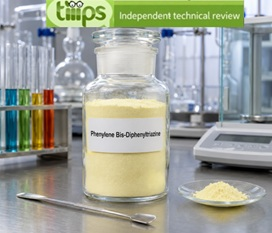
From the European regulatory standpoint, it is an authorized UV filter under Annex VI, entry 31, of the Cosmetics Regulation. The maximum permitted concentration in the ready-to-use product is 5%, and the substance must not be used in applications that may lead to exposure of the end user’s lungs by inhalation.
Description
Phenylene Bis-Diphenyltriazine is a high-molecular-weight organic sunscreen filter designed to absorb solar radiation across a broad range. It belongs to the family of aromatic triazines, a chemical class often appreciated in photoprotection for stability and absorption capacity. In cosmetics it is mainly used in sunscreens, day creams with SPF, protective facial products, and formulas where UVA/UVB protection needs to be increased.
Its interest compared with some more traditional filters lies in its broad-spectrum protection and its possible contribution to protection against portions of visible light, especially in the HEV/blue light range. This does not mean that it automatically provides complete protection on its own: real efficacy depends on the finished formula, filter dispersion, other UV filters present, film formation on the skin, SPF/UVA-PF testing, and the amount applied by the consumer.
Its role is strictly photoprotective and formulation-related.
Production process
Phenylene Bis-Diphenyltriazine is produced by chemical synthesis, through construction of an aromatic structure containing two triazine nuclei linked to a phenylene group. Production requires strict purity control because the substance is intended for direct use on the skin in products that may also be applied over large areas.
After synthesis, the usual steps include purification, impurity control, particle-size or dispersion verification if the grade is supplied in particulate/dispersed form, active content control, color, light stability, compatibility with oily excipients or dispersing systems, and toxicological documentation. SCCS assessment also paid attention to possible critical impurities such as NMP and hydrazine, which must be controlled in the commercial grade.
The quality of the commercial grade is therefore decisive: the INCI name alone is not enough. SDS, COA, purity specification, impurity data, declaration of compliance with the EU Cosmetics Regulation, and confirmation of non-inhalation use are required.
Main compounds present
In the pure grade, the main compound is Phenylene Bis-Diphenyltriazine. Depending on process and supplier, commercial grades may contain:
- traces of synthesis intermediates;
- residual solvents;
- aromatic impurities;
- possible process residues such as NMP or hydrazine, where relevant to the supply chain;
- dispersion components or vehicles, if the material is supplied as a technical mixture;
- stabilizers or co-formulants indicated in the technical data sheet.
In the finished cosmetic formula, the filter is often used together with other UV filters to obtain a more balanced SPF/UVA profile. The protection declared on the product does not depend on the isolated ingredient alone, but on the entire filter system and on testing of the finished product.
Identification data and specifications
| Characteristic | Value | Note |
|---|---|---|
| INCI name | Phenylene Bis-Diphenyltriazine | cosmetic designation |
| Chemical name | 3,3′-(1,4-Phenylene)bis(5,6-diphenyl-1,2,4-triazine) | name in Annex VI |
| Technical abbreviation | PBDT / S86 | used in literature and SCCS documents |
| Known commercial name | TriAsorB | commercial name used in some formulations |
| Chemical category | organic triazine UV filter | aromatic sunscreen filter |
| Molecular formula | C36H24N6 | compound formula |
| Molecular weight | about 540.6 g/mol | theoretical value |
| CAS | 55514-22-2 | substance identifier |
| EC | 700-823-1 | European reference |
| Cosmetic function | UV filter | authorized UV filter |
| EU restriction | Annex VI, entry 31 | positive list of UV filters |
| Maximum EU concentration | 5% | in the ready-to-use product |
| Use limitation | must not be used in applications that may lead to lung exposure by inhalation | regulatory restriction |
Indicative physicochemical properties
| Characteristic | Indicative value | Note |
|---|---|---|
| Appearance | powder or technical dispersion | depends on commercial grade |
| Color | yellow / yellow-orange or similar | typical of many aromatic triazine filters |
| Odor | low or not relevant | depends on grade |
| Water solubility | very low / insoluble | requires dispersion or suitable formulation system |
| Oil solubility | limited or vehicle-dependent | check technical sheet |
| Absorption | UVB, UVA, and part of HEV/blue light in specific formulations | depends on formulation and dispersion |
| Photostability | high / to be verified in the finished system | important property of modern filters |
| Formulation status | organic UV filter | often used in combined filter systems |
| Main technical risk | dispersion, compatibility, impurities, and inhalation use | key safety/formulation points |
| Necessary tests | SPF, UVA-PF, photostability, physical stability | on the finished product |
Cosmetics
In cosmetics, Phenylene Bis-Diphenyltriazine is used as a UV filter in sunscreens and cosmetics with sun protection. It may be present in SPF creams, face and body sunscreens, anti-photoaging products, day products with SPF, and formulas oriented toward UVA/UVB and high-energy visible-light protection.
It is particularly interesting when included in modern photoprotective systems together with other organic or mineral filters. In some publications on TriAsorB, the filter is described as contributing to photoprotection against UVB, UVA, and blue light, but always within the context of complete sunscreen formulations.
The European restriction excludes use in applications that may lead to lung exposure by inhalation. This is relevant for aerosol sprays, powders, or nebulizable formats; the safe use indicated by SCCS concerns products applied to the skin, not products generating significant inhalation exposure.
Pros
- It is a modern UV filter with a broad-spectrum profile.
- It can contribute to protection against UVB and UVA.
- In some formulations it also contributes to protection against blue light / HEV.
- It is photostable and useful in high-protection sunscreen systems.
- It can improve the protection profile of advanced SPF formulas.
- It is authorized in the EU as a UV filter within a defined limit.
- It is not a fragrance allergen and has no perfuming function.
- It can be used in combination with other filters to build more complete protection.
Cons
- It is not a food ingredient and has no nutritional value.
- It is not a therapeutic dermatological active: its function is photoprotective.
- It is subject to the EU limit of 5%.
- It must not be used in applications that may cause lung exposure by inhalation.
- Safety depends on commercial-grade quality and impurity control.
- Performance depends greatly on dispersion, compatibility, and formula stability.
- It does not guarantee the declared protection on its own: SPF, UVA-PF, and blue-light protection must be verified on the finished product.
- It may require specific formulation systems to be distributed uniformly.
Safety, regulatory aspects, and environment
From a cosmetic standpoint, Phenylene Bis-Diphenyltriazine is authorized in the EU as a UV filter under Annex VI, entry 31, with a maximum concentration of 5% in the ready-to-use product. The key limitation is that it must not be used in applications that may lead to exposure of the end user’s lungs by inhalation.
SCCS concluded that the substance is safe as a UV filter in sunscreen products and other cosmetics up to 5%, but only for products applied to the skin and not for products that may involve inhalation exposure. The assessment also discussed control of potentially critical impurities such as NMP and hydrazine.
The main risk is not the typical risk of a fragrance allergen, but concerns:
- compliance with the maximum concentration;
- exclusion of inhalable formats;
- impurity control;
- good dispersion in the formula;
- photostability in the finished product;
- compatibility with other filters;
- SPF/UVA-PF testing on the finished product;
- safe use on sensitive skin and exposed areas.
For correct cosmetic use, it is advisable to request from the supplier:
- updated SDS;
- certificate of analysis;
- purity and assay;
- impurity profile;
- control of NMP and hydrazine, where relevant;
- particle size or dispersion specification;
- photostability data;
- declaration of compliance with Annex VI;
- declaration of non-use in inhalable applications;
- available toxicological data;
- SPF, UVA-PF, and stability tests on the finished product.
From an environmental standpoint, assessment must be specific: it is not enough to say that it is a modern organic filter. Data are needed on biodegradability, persistence, aquatic toxicity, behavior in sediments, environmental exposure from rinse-off or leave-on products, and actual use concentration. UV filters, in general, are ingredients that should also be assessed carefully for possible release into aquatic environments.
Conclusion
Phenylene Bis-Diphenyltriazine is a highly interesting organic UV filter for modern sunscreens, especially when broad protection against UVB, UVA, and, in specific systems, portions of high-energy visible light is desired. Its main value is photoprotective and formulation-related.
Professional assessment must be rigorous. The key points are compliance with Annex VI, entry 31, the maximum limit of 5%, exclusion of inhalable applications, impurity control, and verification of efficacy on the finished product. It is not a food ingredient, not a fragrance, and not a curative active: it is an authorized sunscreen filter to be used with technical precision.
In a well-designed formula, with documented raw material and adequate testing, it can be a favorable and very useful ingredient. The points to control are SDS, COA, purity, impurities, dispersion, photostability, compatibility with other filters, product category, exclusion of inhalation, and SPF/UVA/blue-light test results on the finished product.

