



Eugenyl acetate: properties, uses, pros, cons, safety
Eugenyl Acetate is an aromatic substance belonging to the class of phenolic esters. It is the acetylated derivative of eugenol and is mainly used in fragrances, perfumery and, when supplied in a suitable grade, as a flavouring substance. It has a characteristic sweet, spicy and floral odour, with a note reminiscent of clove. Its documented cosmetic function is related to perfuming the product and/or the skin.
Description
Eugenyl Acetate is a chemically defined substance, not a botanical extract or a complex natural mixture. Chemically, it derives from eugenol through conversion of the phenolic hydroxyl group into the corresponding acetic ester.
This structural modification gives it properties that differ from free eugenol, while retaining a marked olfactory affinity with spicy and clove-like notes. The FAO/JECFA specification describes Eugenyl Acetate as a solid that may melt at relatively warm room temperature to form a pale yellow liquid, with a mild clove-like odour.
Eugenyl Acetate also occurs naturally. It is one of the characteristic components of the essential oil of Syzygium aromaticum, clove, together mainly with eugenol, β-caryophyllene and α-humulene. Its percentage may vary considerably depending on the raw material, the plant part and the extraction method: analytical studies on clove oils report substantial variation among samples.
However, its natural occurrence does not mean that commercial Eugenyl Acetate is necessarily obtained directly from an essential oil. It may be isolated from natural sources or produced by chemical transformation of eugenol.
Production process
One of the main preparation routes is the acetylation of eugenol. The hydroxyl group of eugenol is reacted with an acetylating agent to produce Eugenyl Acetate.
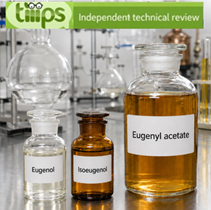
Several production processes have been investigated, including catalysed chemical systems and enzymatic methods. Synthesis may also start from clove essential oil rich in eugenol, converting the latter into the corresponding acetate.
Once the reaction is complete, the product must be separated from residual reagents and unconverted substances and subsequently purified. The commercial grade is then checked using analytical techniques such as gas chromatography.
The JECFA specification for flavour use requires a minimum assay of 98%, while commercial analytical grades may similarly be specified at more than 98% purity by GC.
Actual quality nevertheless depends on the grade purchased. For cosmetic, food or analytical applications, the relevant supplier specifications and documentation must be used.
Main substances contained
In the case of Eugenyl Acetate, the expression “main substances contained” must be interpreted differently from a plant extract or essential oil, because this is an essentially single-component chemical substance.
The main components that may be considered are:
- Eugenyl Acetate: the principal substance. In grades complying with the JECFA specification, it represents at least 98% of the material.
- Eugenol: it may be present in trace amounts as unreacted starting material when Eugenyl Acetate is produced by acetylation of eugenol. Its presence and concentration are not universally defined and must be checked in the certificate of analysis for the specific batch.
- Residual process substances: these may occur at very low levels depending on the production technology and purification process. They are not mandatory characteristic constituents of the ingredient and must be verified in the manufacturer's documentation.
- Water, residual solvents and other analytical impurities may account for part of the fraction not assigned to Eugenyl Acetate in different commercial grades, but there is no single standard composition valid for every supplier.
It is therefore incorrect to list eugenol, β-caryophyllene, α-humulene or other constituents of clove essential oil as substances necessarily contained in purified Eugenyl Acetate. These are components of the natural starting material, whereas high-purity commercial Eugenyl Acetate consists essentially of the single substance itself.
Identification data and specifications
| Characteristic | Value | Note |
|---|---|---|
| INCI name | Eugenyl Acetate | cosmetic denomination |
| Common name | Eugenyl acetate | practical denomination |
| Chemical name | 4-Allyl-2-methoxyphenyl acetate | JECFA denomination |
| Synonyms | Acetyl Eugenol, Eugenol Acetate, Acetyleugenol | alternative names |
| Chemical category | aromatic phenolic ester | acetylated derivative of eugenol |
| Molecular formula | C₁₂H₁₄O₃ | chemically defined substance |
| Molecular weight | 206.24 g/mol | JECFA data |
| CAS | 93-28-7 | substance identifier |
| EC | 202-235-6 | European identifier |
| JECFA | 1531 | flavouring substance |
| FEMA | 2469 | flavour reference |
| FLAVIS | 09.020 | EU reference |
| Cosmetic function | fragrance / perfuming | perfumes the product and/or the skin |
| JECFA assay | minimum 98% | flavour specification |
| EU Cosmetics Regulation | Annex III, entry 368 | fragrance allergen subject to declaration above specified thresholds |
The principal identification data are reported in FAO/JECFA specifications and European regulatory sources.
Indicative physicochemical properties
| Characteristic | Indicative value | Note |
|---|---|---|
| Appearance | molten solid or colourless to pale yellow liquid | depends on temperature and grade |
| Odour | mild, spicy, clove-like | characteristic |
| Melting point | about 25–26 °C | may solidify in cool environments |
| Boiling point | about 282 °C | JECFA data |
| Water solubility | insoluble | lipophilic substance |
| Ethanol solubility | soluble | favourable for perfumery applications |
| Oil solubility | soluble in fixed oils | compatible with lipophilic phases |
| Relative density | 1.077–1.082 | supercooled liquid |
| Refractive index | 1.514–1.522 | supercooled liquid |
| Assay | ≥ 98% | JECFA specification |
| Acid value | maximum 1 | JECFA specification |
| Stability | dependent on purity, temperature, light and storage conditions | check SDS and supplier specification |
JECFA data also indicate a melting point of approximately 25 °C; commercial specifications may report values around 26 °C and describe the product as solid or as a clear liquid depending on temperature.
Food
Eugenyl Acetate is recognised as a flavouring substance. It is not a nutrient, and its food use is intended solely to modify or contribute to the aroma of a product.
JECFA identifies it as substance No. 1531 and classifies it as a flavouring agent. In its 2005 evaluation, the Committee concluded that there was no safety concern at current estimated levels of intake when used as a flavouring substance.
Within the European Union, it is identified as FL 09.020 in the list of flavouring substances.
Food use nevertheless requires a grade specifically suitable for food applications. A raw material purchased for perfumery, laboratory or cosmetic use must not automatically be considered suitable for food.
Cosmetics
In cosmetics, Eugenyl Acetate is used as a fragrance component. Its function is to improve the odour of the cosmetic product and/or perfume the skin.
It may be used in fragrance compositions for:
- perfumes and eau de parfum;
- eau de toilette;
- creams and lotions;
- cleansers;
- shampoos and hair products;
- deodorants;
- body products;
- soaps and other perfumed cosmetic products.
Its olfactory profile is particularly suitable for floral, spicy, carnation-like, balsamic and oriental compositions.
From a regulatory standpoint, Eugenyl Acetate became particularly relevant following Regulation (EU) 2023/1545. It is included in entry 368 of Annex III to the EU Cosmetics Regulation and must be individually declared in the ingredient list when its concentration exceeds:
- 0.001% in leave-on products;
- 0.01% in rinse-off products.
These are ingredient-list declaration thresholds, not general maximum permitted concentrations.
The new requirements apply to cosmetic products placed on the EU market from 31 July 2026. A transitional period allows products placed on the market under the previous requirements to continue being made available until 31 July 2028.
Pros
- It has a characteristic and recognisable floral-spicy, clove-like odour.
- It is effective as a perfumery component.
- It is soluble in ethanol and oily phases.
- It is available as a high-purity chemical substance.
- It may have natural, semi-synthetic or synthetic origin.
- It occurs naturally in aromatic essential oils, particularly clove oil.
- It is identified and standardised in the flavour sector through JECFA, FEMA and FLAVIS.
- Its composition is easier to control than that of a complex essential oil.
Cons
- It is a fragrance allergen subject to specific declaration in cosmetics sold in the European Union above the applicable thresholds.
- It is practically insoluble in water.
- It may require alcohol, solubilisers or an oily phase for incorporation into formulations.
- Its melting point close to room temperature may cause solidification or crystallisation during storage.
- It is not a skin-conditioning ingredient or dermatological active: its principal cosmetic role is olfactory.
- Natural occurrence in essential oils does not remove the obligation to assess and declare it where required.
- When present as a constituent of natural aromatic raw materials, its contribution must be included when calculating the total concentration in the finished product.
- Different commercial grades must not automatically be considered interchangeable for cosmetic, food or analytical use.
Safety, regulations and environment
The main cosmetic safety consideration concerns the potential for fragrance sensitisation.
The European Commission's Scientific Committee on Consumer Safety has examined the behaviour of esters of important contact allergens. Eugenyl Acetate has been included among esters that may undergo enzymatic hydrolysis in the skin, producing the corresponding parent compound. Exposure, metabolic conversion and possible cross-reactivity therefore need to be considered in the safety assessment.
This does not mean that every user will develop an allergy. Individual declaration of fragrance allergens is primarily intended to allow people who are already sensitised to identify the relevant substances more easily in cosmetic products.
For the finished cosmetic product, it is therefore important to know not only the amount of Eugenyl Acetate added directly, but also the quantity potentially introduced through:
- fragrances;
- essential oils;
- aromatic extracts;
- fragrance mixtures;
- other natural raw materials.
For a professional assessment of the raw material, it is advisable to obtain:
- updated SDS;
- certificate of analysis;
- assay and purity;
- analytical method;
- origin of the substance;
- possible residual Eugenol content;
- impurity profile;
- possible residual solvents;
- allergen declaration;
- relevant IFRA documentation where applicable to the fragrance composition;
- cosmetic compliance statement;
- storage conditions;
- stability data;
- specific instructions for handling the concentrated raw material.
In a high-purity grade, the percentage not attributed to Eugenyl Acetate must not automatically be interpreted as Eugenol. Only the batch COA and chromatographic analysis can establish which substances are actually present.
From an environmental standpoint, a potentially natural origin should not be interpreted as an automatic guarantee of environmental harmlessness. The concentrated raw material should be handled and disposed of according to its SDS, avoiding uncontrolled release into water and the environment.
Conclusion
Eugenyl Acetate is a chemically defined aromatic substance derived from eugenol and used mainly as a fragrance ingredient. It also occurs naturally in some essential oils, particularly clove oil, but the high-purity commercial product should not be confused with the essential oil from which it may originate.
The section “Main substances contained” therefore has a precise meaning: in a purified grade, the predominant substance is Eugenyl Acetate itself, normally at least 98% in products complying with the JECFA specification; Eugenol and other substances may only occur as residual components or variable impurities and must be verified in the certificate of analysis.
In cosmetics, its value is mainly olfactory. Its spicy and floral profile makes it useful in perfumery, but the substance is now included among the fragrance allergens subject to individual declaration in the European Union. Its presence must be declared when it exceeds 0.001% in leave-on products or 0.01% in rinse-off products.
A proper assessment should therefore consider purity, the actual concentration in the finished product, contributions from other aromatic raw materials, allergens, stability, SDS, COA and regulatory compliance. Under these conditions, Eugenyl Acetate can be used as a well-characterised aromatic component, while maintaining particular attention to labelling and fragrance sensitisation.

