



Eschscholzia californica flower/leaf/stem extract: properties, uses, pros, cons, safety
Eschscholzia Californica Flower/Leaf/Stem Extract is a botanical extract obtained from the flowers, leaves, and stems of Eschscholzia californica, a plant of the Papaveraceae family commonly known as California poppy. In cosmetics it is used mainly as a skin conditioning ingredient, meaning a component intended to help maintain the skin in good condition.
Description
California poppy is an herbaceous plant native to the western area of North America. It is also a well-known botanical symbol: Eschscholzia californica has been the official flower of the State of California since 1903.
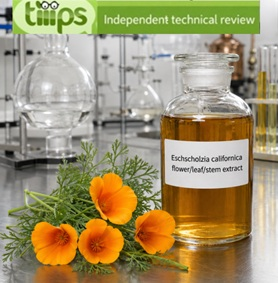
From a cosmetic standpoint, the flower/leaf/stem extract is a complex botanical mixture, not a single molecule. Its formulation interest is linked to water-soluble or hydroalcohol-soluble plant fractions, including phenolic compounds, flavonoids, and alkaloids characteristic of the species. However, in a cosmetic product it should be described cautiously: the documented function is skin conditioning, not a pharmacological, sedative, therapeutic calming, or curative effect.
It is important to distinguish this ingredient from herbal or medicinal preparations based on California poppy. The aerial parts of Eschscholzia californica have a traditional herbal use in oral preparations, but this refers to medicinal herbal products, not to the topical cosmetic use of the extract.
Production process
The production process starts from the aerial parts of the plant: flowers, leaves, and stems. The plant material is collected, cleaned, possibly dried, fragmented or ground, and then extracted with cosmetic-compatible solvents such as water, glycerin, glycols, ethanol, or hydro-glycolic/hydroalcoholic mixtures.
After extraction, the usual steps include filtration, concentration or dilution, stabilization, microbiological control, pH control, possible addition of preservatives, and standardization of the commercial grade. In some commercial materials, the final ingredient may be an aqueous stabilized blend rather than only the pure plant fraction.
The decisive technical point is the supplier specification: the INCI name alone does not clarify the drug/extract ratio, solvent, dry matter content, characteristic compound assay, preservatives present, microbiological load, or any standardization in alkaloids/polyphenols. For this reason, the extract must be assessed on the actual commercial grade purchased.
Main compounds present
Extracts of Eschscholzia californica may contain several classes of plant compounds. The species is particularly known for the presence of benzylisoquinoline alkaloids, including compounds such as californidine, escholtzine, protopine, allocryptopine, sanguinarine, chelerythrine, macarpine, reticuline, and other related alkaloids.
In the cosmetic context, however, the theoretical presence of these compounds should not automatically be turned into functional claims. The real composition depends on plant part, harvest period, solvent, pH, extraction method, extraction ratio, and purification.
Variable amounts may include:
- benzylisoquinoline alkaloids, depending on solvent and standardization;
- flavonoids and other phenolic compounds;
- sugars, mineral salts, and water-soluble compounds;
- plant pigments and minor aromatic fractions;
- cosmetic solvents, water, and preservatives in the commercial grade;
- plant residues or natural impurities if purification is not accurate.
Identification data and specifications
| Characteristic | Value | Note |
|---|---|---|
| INCI name | Eschscholzia Californica Flower/Leaf/Stem Extract | cosmetic designation |
| Common name | California poppy flower/leaf/stem extract | practical designation |
| Botanical name | Eschscholzia californica | California poppy |
| Botanical family | Papaveraceae | botanical family |
| Part used | flowers, leaves, and stems | aerial parts of the plant |
| Chemical/material category | botanical extract | complex natural mixture |
| Molecular formula | not applicable | not a single molecule |
| Molecular weight | not applicable | complex plant extract |
| CAS | 90028-46-9 | reported in cosmetic ingredient databases |
| EC | 289-837-2 | reported in cosmetic ingredient databases |
| Inventory Ref. | 93765 | database reference |
| Cosmetic function | skin conditioning | main cosmetic function |
| Characteristic components | alkaloids, flavonoids, phenolic compounds | depends on commercial grade |
| Food use | not relevant as a common ingredient | distinct from herbal/medicinal preparations |
| Specific cosmetic restrictions | no direct annex record linked in the databases consulted | always verify the official source and supplier dossier |
Indicative physicochemical properties
| Characteristic | Indicative value | Note |
|---|---|---|
| Appearance | liquid, solution, dry extract, or powder | depends on commercial grade |
| Color | light yellow to reddish-brown | varies according to solvent and concentration |
| Odor | mild, vegetal, herbaceous | depends on solvent and raw material |
| Water solubility | variable, often good in aqueous/glycolic grades | depends on solvent |
| Oil solubility | generally low | requires emulsion or indirect solubilization |
| pH | variable, often weakly acidic | to be checked in the technical sheet |
| Dry matter | variable | key parameter of the commercial grade |
| Stability | sensitive to microbiology, light, heat, and oxidation | depends on solvent and preservatives |
| Components to monitor | alkaloids, botanical impurities, residual solvent | according to use and specification |
| Main technical risk | botanical variability and microbiology | complete documentation is required |
Food
Eschscholzia Californica Flower/Leaf/Stem Extract has no common food role. It is not a nutrient, not a usual food flavouring, and should not be confused with oral herbal or medicinal preparations.
Traditional herbal use of the aerial parts of Eschscholzia californica refers to oral herbal medicinal products for adults, especially for mild symptoms of mental stress and sleep support. This does not apply automatically to cosmetics or common foods.
For food assessment, therefore, the judgment is: food focus not relevant. If a California poppy extract were intended for foods, supplements, or oral preparations, it would require food grade, authorizations, use limits, toxicological data, alkaloid control, and specific regulatory documentation. Cosmetic grade should not be considered automatically suitable for ingestion.
Cosmetics
In cosmetics, Eschscholzia Californica Flower/Leaf/Stem Extract is used as a skin conditioning agent. It may appear in creams, lotions, serums, masks, facial products, body products, botanical formulas, natural cosmetics, and preparations where a floral/herbaceous plant extract is to be highlighted.
The skin conditioning function should be interpreted technically: the ingredient may contribute to the sensory profile or to maintaining the skin in good condition, but it does not equal a medicinal effect. In particular, claims such as sedative, anxiolytic, hypnotic, or medicinal should not be transferred to a cosmetic product, even if the plant has a history of herbal use.
In aqueous or hydro-glycolic formulas, the extract may influence color, odor, pH, microbiological stability, and preservative compatibility. If present at very low concentrations, its role is often more botanical and communicative than strongly functional.
Pros
- It is a recognizable and interesting botanical ingredient.
- It derives from flowers, leaves, and stems of Eschscholzia californica.
- It has a skin conditioning cosmetic function.
- It can enhance natural, botanical, or plant-extract-inspired formulas.
- The species is phytochemically known for characteristic alkaloids.
- It is not an essential oil and does not have the same typical issues as volatile fragrance allergens.
- It may be available in aqueous, glycolic, hydro-glycolic, or fermented forms, depending on the supplier.
Cons
- It is not a common food ingredient and has no nutritional value.
- It is not a strong dermatological active: the documented cosmetic function is mainly skin conditioning.
- Composition may vary greatly according to plant part, solvent, harvest, extraction, and batch.
- The presence of alkaloids requires documentation and quality control.
- Aqueous/glycolic extracts may present microbiological preservation issues.
- Sedative, anxiolytic, or medicinal claims should not be attributed to the cosmetic product.
- Not all commercial grades are equivalent: dry matter, solvent, preservatives, and assay may differ substantially.
Safety, regulatory aspects, and environment
From a cosmetic standpoint, Eschscholzia Californica Flower/Leaf/Stem Extract can be considered a botanical ingredient requiring ordinary but careful assessment. No direct specific cosmetic restriction appears linked to the ingredient in the databases consulted, but this does not replace verification on the updated official source before formulation or labeling.
Safety must be assessed on the finished product. For a botanical extract, the critical points are not only toxicological but also qualitative: botanical identification, plant part, solvent, extraction ratio, alkaloid content, residual solvent, pesticides, heavy metals, microbiology, preservatives, and stability.
The fact that the aerial parts of Eschscholzia californica are used in traditional herbal medicinal products does not automatically authorize cosmetic or food claims. The medicinal oral use must be kept separate from the topical cosmetic use of the extract.
For correct cosmetic use, it is advisable to request from the supplier:
- updated SDS;
- certificate of analysis;
- botanical identity;
- plant part used;
- extraction solvent;
- drug/extract ratio;
- dry matter content;
- pH;
- preservatives present;
- microbiological load;
- pesticides and heavy metals;
- possible alkaloid profile or limit;
- geographical origin and cultivation/harvesting method;
- cosmetic compliance declaration;
- stability testing and challenge testing of the finished product, if the formula is aqueous.
From an environmental standpoint, California poppy is a herbaceous and ornamental plant distributed in several areas, but real sustainability depends on cultivation, harvesting, solvent use, extraction yield, transport, stabilization, and packaging. For a commercial extract, a cultivated and traceable supply chain is preferable to indiscriminate harvesting from wild populations.
Conclusion
Eschscholzia Californica Flower/Leaf/Stem Extract is a botanical cosmetic extract of interest mainly as a skin conditioning agent. Its main value is formulation-related and botanical: it can enrich creams, serums, masks, and skin care products with a recognizable and phytochemically interesting plant extract.
Professional assessment must remain cautious. California poppy is a species rich in alkaloids and has a history of herbal use, but these aspects should not be automatically turned into cosmetic claims. In the finished product, the ingredient should be assessed for botanical identity, purity, solvent, concentration, microbiology, stability, compatibility, and safety of use.
In a well-designed formula, with complete supplier documentation, it can be a favorable ingredient. The points to control are SDS, COA, botanical identity, solvent, extraction ratio, dry matter content, possible alkaloid profile, microbiology, contaminants, stability, and consistency between declared function and actual concentration in the finished cosmetic product.

